
AI Stocks Are Crashing. The AI Buildout Is Not.
AI and semiconductor stocks are correcting as leverage unwinds, but demand for compute, memory and power remains strong. This article explores what the selloff means for Palantir, Apple, Micron and NVIDIA.

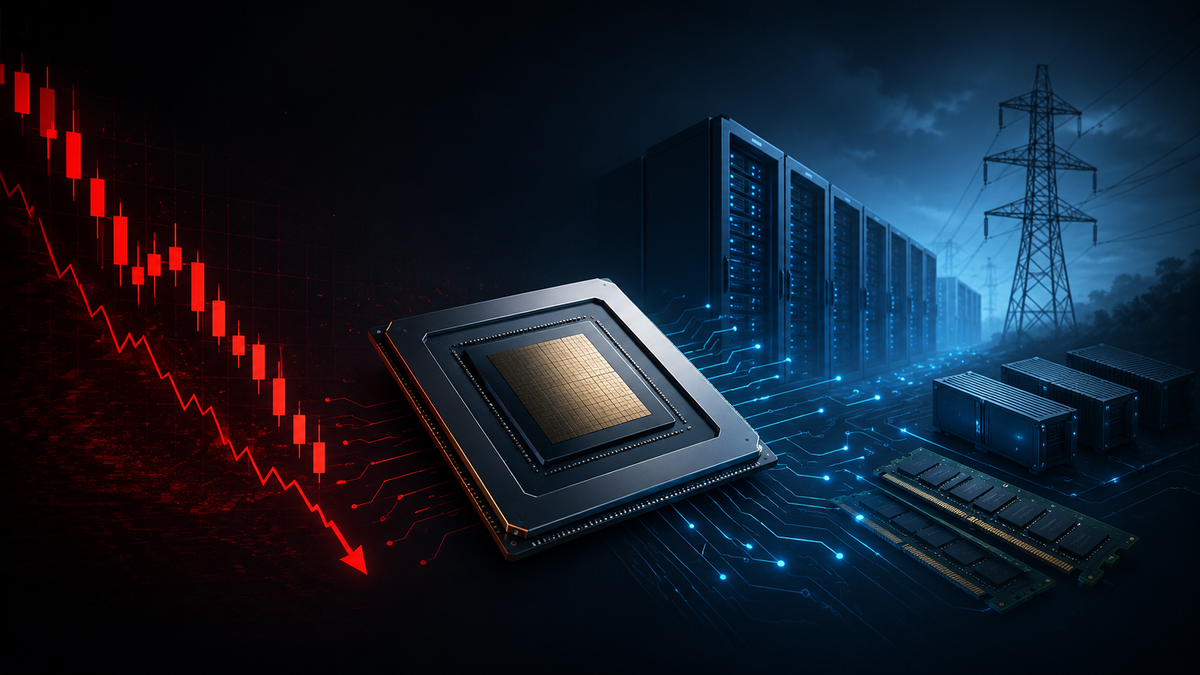
How Leverage Is Fueling the Semiconductor Selloff—While Compute, Memory and Power Grow More Scarce
The latest selloff in AI and semiconductor stocks has revived a familiar question:
Was the AI boom a bubble after all?
The price action certainly looks alarming. Semiconductor shares have fallen sharply, highly leveraged positions are being liquidated, and some of the market’s strongest recent winners have suddenly become its largest sources of volatility.
But two very different forces are operating at the same time.
The first is a short-term financial correction driven by leverage, positioning and forced selling.
The second is a long-term industrial expansion constrained by insufficient compute, memory, power and physical infrastructure.
Confusing these two forces can lead investors to the wrong conclusion. A falling stock price does not automatically mean the underlying industrial cycle has ended. It may instead mean that too much borrowed money accumulated around a fundamentally attractive theme.
The central question is therefore not whether AI stocks can fall further. They clearly can.
The more important question is:
Has the economic demand for AI infrastructure weakened—or is the market simply removing excess leverage from a structurally growing industry?
The Immediate Problem: Too Much Leverage
Fundstrat co-founder Tom Lee has argued that the recent damage in semiconductor markets resembles a rolling correction rather than the end of the AI investment cycle.
His concern is not primarily weak chip demand. It is the amount of borrowed money that entered the trade.
U.S. margin debt rose approximately 54% year over year to a record level, according to recent market data. Historically, unusually rapid growth in margin borrowing has often been followed by periods of consolidation because leveraged investors become increasingly vulnerable to even relatively small declines.
That vulnerability became visible in South Korea.
More than 1.2 million leveraged retail trading accounts reportedly triggered margin calls during the Korean market reversal, with an estimated 320,000 to 360,000 accounts fully liquidated. That represents roughly 3.4% of the country’s adult population—a striking indication of how deeply leverage had entered the market.
This matters because forced selling does not distinguish between a good company and a bad one.
When investors cannot meet margin requirements, brokers sell whatever can be sold. A fundamentally strong semiconductor company may therefore fall alongside speculative names, not because its earnings outlook suddenly collapsed, but because leveraged holders need liquidity.
The same mechanism can spread across markets:
- A crowded position begins to decline.
- Leveraged traders receive margin calls.
- Forced liquidation pushes prices lower.
- Lower prices trigger additional liquidations.
- Volatility spreads to related stocks, ETFs and regional markets.
In such an environment, prices can temporarily become disconnected from long-term fundamentals.
That does not make the correction harmless. U.S. investors have also increased their exposure through margin borrowing, options and leveraged ETFs. A concentrated unwind in technology and semiconductor trades could remain painful even if the underlying AI thesis is intact.
The correct conclusion is not that every decline should be bought immediately.
It is that investors must separate financial positioning risk from industrial demand risk.
The Structural Reality: AI Is Running Into Physical Scarcity
While financial markets are removing excess leverage, the AI industry is confronting the opposite problem:
There is not enough infrastructure.
The bottleneck is expanding beyond advanced GPUs. It now includes:
- High-bandwidth memory
- Conventional DRAM and NAND
- Data-center capacity
- Grid connections
- Transformers and gas turbines
- Cooling systems
- Land and construction capacity
- Long-term electricity supply
International Energy Agency estimates show that global data-center electricity consumption could roughly double by 2030. Electricity use at AI-focused data centers is rising even faster, despite rapid improvements in the energy efficiency of individual AI tasks.
This is a crucial point.
Efficiency improvements do not necessarily reduce total resource consumption. When a technology becomes cheaper and more efficient, it often becomes practical for many more users and applications.
This is the economic principle commonly known as the Jevons paradox.
Cheaper AI Could Create More Demand, Not Less
The bearish interpretation of falling AI-model prices is straightforward:
- Models are becoming cheaper.
- Each token requires less money and compute.
- Therefore, demand for expensive chips should eventually decline.
But that reasoning assumes usage remains constant.
In reality, lower prices frequently create new demand.
Internet bandwidth became dramatically cheaper, but global data traffic did not fall. Lower costs enabled streaming video, social media, cloud gaming, video conferencing and countless other applications.
AI could follow the same pattern.
As inference becomes cheaper, companies can apply AI to work that was previously uneconomical:
- Every customer-service interaction
- Every internal document
- Every software repository
- Every compliance review
- Every sales conversation
- Every manufacturing workflow
- Every employee’s daily tasks
Research into AI pricing shows that the cost of achieving a given level of model performance has been falling rapidly. At the same time, agentic applications can consume far more tokens than simple chatbot interactions because agents repeatedly read context, call tools, evaluate outputs and revise their work.
The result may be a paradoxical combination:
The cost per unit of intelligence falls, while total spending on intelligence rises.
This changes how enterprises deploy AI.
During the first stage of the AI cycle, the market focused on which company had the most powerful model.
In the second stage, corporate finance teams will ask a different question:
Which combination of models, infrastructure and workflows produces the highest return per dollar?
The likely answer is not one model for every task.
Enterprises may use frontier models for their hardest problems, lower-cost models for routine work, specialized models for specific domains and local models where security or latency matters.
That creates a more complex AI stack—and moves economic value toward the companies controlling orchestration, distribution and scarce infrastructure.
The Financialization of Compute
BlackRock Chairman and CEO Larry Fink has described a future in which compute itself becomes an investable and financeable asset.
The logic is significant.
A data center with contracted customers, long-term power access and predictable compute demand can begin to resemble other infrastructure assets. Long-duration compute agreements could support debt financing and attract capital from insurers, pension funds and infrastructure investors.
Over time, markets may develop more sophisticated tools for pricing and hedging compute capacity, just as energy markets developed spot contracts, futures and long-term supply agreements.
This does not mean a mature public futures market for compute already exists.
It means that the economic characteristics of compute are changing.
Compute is no longer simply an internal technology expense. It is becoming:
- A strategic resource
- A contracted infrastructure service
- A potential source of recurring cash flow
- A financing asset
- A capacity market exposed to supply and demand cycles
BlackRock’s broader argument is that capital markets can connect long-term savings with infrastructure investment. Applied to AI, that means institutional capital could eventually finance more data centers, power generation, chips and compute capacity.
The bullish implication is that AI infrastructure may receive access to a much larger pool of capital.
The risk is that abundant financing could eventually produce overbuilding.
For now, however, the industry appears more constrained by physical bottlenecks than by a lack of demand.
Where Could AI Profits Migrate?
If models become cheaper and enterprises adopt multi-model systems, the largest value may not remain concentrated exclusively in model providers.
It could migrate across several layers:
- The orchestration layer
- The device and distribution layer
- The memory layer
- The accelerated-computing layer
- The power and data-center layer
Four public companies illustrate different parts of this shift: Palantir, Apple, Micron and NVIDIA.
They should not be treated as interchangeable investments. Each has a different business model, valuation profile and risk structure.
Together, however, they show how the AI economy is expanding beyond the model itself.
Palantir: The Enterprise Orchestration Layer
As enterprises connect multiple models and AI agents, the challenge becomes less about accessing a chatbot and more about controlling the entire system.
Companies need to determine:
- Which model can access which information
- Which employee can approve an AI-generated action
- How data is mapped to real business operations
- How outputs are evaluated
- How costs are measured
- How sensitive information is protected
- How AI decisions are audited
This is where Palantir’s positioning becomes relevant.
Palantir’s Artificial Intelligence Platform provides secure connectivity to third-party models, tools for building agents and automations, and governance frameworks for running AI workflows in production. Its Foundry platform connects these applications to the company’s Ontology, which maps data to operational entities, relationships and decisions.
The investment thesis is not that Palantir will build the world’s strongest foundational model.
It is that enterprises may need a durable operating layer above rapidly changing models.
A company can replace one model with another. Replacing the system that encodes its permissions, operational relationships, workflows and governance may be much harder.
That creates potential switching costs—but it also creates risk.
Palantir must justify its valuation through sustained commercial growth, successful deployments and measurable customer returns. A strategically important position does not make the stock immune to price compression.
Apple: Distribution, Privacy and Local AI
Apple’s AI advantage is different.
It controls the device, processor, operating system, software distribution and customer relationship across an installed base of more than 2.5 billion active devices.
That gives Apple a powerful position even if it does not own the leading frontier model.
As enterprises and consumers adopt multiple models, Apple can potentially act as a distribution and integration layer. It can decide which workloads run locally, which are sent to private cloud infrastructure and which require external models.
Local AI is particularly relevant in industries where data cannot easily be uploaded to a third-party service:
- Legal services
- Financial institutions
- Healthcare
- Software development
- Government
- Research and engineering
Reports that a future M7 Ultra could support as much as 1.5TB of unified memory have strengthened the idea of high-end Macs evolving into desktop AI systems. But this specification remains a reported future target—not a confirmed shipping product—and the chip is not expected in the near term.
The larger point does not depend on one rumored specification.
AI workloads are increasing the strategic value of memory capacity, energy efficiency and tightly integrated hardware and software. Apple already controls all three at the device level.
Its challenge is execution. Owning the distribution layer is valuable only if Apple can deliver AI products that users genuinely adopt.
Micron: Memory Is Becoming a Core AI Constraint
GPUs perform the calculations, but memory determines how much information the system can hold and move.
Larger models, longer context windows and more simultaneous AI agents all increase memory requirements.
High-bandwidth memory is especially important because advanced accelerators need extremely fast access to data. But the demand is spreading beyond HBM into server DRAM, storage and other parts of the memory hierarchy.
Micron has said AI-driven demand is pushing data-center memory and storage toward an unprecedented share of the overall industry. In its latest outlook, the company said DRAM and NAND demand was materially exceeding supply and that tight conditions could persist beyond calendar 2027.
This supports the argument that memory is not a secondary component of the AI boom.
It is one of its central constraints.
However, memory remains a cyclical industry. High prices encourage additional investment, while new capacity can eventually shift the market from shortage to oversupply.
The long-term AI thesis may be correct while Micron’s stock still experiences violent cyclical corrections.
Investors therefore need to monitor both structural demand and the industry’s capital-expenditure response.
NVIDIA: The Compute Platform
NVIDIA remains the clearest exposure to accelerated computing.
Its advantage is not limited to selling GPUs. It combines processors, networking, systems, software libraries and the CUDA developer ecosystem.
That full-stack position makes NVIDIA difficult to replace, especially for organizations that have already designed applications and infrastructure around its software.
The company’s recent financial results continue to show extraordinary data-center demand.
Those figures do not guarantee that the stock will rise continuously.
NVIDIA faces several risks:
- Customers developing custom accelerators
- Greater competition
- Export restrictions
- Supply-chain constraints
- Margin normalization
- A future pause in hyperscaler spending
- High expectations already embedded in the valuation
But falling inference costs do not automatically undermine NVIDIA.
Lower costs can make more AI applications economically viable. If total AI usage grows faster than efficiency improves, aggregate compute demand can continue rising.
That is the central Jevons-paradox argument applied to accelerated computing.
Two Clocks Are Running at the Same Time
The AI market is being driven by two different clocks.
The Market Clock
This clock moves quickly.
It is shaped by:
- Leverage
- Options positioning
- Momentum
- ETF flows
- Margin calls
- Earnings expectations
- Valuation
It can produce 20% declines before the long-term business outlook changes meaningfully.
The Infrastructure Clock
This clock moves slowly.
It is shaped by:
- Semiconductor fabrication capacity
- Memory production
- Data-center construction
- Power generation
- Grid upgrades
- Customer contracts
- Enterprise adoption
These systems require years of planning and billions of dollars in capital.
When the market clock suddenly turns bearish, it does not automatically reset the infrastructure clock.
That is why both of the following statements can be true:
AI and semiconductor stocks may remain highly vulnerable to further corrections.
And:
The world may still be underinvesting in the infrastructure required for widespread AI adoption.
What Investors Should Watch Next
Investors should avoid treating “AI” as a single trade.
The next stage will likely reward companies that can demonstrate control over scarce resources or measurable customer value.
The most important indicators include:
Leverage and Positioning
Are margin balances, leveraged ETFs and speculative options positions still expanding—or has the forced-selling cycle run its course?
Memory Supply
Are HBM and server-memory shortages persisting, and how quickly are manufacturers adding capacity?
Hyperscaler Capital Expenditure
Are cloud companies continuing to increase AI infrastructure spending, or are they beginning to delay projects?
Enterprise Return on Investment
Are AI deployments moving from experiments into production workflows that generate measurable savings or revenue?
Power Access
Can data-center developers obtain grid connections and long-term electricity contracts quickly enough?
Inference Demand
Is lower pricing leading to reduced spending—or to a much larger volume of AI usage?
These indicators matter more than any single day’s stock movement.
The Bottom Line
The current semiconductor correction should not be dismissed.
Leverage can amplify declines, force fundamentally strong assets lower and create contagion across regions and asset classes. The Korean experience demonstrates how quickly a popular investment theme can become a liquidation event.
But forced selling is not the same as technological obsolescence.
The long-term AI buildout continues to require more compute, more memory, more power and more sophisticated enterprise software. Cheaper models may accelerate that demand by making AI practical for a much wider range of tasks.
The next phase of the AI cycle may therefore be less about identifying one winning model and more about identifying the companies that control:
- Enterprise orchestration
- User distribution
- Memory capacity
- Accelerated computing
- Energy and infrastructure
Palantir, Apple, Micron and NVIDIA represent four different positions within that system.
None is risk-free. None should be bought simply because its stock has fallen. And even a correct long-term thesis can produce poor returns when the entry valuation is too high.
But the broader conclusion remains:
Markets are currently repricing the leverage around AI. They are not yet eliminating the need for AI infrastructure.
The correction and the buildout are not opposing stories.
They are two stages of the same cycle.
This article is provided for market information and educational purposes only. It does not constitute financial, investment or trading advice.