
Apple’s New Era: John Ternus Takes the Helm Amidst AI Challenges and the Foldable Dilemma
On September 1, 2026, John Ternus officially succeeds Tim Cook as Apple's CEO. Ahead of the crucial September 9 event and the rumored $2,000 foldable iPhone, we analyze the four major structural challenges Apple faces: AI lag, cost pressures, talent drain, and valuation risks.

On September 1, 2026, the technology world witnessed a historic passing of the torch. After 15 transformative years, Tim Cook officially stepped down as CEO of Apple, transitioning to the role of Executive Chairman. Stepping into the spotlight is John Ternus, Apple’s second CEO of the last decade and a half, whose 20-plus year tenure at the company is defined by deep hardware engineering roots.
While Cook’s genius lay in supply-chain alchemy—transforming Apple from a single-product company into a hardware-and-services empire and pushing$AAPL’s market cap across multiple trillion-dollar thresholds—Ternus brings a different DNA. As a pure engineer who led the transition to Apple Silicon (M-series chips), the market is now looking to Ternus to solve Apple's most pressing modern challenge: the seamless integration of breakthrough hardware with Artificial Intelligence.
With his debut scheduled for the September 9 Autumn Event, all eyes are on Apple. But beneath the glittering product reveals lies a series of historical and structural challenges that the new leadership must immediately address.
The September 9 Showdown: Breaking the "Event Curse"
Wall Street has long observed the "Apple Event Curse"—a classic "buy the rumor, sell the news" phenomenon. Historically,$AAPLstock often dips post-event unless a product demonstrates truly unimaginable, revolutionary innovation.
For his first major test, Ternus is expected to unveil the iPhone 18 series, updated wearables, and, most notably, Apple’s first-ever foldable smartphone. Supply chain leaks suggest this foldable device will feature a liquid metal hinge to eliminate screen creases, with a form factor resembling a smaller iPad when unfolded. However, this premium engineering comes at a steep cost: the starting price is widely estimated to approach $2,000.
Will this hardware flex be enough to trigger a sustained rally for$AAPL? The market remains cautious. A foldable screen is a powerful narrative, but it takes quarters of proven sales and margin contributions to fundamentally alter Apple's valuation matrix.
Four Hidden Crises Facing the New CEO
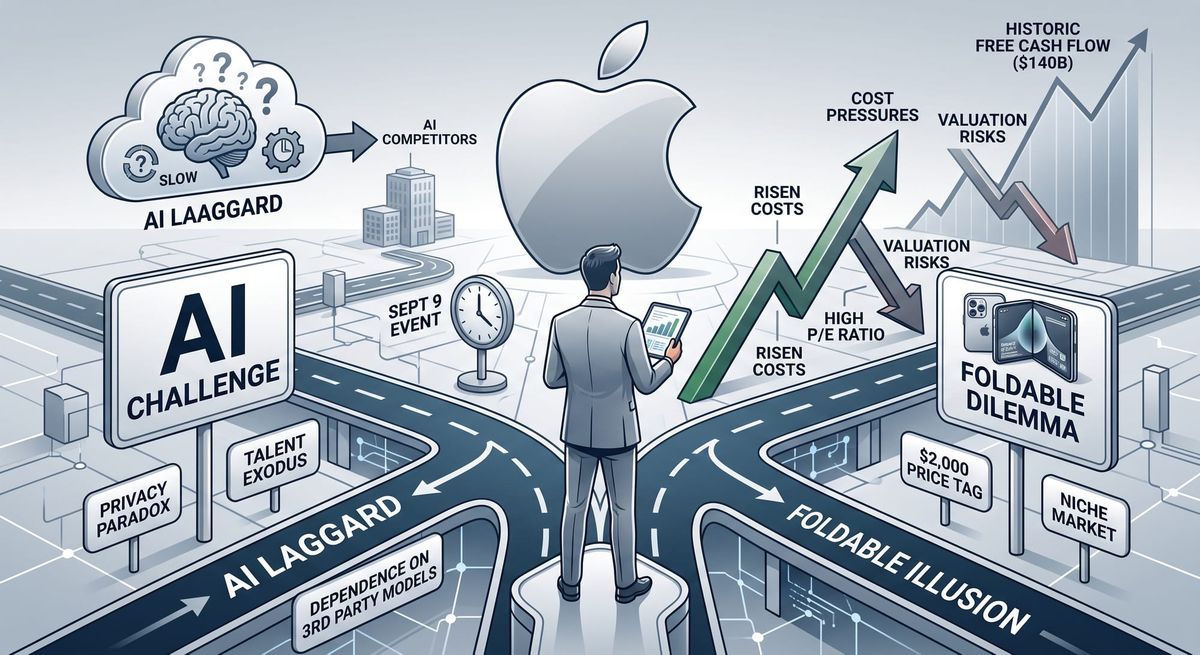
While Apple's fundamentals remain robust, Ternus inherits a commercial empire hiding four distinct structural risks:
1. The Cost-Pricing Dilemma Surging costs in memory chips and upstream raw materials are squeezing margins. Apple has already raised prices on non-phone product lines like the Mac and iPad. Now, the pressure transfers to the iPhone. The company faces a difficult choice: raise iPhone prices and risk extending the consumer replacement cycle, or absorb the costs and directly erode net profit margins.
2. The AI Catch-Up Game This is arguably Apple’s biggest vulnerability. As the AI wave swept the globe, Apple’s rhythm lagged. Its commitment to a privacy-first, "on-device AI" approach inherently limits computational power. Consequently, Apple has been forced to rely on third-party cloud models to bridge the gap. This creates a critical strategic paradox: if users form the habit of accessing AI through third-party models on their iPhones, the closed-ecosystem moat iOS has built over a decade could be severely compromised.
3. Severe Talent Drain The AI gold rush has turned Apple into a poaching ground. Companies like OpenAI have aggressively recruited Apple's top hardware and software engineers. This talent exodus not only disrupts current product development but also threatens the company's long-term innovation foundation. Furthermore, with several veteran executives approaching retirement age, management stability is facing turbulence.
4. The Foldable Illusion Can the foldable phone replicate the original iPhone's miracle? Objective reality suggests otherwise. The Android camp has developed foldable phones for years, yet they remain a niche, high-end toy rather than a mainstream phenomenon. Even with Apple's entry, the foldable iPhone is highly likely to remain a premium, low-volume product meant to elevate average selling prices (ASP), rather than a revolutionary blockbuster capable of single-handedly driving Apple's next massive growth phase.
Valuation vs. Reality: The Financial Bottom Line
Despite these hurdles, Apple's financial fortress is largely intact. Even amidst sluggish overall smartphone market growth, iPhone sales have shown remarkable resilience, and the services business continues to pump out stable cash flow. Market institutions project that Apple’s Free Cash Flow (FCF) will reach a historic high of $140 billion in 2026. While other tech giants are burning cash on AI infrastructure, Apple boasts unparalleled capital reserves.
However, there is a flip side to the coin: Valuation. Apple's current forward P/E ratio sits at historical highs. The market has already priced in a significant amount of optimism regarding its foldable innovations and AI integration into$AAPL.
Apple is currently in an awkward position. It remains one of the greatest cash-generating machines in history, yet it is priced like a hyper-growth innovation startup. If John Ternus and his team fail to deliver technological breakthroughs that exceed these lofty expectations,$AAPLwill face severe valuation contraction.
The baton has been passed. John Ternus now holds the "Foldable" and "Apple Intelligence" cards in his hand. The true test isn't the September 9 keynote—it's the quarters that follow, where order volumes, AI adoption rates, and margin resilience will write the real story of Apple's next decade.
Disclaimer
This article is published for informational and research purposes only and does not constitute financial, investment, legal, or trading advice. Digital asset and perpetual contract trading involve substantial risk of loss and are not suitable for every investor. The price of underlying assets and synthetic contracts can be highly volatile. Readers and users should conduct their own independent research (DYOR) and evaluate their financial situation, risk tolerance, and investment objectives before entering into any derivatives or spot trading positions on BBX.