
Breaking the Linear Growth Bottleneck: Deconstructing the "Fractional Kelly" Engine for Asymmetric Compounding
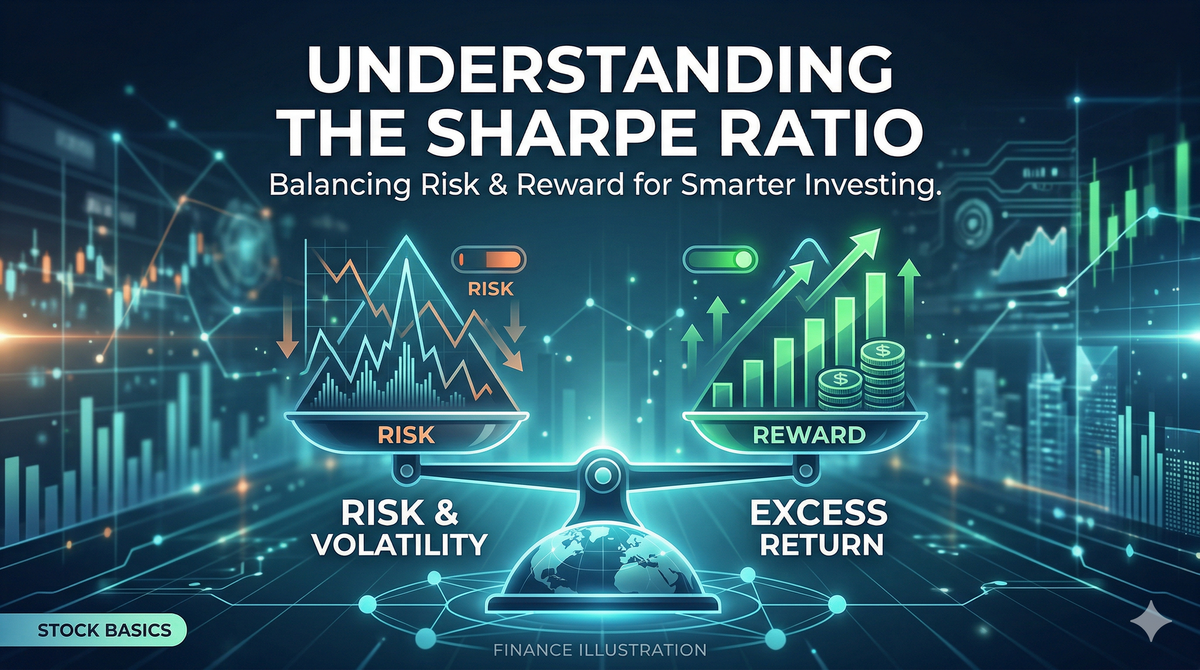
The Sharpe ratio measures how much excess return an investment portfolio generates for every unit of total risk it takes. This article provides an in-depth analysis of the core formula and practical applications of the Sharpe ratio, helping you scientifically evaluate your actual investment returns.

TL;DR (Core Summary): A fixed 2% risk limit is a trader's "survival baseline," but to achieve true wealth generation, you need a quantitative engine capable of dynamic throttle control.The Essence of the Kelly Mindset: Abandon rigid, fixed position sizing. Dynamically seek the optimal bet size that maximizes your Geometric Growth Rate based on your trading system's verified Win Rate and Risk/Reward Ratio.The Abyss of Full Kelly: The theoretical optimal solution is often a real-world death warrant. Pursuing maximum capital efficiency inevitably invites devastating Volatility Drag and psychologically unbearable Maximum Drawdowns.Wall Street’s Asymmetric Holy Grail—Fractional Kelly: Elite institutions never deploy Full Kelly. Instead, they utilize compromise strategies like Half-Kelly. By sacrificing a small fraction of the absolute peak return, they slash drawdown risk by half—this is the true art of advanced risk management in high finance.
Introduction: Breaking the "Fixed 2%" Shackle to Find the Quant Fund Growth Engine
In the Risk Management series, we established an ironclad rule: never risk more than 2% of your total equity on a single trade. This impregnable shield is sufficient to ensure your long-term survival in the brutal meat grinder of the financial markets.
However, survival does not equal victory. After hundreds of backtests, when you finally forge a trading system with a remarkably high Positive Expected Value (+EV), you will confront a painful reality: If you permanently adhere to a fixed 1% or 2% risk parameter, your account growth will mirror a painfully slow, linear crawl.
When Proprietary Trading Desks (Prop Desks) on Wall Street lock onto high-conviction prey, they are never bound by rigid rules. They deploy a rigorous, dynamic position-sizing logic to achieve exponential capital leaps under strictly controlled risk. Today, we will bypass the complex calculus and take you directly to the crown jewel of quantitative money management: the Kelly Mindset.
I. From Linear Defense to Exponential Breakout: The Core Logic of Kelly Thinking
The "Kelly Criterion" originally emerged from information theory research at Bell Labs before making its stellar debut in quantitative investing. While we will spare you the calculus formulas today, you must deeply grasp its philosophical essence.
In the financial arena, if you bet too light (e.g., risking only 0.1% per trade), your capital becomes a stagnant pool, mercilessly eroded by inflation. Conversely, if you bet too heavy (e.g., 20% per trade), an inevitable statistical streak of losing trades—a Black Swan—will instantly liquidate your account.
The core of the Kelly Mindset is to help you locate that "singular optimal point" between these two extremes. This sweet spot is not guessed via intuition; it is dictated by the two core metrics of your trading system:
- The Historical Win Rate (the probability of your directional bias being correct).
- The Average Risk/Reward Ratio (how much you make when you are right versus how much you lose when you are wrong).
When your system boasts a high win rate and massive payoffs, the Kelly logic flashes a green light, authorizing you to aggressively scale up your single-trade Risk Exposure. Conversely, when market conditions deteriorate and your edge diminishes, it forces you to deleverage. This data-driven "dynamic scaling" is the only path to maximizing compounding capital.
II. The Abyss of Symmetry: Beware the "Full Kelly" Volatility Trap
If the Kelly logic deduces that your optimal risk exposure per trade is 10%, should you immediately execute at maximum capacity?Absolutely not.
In the real world of quantitative trading, there is a lethal, invisible assassin: Volatility Drag. Even if your system possesses a massive positive expected value, as long as your win rate is not 100%, you will inevitably encounter the "random walk" of consecutive losses. If you strictly wager the absolute mathematical ceiling (i.e., Full Kelly), your equity curve will violently whip around like a rollercoaster.
A string of just 5 losses would plunge your account into a 50% Deep Drawdown. From a purely mathematical standpoint, the theoretical model might survive this drawdown and eventually reach new all-time highs. But from a behavioral economics perspective, when witnessing cold, hard cash slashed in half, 99.9% of traders will suffer severe Emotional Hijacking. Fear will compel them to halt trading at the absolute bottom or recklessly alter their rules, thereby converting temporary paper drawdowns into permanent, realized ruin.
On Wall Street, "Full Kelly" is widely considered synonymous with "rationally marching toward bankruptcy."
III. Wall Street’s Asymmetric Holy Grail: The Risk Compromise of "Fractional Kelly"
If "Fixed 2%" is too sluggish, and "Full Kelly" is sheer lunacy, how exactly do top-tier hedge funds manage their books? The answer lies in implementing a highly pragmatic risk patch: Fractional Kelly, with the most prominent variation being the "Half-Kelly" strategy.
Its execution is remarkably restrained: you take the theoretical optimal position size calculated by the system and physically cut it in half. If the theory dictates a 10% wager, you only risk 5%.
Why is this "concession" revered as the Holy Grail of the quantitative world? Because hidden within this de-leveraging maneuver lies the most mesmerizing Asymmetric Payoff phenomenon in finance: When you employ Half-Kelly, due to the reduced leverage, your account's volatility and Maximum Drawdown potential plummet drastically by more than 50%. Yet, the Compound Annual Growth Rate (CAGR) you achieve does not halve proportionately; astoundingly, it retains roughly 75% of the theoretical Full Kelly peak!
Trading 50% of the psychological pressure and ruin risk in exchange for 75% of the hyper-compounding growth. This is the perfect equilibrium that institutional risk masters have discovered between aggressive offense and impregnable defense.
Conclusion: Revere the Data to Harness the Leverage
Position sizing is a double-edged sword. Fractional Kelly can serve as the turbocharged engine that launches your account to new stratospheres, but it carries a strict prerequisite: You must possess an excruciatingly precise, quantitative understanding of your own trading system.
If your win rate and risk/reward metrics are not derived from hundreds of rigorous Backtesting and Forward Testing trials, but rather from subjective, "optimistic guesswork," then any dynamic sizing model will merely accelerate your demise.
For traders still in the nascent stages of system building, stay obediently within the 1% to 2% safe zone. Only when your trading journal has accumulated a sufficiently robust dataset that proves your system has a stable Positive Expected Value (+EV) have you earned the right to unseal the engine, deploy "Fractional Kelly," and embrace your asymmetric breakout.
Disclaimer: This report is for informational purposes only and does not constitute financial advice.