Building an Institutional "Pre-Trade Routine" and Closed-Loop Feedback System
Why is your account equity stagnating or bleeding out? Because human memory is riddled with cognitive bias. Learn to eradicate subjective guesswork by building an institutional Pre-Trade Routine and a quantitative Trading Journal to plug the leaks in your profitability funnel.

TL;DR (Core Summary): In the financial arena, trading based on "gut feeling" and memory is equivalent to flying a plane blind without an instrument panel. Consistent profitability is fundamentally about running a data-driven risk management business.The Deception of Memory: The human brain suffers from severe Survivorship Bias. It tends to immortalize accidental windfalls while rationalizing catastrophic losses caused by rule-breaking. Only cold, hard data can pierce this psychological defense mechanism.The Pre-Trade Routine: Transforming "prediction" into a Scenario Matrix. You must draft "If-Then" execution protocols pre-market when your emotional baseline is perfectly stable. The live session is strictly for Mechanical Execution; impromptu decision-making is strictly prohibited.The Quantitative Black Box: A Trading Journal is not a simple PnL ledger. It is a core database designed to track your Execution Fidelity, calculate strategy R-Multiples, and monitor your Psychological Variance.
Introduction: The Dividing Line Between "Market Gamblers" and "Professional Risk Managers"
If, during your weekend review, you cannot precisely articulate the "entry logic, initial risk exposure (1R), anticipated risk/reward ratio, and emotional state at the time of exit" for a losing trade from last Wednesday, then by institutional definitions, you are not trading—you are pulling the lever on a market slot machine.
"It feels like it can't drop any further," or "I think it's about to break out"—"Feeling" is the most expensive and lethal word in the trading universe.
Elite proprietary trading desks never rely on a trader's sudden stroke of genius. They rely on a rigorous, mundane, and highly standardized Closed-Loop Feedback System. From pre-market scenario mapping to ruthless intraday execution, and finally to post-market data extraction and vulnerability patching, every single step must leave a digital footprint.
Today, we will install this institutional operating procedure into your workflow, helping you transform every single loss into the quantitative fuel needed to optimize your Positive Expected Value (+EV) system.
I. The Pre-Trade Routine: Constructing an Emotionless "Scenario Matrix"
As we discussed in the previous [Trading Psychology] chapter, the moment you start staring at a live chart, your cognitive abilities plummet due to dopamine and adrenaline surges (i.e., Emotional Hijacking). Therefore, one of the supreme laws of professional trading is: Never make strategic decisions in front of a fluctuating live chart.
All chart analysis, key level demarcation, and strategy deployment must be completed when the market is closed or before the opening bell. This is known as your Pre-Trade Routine.
Drafting the "If-Then" Scenario Matrix
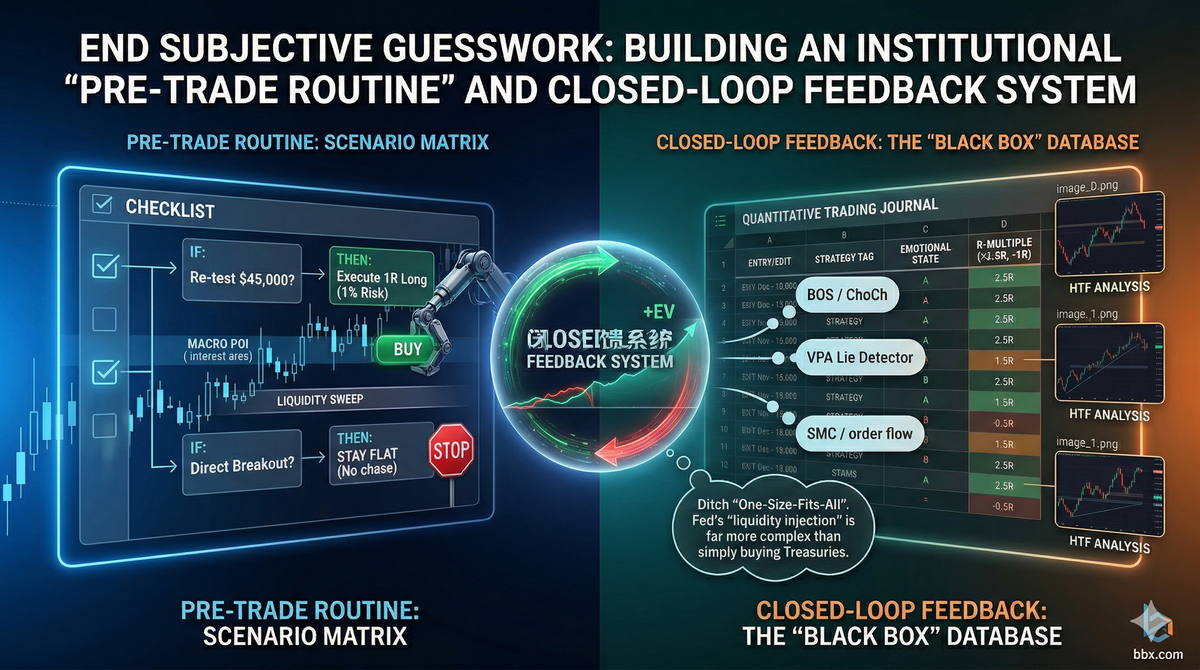
Do not attempt to predict the market (Prediction); instead, map out your response protocols (Reaction). You need to construct detailed logical branches for your target asset:
- Scenario A (Trend Pullback): If the price retraces to the macro Demand Zone at $45,000 and the 15-minute chart prints a high-volume Liquidity Sweep signal; Then I will execute a long position risking 1% of total equity, placing a Hard Stop strictly below the micro-structure.
- Scenario B (Momentum Exhaustion): If the price shoots directly into the $48,000 Supply Zone and prints a definitive Change of Character (ChoCh); Then I will activate my short-selling protocol, targeting a 3R minimum payoff.
- Scenario C (Chaotic Chop): If the price oscillates aimlessly in the "No Man's Land" between these two core zones; Then, regardless of how indicators flash, I will remain strictly flat (no position) and refuse to provide liquidity to the market.
The Ironclad Rule of Execution: The bell rings, the market opens. If the price action steps into your Scenario Matrix, you pull the trigger like lines of executing code. If the action deviates from your script, your hands must leave the keyboard. Plan your trade, trade your plan.
II. The Trading Journal: Building Your Quantitative "Black Box"
When the trading day concludes, the real quantitative research begins. A fully compliant institutional trading journal is far more than an exported broker statement; it must be a multidimensional database capable of deeply X-raying your trading behavior.
Your spreadsheet or Notion template must mandatorily include the following core dimensions:
- Structural Parameters: Date, Ticker, Direction (Long/Short), Entry Price, Initial Hard Stop (Invalidation Level), and Exit Price.
- Risk Metrics: The initial risk amount for the trade (1R) and the final realized Risk/Reward ratio (e.g., +2.5R or -1R). This is the core data required to calculate your system's Expected Value.
- Setup Classification: Which specific model in your arsenal did this trade trigger? (e.g., Mean Reversion, Breakout Retest, Order Block Mitigation).
- Chart Snapshots: This is the soul of the journal! You must archive a screenshot of the chart at the exact moment of entry and exit (including your drawn analysis). Months later, these visual archives will ruthlessly expose your analytical biases.
- Emotional State Logging: What was your psychological state during entry and while holding the position? Was it strict Disciplined Execution, or were you hijacked by FOMO? Did panic cause you to manually widen your stop-loss mid-trade?
III. The Feedback Loop: Diagnosing "System Bugs" with Large Sample Data
The purpose of journaling is not self-admiration or self-torture; it is to conduct Large Sample Statistics analysis.
Once you have accumulated 50 to 100 fully documented trades, the data will diagnose your operational health with icy precision:
- Diagnosis 1: Strategy Decay. The data reveals that your "Breakout Momentum" strategy has yielded a win rate of only 25% over the last 30 executions, resulting in a negative net expected value. System Patch: Immediately quarantine this strategy from your live arsenal, or relegate it back to paper trading to stop the real-money bleed.
- Diagnosis 2: Environmental/Time Sensitivity. You might discover that trades opened on Friday afternoons, or within 1 hour of FOMC rate decisions, carry an 80% loss rate. System Patch: Hardcode a new filtering rule into your "Scenario Matrix": mandatory flat positioning during specific high-volatility windows.
- Diagnosis 3: Execution Fidelity Collapse. By cross-referencing your "Emotional State" with "PnL Results," you make a startling discovery: trades executed with strict discipline show steady account growth. Conversely, the massive drawdowns crippling your account are universally tagged with "FOMO," "Revenge Sizing," or "Premature Take Profit." System Patch: This confirms your technical system works, but your Operational Compliance is severely flawed. You must introduce harsher external physical constraints, such as a "Daily Maximum Drawdown Circuit Breaker."
Conclusion: Embrace the Anti-Human "Boredom" of Compounding
Building and maintaining a trading journal is an intensely "anti-human" endeavor. It forces you, after every closing bell, to confront your most impulsive, undisciplined, and foolish decisions—the ones you desperately want to ignore.
Many retail traders would rather pay thousands of dollars for supposed "insider tips" or blind-buy the latest technical indicator than spend 15 minutes a day updating their trading journal. This is precisely why 90% of traders remain permanently trapped in the mud of consistent losses.
Without a closed feedback loop, ten years of trading experience is simply your first year of mistakes repeated mechanically ten times. Only by leveraging cold data logs to transform every loss into systemic immunity can you truly cross the chasm from amateur to professional, forging an impenetrable, positive-expectation money-printing engine.
Disclaimer: This report is for informational purposes only and does not constitute financial advice.