
Crypto Overtakes TradFi: Why Stablecoins are the New Settlement Layer
Stablecoins have officially surpassed the US ACH system in transaction volume, hitting $7.2T. Explore the macro shift as crypto overtakes traditional finance, the impact of US employment data, and why the "quantum threat" is accelerating the move to secure RWA integration.

How to buy US stocks with USDT and why crypto is outpacing traditional banking systems are no longer future theories—they are present-day realities supported by record-breaking on-chain data.
Market Pulse: The Great Displacement
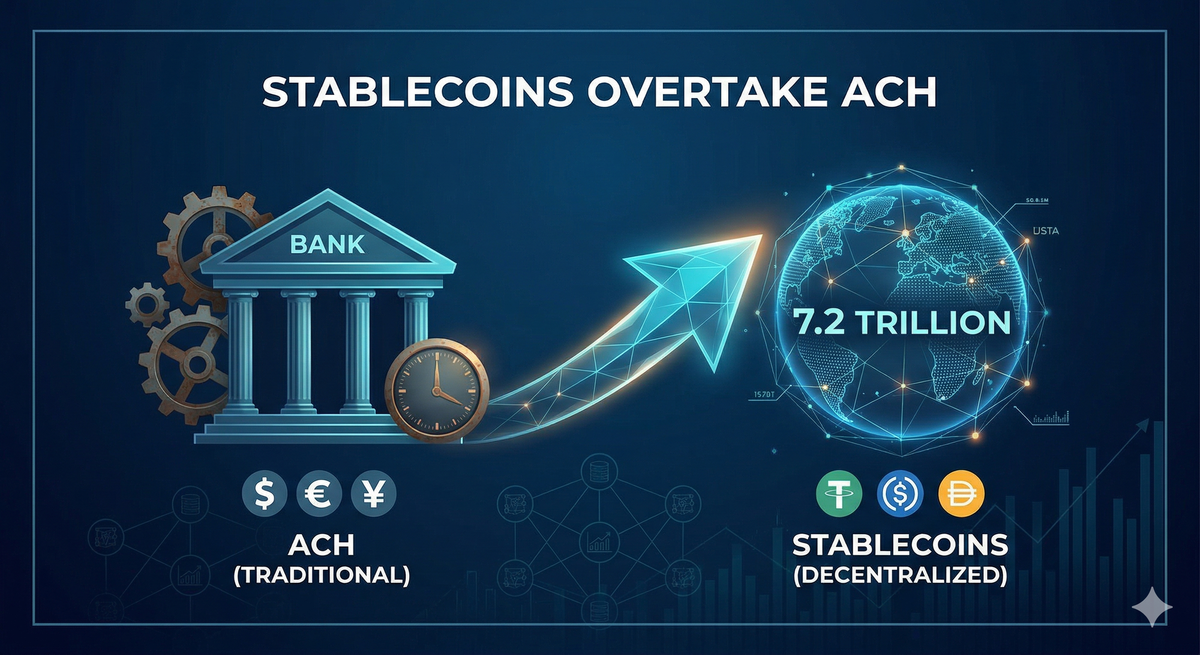
While geopolitical tensions between the US and Iran continue to dictate short-term volatility, a structural shift is occurring beneath the surface. For the first time in history, stablecoin transaction volume reached $7.2 trillion in February 2026, officially surpassing the US ACH (Automated Clearing House) system’s $6.8 trillion.
This represents a fundamental "overtaking" of traditional electronic fund transfer networks. Unlike ACH, stablecoins operate 24/7, ignore borders, and settle nearly instantaneously, making them the preferred choice for global payroll, supply chain settlements, and cross-border trade.
Macro Data: Employment vs. Inflation
The latest US Non-Farm Payroll (NFP) report showed a surprising addition of 178,000 jobs, with unemployment steady at 4.3% (lower than the 4.4% forecast). However, leading economists warn that these lagging indicators fail to reflect the immediate impact of rising energy costs and war-driven consumption drops.
For BBX users, this creates a "wait-and-see" environment for the Fed. If inflation (CPI) exceeds the 3.4% forecast in the coming week, expect continued pressure on risk assets. Conversely, any economic "crack" could trigger the massive liquidity injection (the "money printer") that crypto bulls have been anticipating.
The Quantum Threat: A 2029 Deadline?
Google’s latest research indicates that quantum computers could potentially crack Bitcoin’s ECDSA encryption by 2029—much earlier than previous 2045 estimates. While this sounds alarming, the "Quantum Defense" is evolving alongside the threat. The industry is already pivoting toward post-quantum migration. This highlights the importance of using platforms that prioritize security infrastructure and adaptive custody solutions.
Strategy: Institutional Resilience
Despite the current "Extreme Fear" sentiment (Fear & Greed Index), on-chain activity on Ethereum remains at all-time highs. While some public companies are selling their BTC "strategic reserves" to cover high-leverage positions, the underlying utility—specifically in RWA (Real World Assets) like on-chain US Treasuries and tokenized stocks—is growing at a double-digit monthly rate.
Key Takeaways for the Week:
- Stablecoins are the base layer: They are no longer just for trading; they are for global settlement.
- Watch the CPI: April 10th's inflation data will be the primary driver for the next 30 days.
- Infrastructure over Hype: Focus on chains with high liquidity (Ethereum/Solana) and robust RWA integration.
Disclaimer: The information provided in this article is for informational purposes only and does not constitute financial, investment, or legal advice. Cryptocurrency investments carry high risk; always conduct your own research before trading.