Dimensional Arbitrage and the Macro View: An Institutional Framework for "Multiple Timeframe Analysis (MTFA)" and Technical Confluence
Why does your perfect 15-minute breakout constantly get crushed? Escape retail "tunnel vision." Master the institutional Multiple Timeframe Analysis (MTFA) framework to execute top-down, dimensional arbitrage and locate high-EV "Technical Confluence" sniper entries.

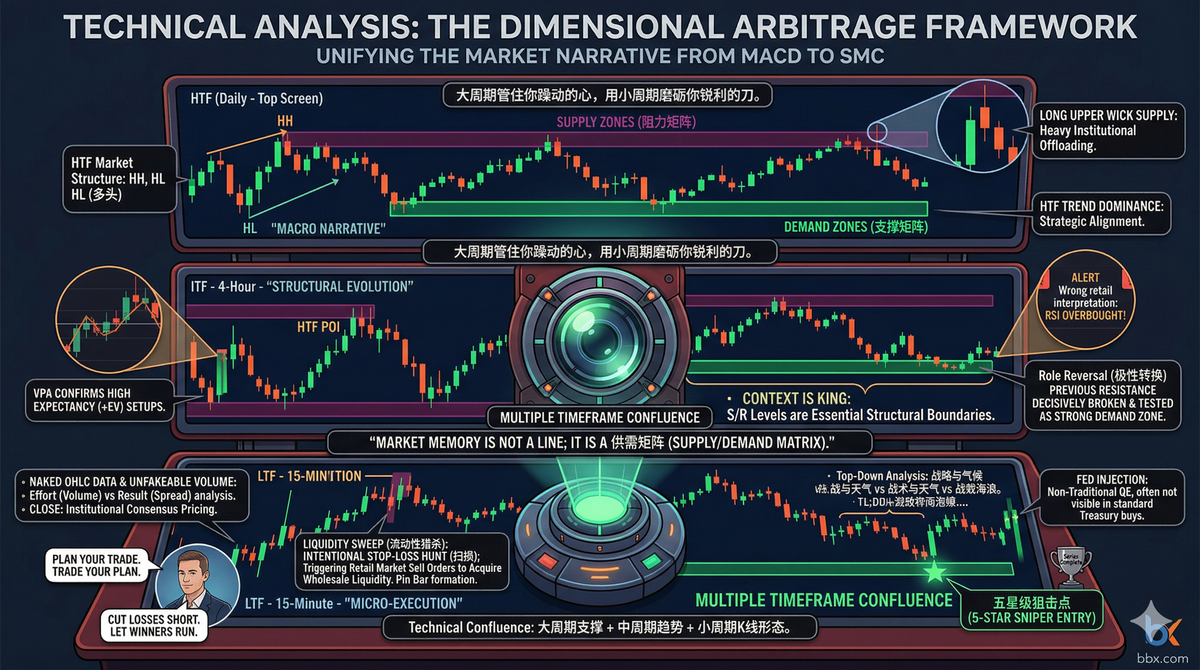
TL;DR (Core Summary): In the asymmetric warfare of financial markets, executing trades based solely on a single timeframe (like staring blindly at a 15-minute chart) is tantamount to sprinting through a minefield blindfolded.The Absolute Power Hierarchy: Markets operate on a strict chronological hierarchy. Higher Timeframes (HTF) carry the macro fundamentals and the true Order Flow of mega-institutions. They perpetually dominate and suppress the micro-fluctuations of Lower Timeframes (LTF).Top-Down Analysis: An elite trading system operates via "dimensional arbitrage." Establish the Macro Narrative and strategic boundaries on the HTF, then drill down into the LTF to pinpoint the exact Micro-Execution Window.Timeframe Alignment: The holy grail of trading lies in Confluence. When key macro support, intermediate bullish structure, and micro reversal signals align at the exact same price extreme, it births an asymmetrical trading opportunity with an exceptionally high Positive Expected Value (+EV).
Introduction: The Retail "Tunnel Vision" and the LTF Noise Trap
Countless day traders have fallen into this despairing loop: You spot the price on a 15-minute (15m) chart printing a massive, full-bodied bullish candle, shattering resistance on massive volume after a prolonged consolidation. Every micro-indicator on your screen is flashing a "Strong Buy" signal.
You go heavy long. The very next second, the price hits what feels like an invisible titanium wall, executing a violent V-shaped reversal. A gigantic bearish candle instantly slices through your hard stop-loss. You are left angry and bewildered: "The setup was flawless, why was I hunted?"
The brutal truth is: No institution is targeting your specific account; your "Tunnel Vision" has blinded you. If you had simply zoomed out one dimension and switched to the Daily Chart, you would have been shocked to discover that your seemingly invincible 15m "breakout point" slammed precisely into an overwhelmingly dense Historical Supply Zone on the daily timeframe.
Against the strategic, heavy artillery of HTF sellers, an LTF bullish charge is as fragile as paper. Today, we will equip you with the "God's eye view" used by professional traders: Multiple Timeframe Analysis (MTFA).
I. The Hierarchy of Time: The Absolute Dominance of Higher Timeframes (HTF)
Financial markets are ecosystems composed of participants operating across different time dimensions. In this ecosystem, capital size dictates timeframe weight.
- Higher Timeframes (HTF - e.g., Weekly/Daily): The Macro Climate. They filter out the vast majority of market noise and reflect the strategic Accumulation/Distribution intentions of sovereign wealth funds and massive asset managers. Once an HTF trend is established, it possesses immense physical inertia.
- Intermediate Timeframes (ITF - e.g., 4H/1H): The Campaign Trajectory. These are the primary battlegrounds for Swing Traders, illustrating the mid-term battle for Liquidity and the evolution of market structure.
- Lower Timeframes (LTF - e.g., 15m/5m): The Tactical Noise. These are plagued by intraday algorithmic wash-outs, retail emotional trading, and Fakeouts.
The Institutional Ironclad Rule: The macro timeframe sets the tone; the micro timeframe finds the entry. Never use an LTF micro-signal to counter-trade the macro Order Flow of the HTF! Aligning your LTF positions with the direction of the HTF is the foundational logic for trading with the trend and maximizing your Win Rate.
II. Institutional Dimensional Arbitrage: The Top-Down Analysis Framework
Professional proprietary trading desks enforce strict charting protocols—a Standard Operating Procedure (SOP) known as Top-Down Analysis. We typically select three timeframes that share a logical multiplier relationship (usually 4x to 6x) to build our matrix.
Step 1: HTF (Daily) — Establishing the Macro Narrative and POI
Open the daily chart, mute all complex oscillator indicators, and execute only two strategic deployments:
- Identify Market Structure: Determine whether the macro trend is a bullish structure (HH/HL) or a bearish structure (LH/LL).
- Demarcate Points of Interest (POI): Plot the most dominant macro Supply & Demand Zones. Tactical Directive: If the daily chart is in a definitive uptrend, you are strictly stripped of your "authorization to short" for the day. You must patiently wait for price pullbacks to execute longs.
Step 2: ITF (4-Hour) — Confirming Structural Evolution and Liquidity
Zoom in to the 4H chart and observe how the price approaches the POI you mapped on the daily chart.
- Momentum Exhaustion Test: As price nears the macro support, is the downward momentum decelerating? Is the volume contracting?
- Structural Alignment: Wait for the 4H price to enter the kill zone. If the price is still floating in mid-air, you must hold your fire, regardless of what the LTF is doing.
Step 3: LTF (15-Minute) — Pulling the Micro-Execution Trigger
If and only if the price steps precisely into the high-value POI confirmed by the HTF/ITF, switch to the 15m chart to hunt for asymmetrical Entry Triggers:
- Capture a bottom Liquidity Sweep (e.g., a Pin Bar with a long lower wick that probes deep and recovers rapidly).
- Or wait for an extremely definitive Change of Character (ChoCh) signal—where the 15m bearish structure is substantively broken, and bulls reclaim control. Tactical Directive: Once the signal is confirmed, execute at market immediately. Place your Hard Stop-Loss tightly below the extreme low of the LTF structure. This allows you to risk a microscopic LTF exposure in exchange for capturing massive macro profits on the HTF scale.
III. The Holy Grail of Trading: Multi-Dimensional Confluence
Why go through the painstaking process of constructing a triple-timeframe matrix? The ultimate goal is to capture the most powerful phenomenon in trading: Confluence.
An isolated technical signal (like a standalone RSI oversold reading or a single engulfing candle) in a noisy market often yields a statistical win rate below 50%. But consider a trade that achieves Timeframe Alignment across multiple dimensions:
- HTF (Daily): In a robust, structural uptrend.
- ITF (4H): Price has perfectly retraced into a long-term Order Block / strong support zone.
- LTF (15m): Prints Ultra-High Volume as Smart Money completes a liquidity hunt and forms a reversal pattern.
When macro institutional capital, mid-term swing funds, and intraday quantitative algorithms reach consensus and exert force in the same direction, at the exact same time and price level, it forms an impregnable Five-Star Sniper Entry. Executing here skews your Risk/Reward Ratio into a terrifyingly asymmetrical advantage.
Conclusion: Zoom Out, Eliminate the Noise
When you feel lost in day trading, constantly getting chopped up by stop-loss sweeps, it usually means you are trapped deep in the micro-mud of the LTF. The only rescue protocol is to hit the Zoom Out button on your platform and forcefully elevate your timeframe by two dimensions.
Step away from the micro hand-to-hand combat and re-examine the global liquidity map from the institutional God's eye view. You will experience a sudden epiphany: those "violent wash-outs" that caused you so much pain were nothing more than tiny, "normal breaths" within the macro trend. Use higher timeframes to govern your strategic discipline, and use lower timeframes to sharpen your tactical blade. Master the dimensional arbitrage of MTFA, and you will truly step through the gates of professional trading.
Disclaimer: This report is for informational purposes only and does not constitute financial advice.