Exposing Liquidity Traps: Decoding Institutional Order Flow and Wyckoff Logic via Volume Price Analysis (VPA)
Price can be easily manipulated, but volume cannot be faked. This guide delves into Volume Price Analysis (VPA), applying Wyckoff's "Law of Effort vs. Result" to precisely identify Smart Money's true accumulation and distribution footprints, helping you survive liquidity traps and fakeouts.

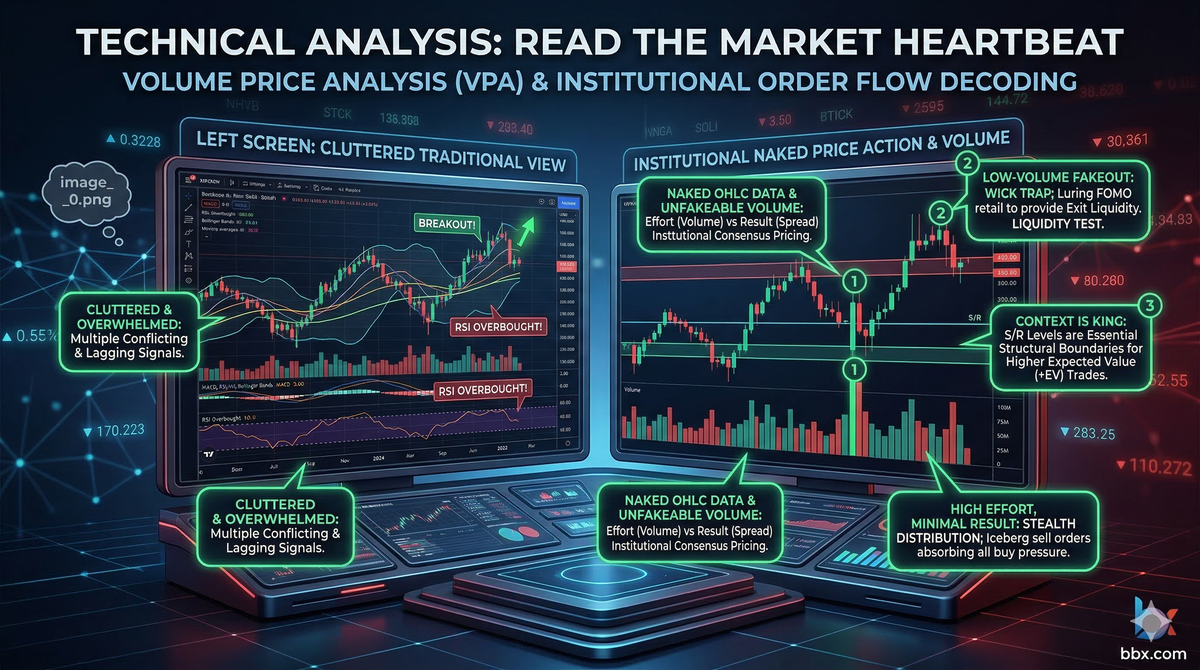
TL;DR (Core Summary): In the high-stakes game of financial markets, Price maps the trajectory of an asset, while Volume reveals the true kinetic energy driving that trajectory. If a candlestick is the "story" the market is telling, volume is the "polygraph test" that verifies its authenticity.The Unfakeable Nature of Volume: Institutions can "paint the tape" and manipulate candlesticks with minimal capital during illiquid hours, but they absolutely cannot hide their tracks when completing massive Accumulation or Distribution campaigns involving millions of shares. Anomalous volume spikes are the indelible footprints left by Smart Money.The Underlying Wisdom of Wyckoff: Based on the Law of Effort vs. Result, when an enormous surge in volume (extreme effort) yields only a negligible change in price (minimal result), it signals a severe Supply/Demand Imbalance. This divergence is often a nuclear-level warning of an impending trend reversal.Liquidity Tests and True Breakouts: A genuine structural breakout must be accompanied by Volume Expansion to prove that institutional capital is actively absorbing overhead supply. Conversely, a Low-Volume Breakout is typically an unsupported Liquidity Test or a bull trap engineered to lure retail traders.
Introduction: Analyzing Price Without Volume is "Driving Blind"
In our previous article on Price Action, we learned how to read the outcome of the battle between bulls and bears through the micro-structure of candlesticks. However, if you rely solely on candlestick patterns in live trading, you easily become prey to high-frequency algorithms and institutional wash routines.
Why do you constantly find yourself going heavy on a picture-perfect "bullish breakout," only to suffer a guillotine-like crash the very next day?
The reason is simple: You are only watching the car "accelerate forward" (price breakout), without checking if "there is actually fuel in the tank" (volume). Pushing the price higher in a zone with thin liquidity requires very little capital. This "false prosperity" is a classic tactic used by Smart Money to lure retail traders into providing exit liquidity.
Today, we will introduce a core dimension of the technical analysis framework—Volume Price Analysis (VPA). We will teach you how to use volume as the "heartbeat monitor of capital" to see through the true order flow behind the candlesticks.
I. The Absolute Cornerstone of VPA: Wyckoff's "Law of Effort vs. Result"
Legendary Wall Street trader Richard Wyckoff established the unshakable foundation of volume-price dynamics for modern technical analysis. The core essence of his theory is simple: Effort must be validated by a proportionate Result.
We view trading volume as the "Effort" exerted by buyers and sellers, and the real body spread of the candlestick (the distance between the open and close) as the ultimate "Result."
1. Logical Harmony (Validation): Volume Expands, Price Advances
If the market prints massive volume on a given day (100% effort) and the candlestick closes as a full, wide-spread bullish candle (yielding a 100% upward result), this indicates that bullish capital is highly aggressive and overhead Supply has been thoroughly absorbed. This is the healthiest signal of trend continuation.
2. Logical Divergence (Anomaly): Ultra-High Volume, Stagnant Price (Extreme Danger)
What if the market prints Ultra-High Volume (200% effort), but the candlestick is a tiny Doji or a shooting star with a massive upper wick (yielding only a 10% result)?
Deep Dive: If an enormous wave of buy orders slammed into the market, why couldn't the price advance? There is only one logical explanation: at that specific price level, a much larger, more determined institutional presence is engaged in Stealth Distribution. The buying pressure from retail traders and momentum algorithms is being absorbed like a sponge by institutional iceberg sell orders. This anomaly—where "effort yields no result"—is a highest-level warning that bullish momentum is exhausted and the trend is nearing its peak.
II. Trend Health Check: Identifying "Impulsive Waves" and "Healthy Corrections"
How do you determine whether the position you are holding is in a robust Uptrend, or if it is on the verge of collapse? Ignore the noise of macroeconomic news and simply observe the "breathing rhythm" of price and volume.
In a healthy uptrend dominated by institutional capital, the volume-price relationship will exhibit a highly rhythmic pulse:
- The Impulsive Move (Exhalation): As the price surges upward, it must be accompanied by significant Volume Expansion. This proves that a continuous stream of Incremental Capital is actively sweeping the order book and driving asset prices higher.
- The Corrective Move (Inhalation): Pullbacks are inevitable in any trend. When the price naturally retraces, Volume Contraction must be sharp and evident. This indicates that Smart Money has not abandoned the asset; the current decline is merely the result of retail Profit Taking or the shaking out of weak hands. Overall Selling Pressure remains extremely light.
[Risk Control Red Line]: If, during an uptrend, the price begins to pull back and volume anomalously spikes, it signifies a fundamental shift in market character—large capital is rushing for the exits. The healthy "breathing" rhythm has been broken, and you must immediately tighten your trailing stops or reduce your risk exposure.
III. Liquidity Tests and True Breakouts: How to Avoid "Fakeout" Traps
Returning to the pain point mentioned in the introduction: How do you avoid buying at the absolute top of a "Fakeout"? The synergy of volume and price is the only gold standard for verifying the validity of a breakout at Key Structural Levels.
When the price challenges a long-term Resistance Zone:
Scenario A: The True High-Volume Breakout
The price forcefully penetrates the resistance zone with a full, wide-bodied bullish candle, while the underlying volume bars multiply in size compared to the recent average.
- The Order Flow Truth: Key resistance levels are typically densely packed with trapped overhead supply and the stop-loss orders of short sellers. To smash through this "liquidity wall," Smart Money must pay a massive capital toll (absorbing all the selling pressure). The sheer magnitude of the volume is the ironclad proof of institutional backing. This is a trend-following entry point with highly Positive Expected Value (+EV).
Scenario B: The Low-Volume Fakeout / Bull Trap
The price similarly breaches the resistance level, perhaps even printing a new high, but the volume shrinks drastically, falling even below average levels.
- The Order Flow Truth: A breakout of this nature often occurs because institutions intentionally pull their limit sell orders, allowing a tiny amount of capital to "push" the price above the resistance line. Their core objective is to conduct a Liquidity Test, or to trigger the "breakout alerts" on retail trading platforms, luring FOMO-driven retail traders into buying the top. Lacking the underlying support of heavy institutional capital, this low-volume breakout is a house of cards. Once retail buying exhaustion sets in, Smart Money flips short, and the price will rapidly collapse.
Conclusion: Seeking "Technical Confluence" Between Price and Volume
In a market saturated with high-frequency algorithms and complex game theory, the candlestick chart displays the market's "behavior," while volume reveals the "motive" behind that behavior.
Any price movement unvalidated by volume is a potential, carefully orchestrated trap. The next time you spot a highly seductive breakout pattern or a panic-inducing crash on the chart, make sure you glance down at the volume bars before pulling the trigger. Ask yourself one soul-searching question: "Does the current volume of capital participation justify the grand narrative of this price action?" If the answer is no, halt your trade immediately—you are very likely staring down the barrel of a lethal liquidity trap.
Disclaimer: This report is for informational purposes only and does not constitute financial advice.