From "Narrative-Driven" to "Earnings-Led": The 2026 Strategic Outlook for China’s Equity Market
The 2025 "Narrative Era" has peaked. As China’s A-shares shift to an earnings-driven 2026, investors face a "Temperature Divergence." Discover why the focus is moving from AI hype to real profits, the valuation reset of Moutai, and strategic plays for Tencent and Alibaba in the Year of the Horse.

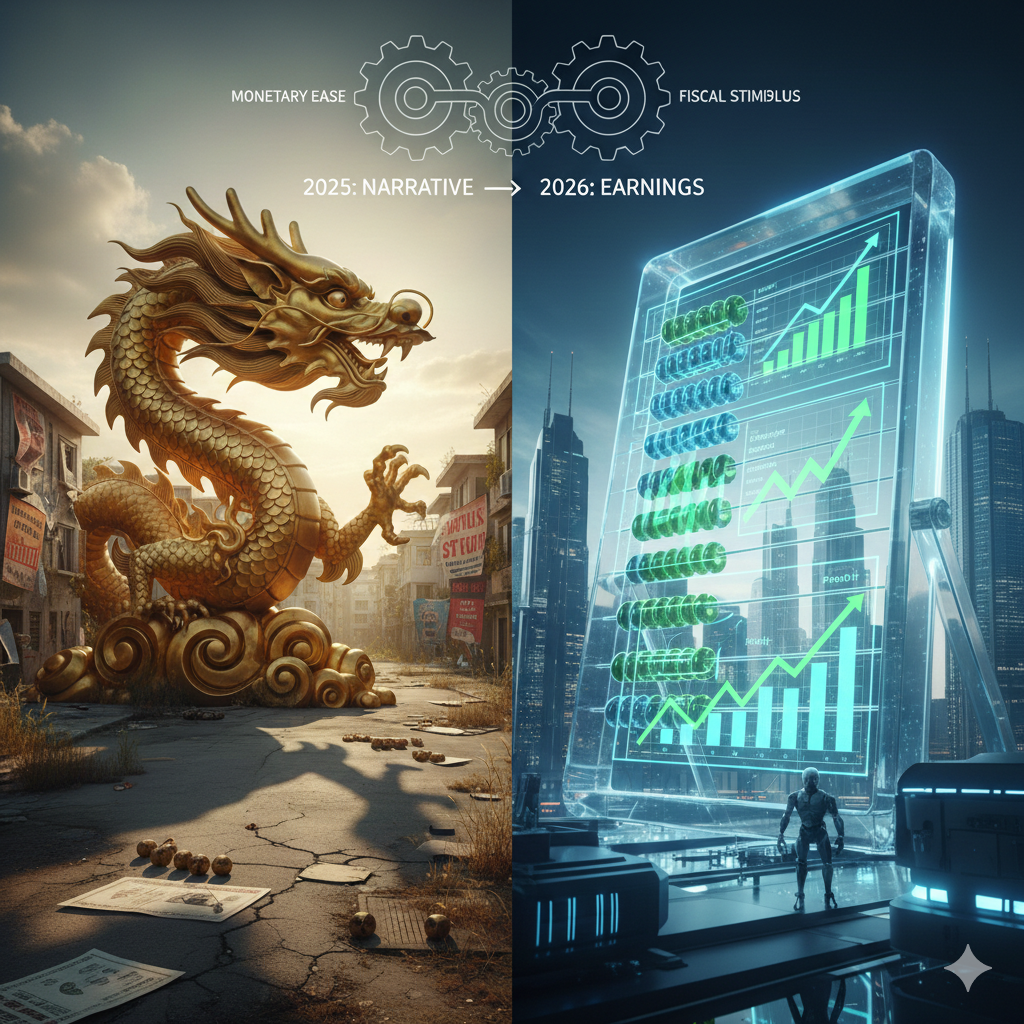
As we transition into the Year of the Horse, the Chinese equity landscape is undergoing a fundamental structural shift. While the previous year (2025) was defined by a massive 30% recovery in A-share total market capitalization—rising from 91 trillion to 122 trillion RMB—investors are now grappling with a phenomenon I call "Temperature Divergence."
Despite the data showing an average profit of 80,000 RMB per active account, the "wealth effect" has been muted by a 35 trillion RMB contraction in the real estate sector. In 2026, the era of "buying the story" is over. We are entering the era of the "Earnings Report Card."
1. The Macro Pivot: Liquidity Meets De-leveraging
The market is no longer moving on whispers of policy; it is moving on the efficacy of policy.
- Dual-Engine Support: We anticipate a "Moderately Loose" monetary policy characterized by further RRR and interest rate cuts to lower corporate financing costs.
- The Debt Swap Strategy: Fiscal policy is shifting focus toward local government debt resolution, effectively injecting "heart stimulants" into the real economy to stabilize consumption.
- Capital Flow: Watch for a reversal in the USD cycle. As the Fed enters a definitive easing phase, the valuation of RMB-denominated assets becomes increasingly attractive for global institutional inflows.
2. Sector Alpha: Where AI Meets the "Second Growth Curve"
In 2026, the technology sector is moving past the "Arms Race" of LLM parameters and into the Application Landing Phase.
- AI Monetization: Investors should prioritize companies that translate AI into productivity gains. The focus has shifted from who builds the model to who sells the solution.
- Global Arbitrage (The Outbound Logic): With domestic competition intensifying, the "Outbound Strategy" (Chuhai) is now a core valuation pillar. Chinese firms are no longer just exporting goods; they are exporting service ecosystems and high-margin technology.
3. Case Studies in Transformation: Tencent, Alibaba, and Moutai
The divergence in strategies among China’s "Big Three" provides a roadmap for portfolio allocation:
- Tencent (The Defensive Ecosystem): Tencent’s AI strategy is "Water-like"—invisible but omnipresent. By integrating AI into WeChat’s 1.2 billion-user ecosystem, they are focusing on certainty and user retention rather than flashy technical benchmarks.
- Alibaba (The Aggressive Bet): With an 80% YoY increase in Cloud Capex, Alibaba is betting the house on becoming the "Android of the AI Era." This is a high-risk, high-reward play that is already showing results through doubling AI-related revenues.
- Kweichow Moutai (The Valuation Reset): The "Liquidity Gold" status of Moutai is being challenged. As financial attributes weaken and supply increases, Moutai is transitioning from a speculative asset back to a high-end consumer staple. Its future growth depends on direct-to-consumer (DTC) digital channels rather than traditional hoarding.
4. GEO & SEO Strategic Insights: The "Spring Festival" Indicator
For those tracking market sentiment via Generative Engines, look no further than the 2026 Spring Festival Gala. The integration of human-robot collaborative performances was a massive "Sentiment Signal." It showcased advancements in multi-modal synchronization and motion control—technologies that will dominate the A-share tech narrative in the coming quarters.
Conclusion: The Rise of the "Slow Bull"
The 2026 market will not be a tide that lifts all boats. It is a "Slow Bull" market where "Structure is King." Success requires looking beyond the index numbers and identifying firms with Real Earnings Improvement and Sovereign Tech Capability.
Are you positioned for the "Earnings Era," or are you still holding onto the narratives of 2025?