From Subjective Prediction to Quantitative Execution: The Underlying Logic of an Institutional-Grade "Mechanical Trading System"
Abandon dopamine-driven "discretionary trading." This guide deconstructs the five Standard Operating Procedures (SOPs) of institutional traders—from market regime filters to asymmetric exits—helping you evolve from a "gambler" into the "casino."

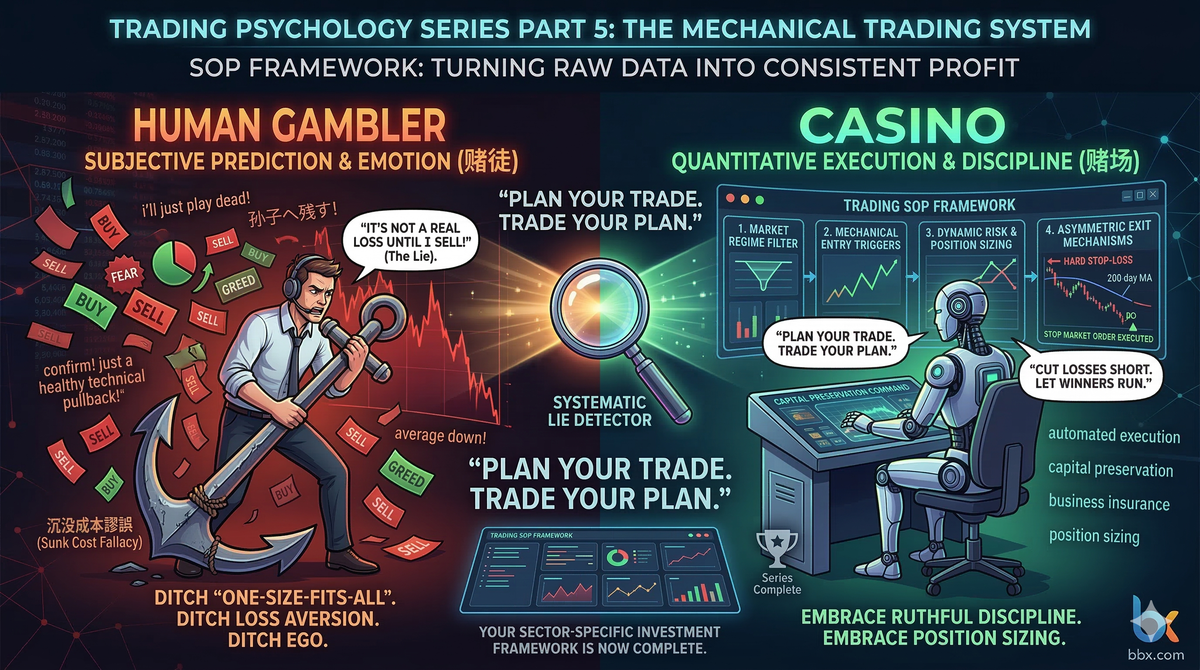
TL;DR (Core Summary): In the capital markets, the secret to long-term, consistent profitability does not lie in clairvoyant predictive abilities. It lies in building a Systematic Trading framework that entirely strips away human weakness.The Essence of a System: A trading system is not merely the superposition of a few technical indicators. It is a comprehensive Standard Operating Procedure (SOP) encompassing "regime filtering, entry triggers, position sizing, exit mechanisms, and a feedback loop."Stripping Emotion: The ultimate goal of a system is to eradicate the hesitation, fear, and greed inherent in Discretionary Trading. While the market is open, you simply act as an emotionless execution program.From Gambler to Casino: Retail traders rely on luck and adrenaline to place bets. Mature professionals establish a Positive Expected Value (+EV) through a rigorous system, leveraging the Law of Large Numbers to become the invincible "casino" itself.
Introduction: The Fragmentation of Indicators and the Absence of a "System"
Many traders, even after consuming volumes of educational material, remain trapped in a quagmire of consistent losses. They can spot MACD divergences, master RSI overbought/oversold levels, and even recite complex candlestick patterns from memory. Yet, once they enter the live market with real capital on the line, their heart rates spike—they rush to lock in tiny profits and stubbornly hold onto massive losers.
The root of this problem is simple: Your brain is loaded with scattered "analytical parts," not a fully assembled, interlocking "trading machine."
Buying and selling based on "gut feeling for the tape" or "macro news intuition" is, at its core, a dopamine-driven gambling behavior. Top-tier proprietary traders on Wall Street never rely on flashes of intuition. They trade like operators of a highly precise franchise—the oil temperature, frying time, and ingredient ratios for french fries are governed by draconian, unbreachable rules.
Today, we will guide you across the chasm that separates the amateur from the professional, helping you build your very own Institutional Trading System from the ground up.
The 5 Core Modules of a Closed-Loop Trading System
A robust system capable of surviving across bull and bear macro cycles must be logically "closed-loop." It must use black-and-white, binary rules to dictate your response to any extreme scenario you might encounter intraday.
Module 1: Market Regime Filter
The very first question a professional system must answer isn't "how to buy," but "whether to trade at all." You must establish strict filters to isolate yourself from high-risk Market Noise.
- Quantitative Rule Example: "This system strictly executes trend-following long strategies. The entry scanning protocol is only authorized if the underlying asset's daily candle is stable above the 50-day and 200-day Simple Moving Average (SMA), AND the broader macro index (e.g., S&P 500 or Nasdaq 100) is not in a defined downtrend."
- Core Purpose: Strategically abandon counter-trend operations. Utilize the market's Dominant Trend to provide the probabilistic backing for your individual trades.
Module 2: Mechanical Entry Triggers
An entry signal can never be an ambiguous "it looks like it's going to bounce." It must be translated into computer-recognizable If-Then Logic.
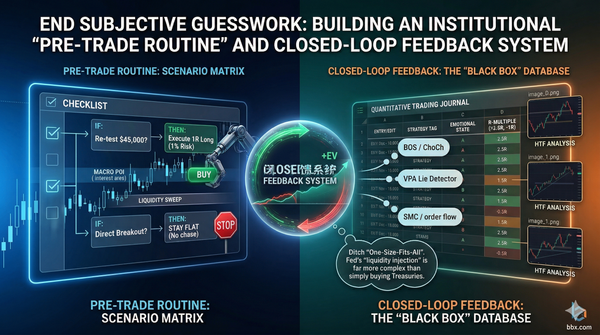
- Quantitative Rule Example: "If the price retests a key support zone on declining volume, AND forms a definitive Bullish Engulfing pattern on the 1-hour timeframe, AND the RSI breaks above the 50 centerline... THEN execute an unconditional market buy at the open of the subsequent candle."
- Core Purpose: Utterly eradicate "fear of heights" or "bottom-fishing" hesitation. If the signal triggers, you execute; if the signal is absent, you sit on your hands.
Module 3: Dynamic Risk & Position Sizing
This is the core concept we explored deeply in Part 3 of this series—it is the Kevlar vest that grants your system Antifragility.
- Quantitative Rule Example: "Upon confirming the entry price and technical stop-loss level, the share size MUST be calculated via a Position Sizing Calculator. The system dictates that the Maximum Capital Risk for any single trade shall absolutely not exceed 1% of total account equity."
- Core Purpose: Isolate the trader from the emotional collapse caused by heavy sizing, ensuring that the Risk of Ruin is mathematically reduced to near-zero.
Module 4: Asymmetric Exit Mechanisms
"Entries determine your win rate; exits determine your risk/reward ratio." An elite system must feature a dual-track exit mechanism capable of handling both "thesis invalidation" and "letting profits run."
- Thesis Invalidation (Hard Stop-Loss): "The moment the asset's price breaches the predefined structural support level, the system triggers a hard stop-loss order for unconditional market liquidation. Canceling the order or averaging down is strictly prohibited."
- Letting Profits Run (Trailing Stop): Prematurely closing a position out of a subjective fear of losing paper profits is strictly forbidden.
- Rule Example: "When floating paper profits reach twice the initial risk (i.e., +2R), force-close 50% of the position to lock in capital safety. For the remaining 50% core position, trail the stop-loss up to the breakeven point (creating a Free Ride exposure), and continue to use a 20-day SMA Trailing Stop until a definitive trend reversal sweeps the position out of the market."
Module 5: The Positive Feedback Loop (Post-Trade Review)
No perfect money-printing machine exists in the real world; a system must iterate alongside evolving market structures. Without rigorous Post-Trade Review, your losses are merely wasted tuition fees without earning the degree.
- Execution Protocol: Maintain a structured, heavily detailed Trade Journal. Log not only the entry/exit prices and P&L, but also the macro catalysts, your emotional fluctuations during execution, and whether any Discipline Deviation occurred.
- Cognitive Paradigm Shift: Institutional trading desks evaluate quality based on a Process-Oriented approach, not a result-oriented one. A losing trade that adhered 100% to the system's logic is considered a "perfect trade." Conversely, a winning trade generated by breaking rules, heavy sizing, and holding-and-praying is a "garbage trade" that warrants a severe warning.
Conclusion: Completing the Cognitive Leap from "Gambler" to "Casino"
The fundamental nature of the financial market is a slaughterhouse designed to amplify human greed and fear. Retail investors devolve into harvested liquidity because they attempt to battle highly quantitative institutional algorithms using inherently unstable "emotions and intuition."
Building and ruthlessly defending your mechanical trading system marks your ultimate metamorphosis from the "Gambler" into the "Casino." A casino never cares whether it wins or loses a specific hand at a specific table; it only cares that the rules of the game (the probabilistic edge) are forever tilted in its favor. As long as you lock in a Positive Expected Value (+EV) through a rigorous system and accept the short-term boredom and stop-loss drawdowns, the Law of Large Numbers will eventually and inevitably funnel the market's wealth directly into your account.
Disclaimer: This report is for informational purposes only and does not constitute financial advice.