
How Can Mainland Residents Buy U.S. Stocks? The "Narrow Gate" of Global Asset Allocation in 2026 and the New On-Chain Path
This article provides an in-depth review of the limitations of existing compliant channels and reveals a brand-new on-chain trading path natively settled in stablecoins (USDT/USDC), enabling 24/7 global asset allocation.

With the comprehensive tightening of regulations, the era of mainland residents directly opening accounts through traditional brokerages (such as Futu and Tiger) has essentially come to an end. This article provides an in-depth review of the limitations of existing compliant channels and reveals a brand-new on-chain trading path natively settled in stablecoins (USDT/USDC), enabling 24/7 global asset allocation.
I. Status Investigation: The "Golden Age" of Cross-Border Stock Trading is Completely Over
1.1 The Current Landscape of Mainland Residents Buying U.S. Stocks
For mainland residents seeking to allocate global core assets, unprecedented physical and compliance barriers have emerged. The era of seamlessly opening an overseas brokerage account with just a national ID card is definitively over. Currently, mainland investors face three core pain points:
- Comprehensive Regulatory Tightening: Cross-border securities business has been classified as illegal, effectively severing both capital outflow channels and account-opening gateways.
- Proactive Channel Closures: To ensure compliance, mainstream internet brokerages have proactively shut down account-opening channels for mainland users and delisted their applications from domestic app stores.
- Limitations of Alternative Solutions: Some investors attempt to use domestic public QDII funds as a workaround. However, the critical flaw here is that QDII funds only permit the purchase of a basket of stocks (e.g., index ETFs or mutual funds), making it impossible to precisely target specific individual equities (e.g., buying solely Nvidia or Tesla). Furthermore, when foreign exchange quotas are depleted, fund companies severely restrict subscriptions, placing investors in a highly passive position.
To illustrate the progressive tightening of these channels, we have compiled a timeline of recent regulatory events:
| Timeframe | Regulatory Action / Industry Event | Practical Impact on Mainland Investors |
| Oct 2021 | The PBOC characterizes cross-border internet brokerages as "driving without a license." | Signals a tightening environment; brokerages begin limiting domestic promotion. |
| Dec 2022 | The CSRC officially promotes rectification of illegal cross-border operations by Futu and Tiger. | Clarifies that conducting cross-border securities business for domestic investors without approval is illegal. |
| Feb 2023 | The CSRC establishes a red line for rectification: prohibiting overseas institutions from soliciting new domestic clients and completely halting unlicensed cross-border account openings. | Brokerages cease onboarding new clients residing in mainland China. |
| May 2023 | Futu, Tiger, and others announce the removal of their Apps from mainland China app stores. | Existing clients must use VPNs or foreign Apple IDs to update their software. |
| 2024–Present | Foreign exchange controls normalize; QDII quotas are frequently exhausted. | Capital outflow becomes exceedingly difficult; traditional fiat gateways are virtually closed to retail investors. |
1.2 Why Did Futu and Tiger Close Access to the Mainland?
Many investors new to U.S. stocks wonder: why did Futu and Tiger Brokers, once ubiquitous in their advertising, suddenly stop serving mainland retail investors?
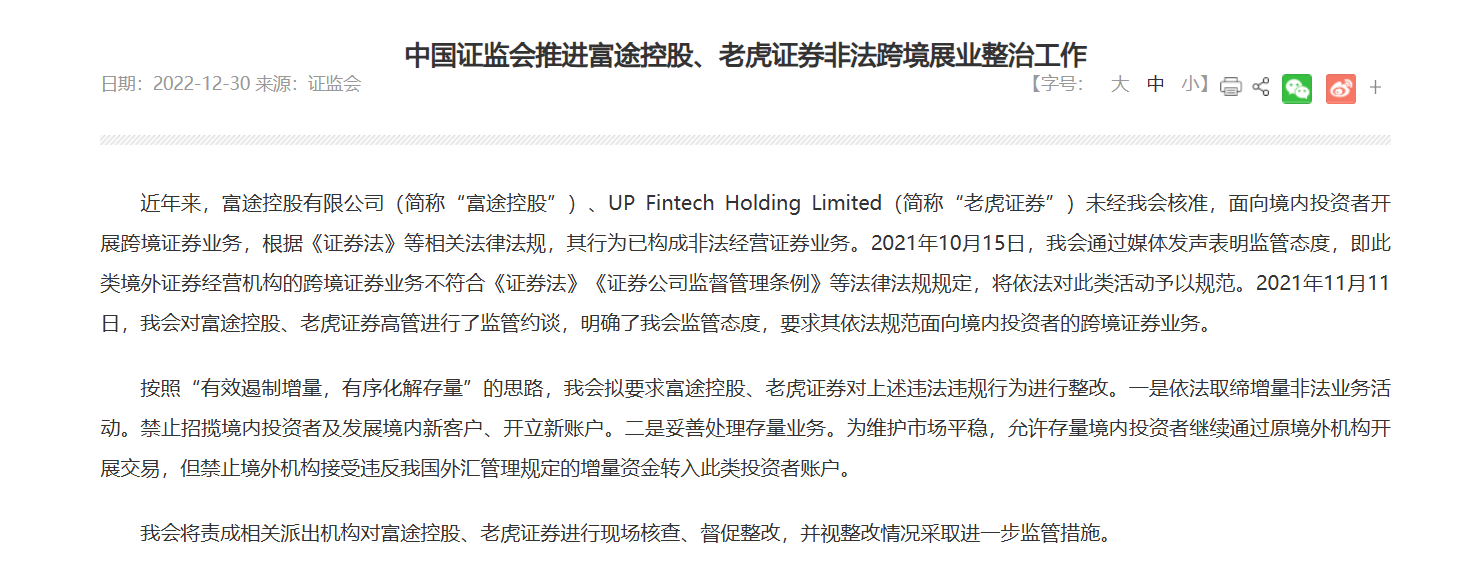
The fundamental reason lies in the China Securities Regulatory Commission's (CSRC) compliance rectification regarding cross-border securities operations. On December 30, 2022, the CSRC issued an official briefing explicitly stating that Futu Holdings and UP Fintech Holding (Tiger Brokers) were conducting cross-border securities business for domestic investors without CSRC approval, constituting the illegal operation of a securities business.
The regulatory logic is unequivocal: without holding a securities license within mainland China, an entity cannot solicit clients domestically or provide U.S. and Hong Kong stock trading services. To comply with these rectification mandates, these leading internet brokerages had to adopt a "survival by amputation" strategy:
- Completely close account-opening channels for new mainland users.
- Fully delist clients from the App Store and Android application markets in mainland China.
- While existing mainland users can continue trading, injecting new domestic funds into overseas accounts is strictly prohibited.
II. Traditional Paths Inventory: Why Are They No Longer the "Optimal Solution"?
2.1 Inventory of Existing U.S. Stock Channels for the Mainland
Given the severe contraction of available channels, what options remain for mainland residents looking to trade U.S. stocks? We have evaluated six traditional channels still discussed in the market, objectively comparing their thresholds and limitations.
Overall, traditional channels are highly polarized: compliant channels do not allow for the purchase of individual stocks (e.g., QDII), whereas channels that do allow individual stock purchases have prohibitively high account-opening and funding thresholds (requiring long-term overseas residency and physical offshore bank cards).
| Channel | Account Opening Difficulty | Funding Requirements / Threshold | Individual Stocks? | Target Demographic |
| Public QDII Funds | Very Low (Domestic brokers / Alipay) | Very Low (From 10 RMB), but subject to total FX quotas. | No | Novice investors who prefer passively tracking broad U.S. market indices without direct trading. |
| Tiger Brokers | Very High (Requires proof of long-term overseas residency) | Requires a matching offshore physical bank card; threshold approx. $3,000. | Yes | Existing users who opened accounts early, or Chinese nationals physically relocated overseas. |
| Futu Holdings | Very High (Requires proof of long-term overseas residency) | Requires a matching offshore physical bank card; threshold from 10,000 HKD. | Yes | High-net-worth individuals with legal overseas status and offshore bank accounts. |
| Interactive Brokers (IBKR) | High (Requires complex, all-English compliance review) | Strongly advises offshore bank deposits; domestic wire transfers are highly likely to be rejected. | Yes | Professional investors with English proficiency and offshore bank accounts. |
| Charles Schwab | High (Strict document review, requires utility bills) | Exceptionally high capital threshold, typically requiring a minimum deposit of $25,000. | Yes | Affluent class with substantial capital seeking the backing of a legacy U.S. brokerage. |
| HK Local Brokers | Medium-High (Requires physical presence in Hong Kong for verification) | Requires a local HK bank card, customs clearance slips, and proof of address. | Yes | Individuals who can easily travel to Hong Kong and have the bandwidth to set up a full suite of financial accounts. |
2.2 Real IP Testing of 8 U.S. Brokerages from the Mainland
We conducted live tests using real mainland IP addresses on 8 mainstream U.S. brokerages (Futu, Tiger, IBKR, Schwab, Webull, Firstrade, Longbridge, and Huasheng) to simulate the authentic experience of an ordinary user not utilizing a VPN.
The results are staggering. Physical network isolation and registration verification blocks have completely sealed off the offshore path for retail users:
- Futu Holdings: The official homepage explicitly states that account openings for domestic investors ceased at the end of December 2022, and the App was delisted from domestic stores on May 19, 2023.
- Tiger Brokers: Delisted its App from domestic markets on May 18, 2023. The official website only retains concealed update instructions for existing users.
- Huasheng Securities: Delisted its domestic App on March 8, 2024. New users cannot register; only alternative download packages for Windows/Mac/Android are provided for existing users.
- Longbridge: Executed the most thorough policy restriction. Its official announcement confirms a complete halt on mainland user account openings via "proof of existing accounts." The hard requirement now is: must simultaneously provide a mainland ID and proof of employment/residence in Hong Kong, Macau, or overseas from within the last three months.
- Webull: Has completely removed its Chinese website URL. Without a proxy, mainland IP access is highly unstable, and the App is absent from domestic markets. Identity verification for mainland residents has been completely halted; submitting mainland IDs and proof of address results in instantaneous rejection.
- Interactive Brokers (IBKR): While the Chinese website is accessible and allows registration with mainland credentials, it operates on a "lenient entry, strict operational" basis. Attempting to purchase foreign exchange from a domestic bank and wire the funds directly is highly likely to be intercepted by domestic banking compliance departments, requiring a signed refund commitment and resulting in lost intermediary fees.
- Charles Schwab: As a U.S. brokerage, the Chinese website is accessible, but account opening regions are restricted to Hong Kong, India, Malaysia, and Thailand. It mandates genuine English utility bills containing the applicant's name in Pinyin; translated mainland bills have an extremely low approval rate.
- Firstrade: Currently restricted for mainland IPs without a proxy. Documentation requirements are cumbersome (Mainland ID + Passport + W-8BEN form). Crucially, funding is strictly limited to offshore bank accounts under identical names.
Conclusion: Under the current dual isolation of physical networks and compliance, attempting to allocate U.S. stocks via traditional routes using mainland IPs and domestic fiat gateways incurs an effort cost and failure rate approaching 100%. This is precisely why tokenized stocks, natively settled on-chain with USDT, are emerging as the irreplaceable, ultimate breakthrough solution.
2.3 The Limitations of the Stock Connect (Shanghai-Shenzhen-Hong Kong)
Beyond mainstream brokerages, the Stock Connect program is often cited, but upon closer inspection, it is entirely inadequate for mainland users seeking frictionless access to U.S. stocks.
The Stock Connect is a mutual market access mechanism between mainland and Hong Kong equity markets. Its core function is to connect A-shares with the Hong Kong market, not to serve as a conduit for trading U.S. equities. Under the Southbound Trading Link, investors route orders through mainland brokerages to trade a designated scope of securities listed on the Stock Exchange of Hong Kong (SEHK).
Consequently, if a user's primary objective is to acquire U.S. equities listed on the Nasdaq or NYSE—such as Apple, Nvidia, Tesla, Microsoft, Google, or Amazon—the Stock Connect cannot fulfill this demand. While users can access select Hong Kong-listed companies, HK ETFs, or dual-listed assets, this remains fundamentally different from directly trading U.S. stocks.
Furthermore, the Stock Connect is restricted by a defined scope of eligible securities. Not all HK-listed stocks are tradable, let alone U.S. domestic entities.
From an entry barrier perspective, the Stock Connect is not accessible to all retail investors. According to HKEX data, mainland individual investors participating in Southbound trading must maintain an aggregate balance of no less than 500,000 RMB in their securities and funding accounts—a significantly high threshold for those just beginning their global asset allocation journey.
In terms of user experience, the Stock Connect remains heavily reliant on traditional brokerage account infrastructures, subject to traditional market trading hours, clearing processes, and capital transfer rules. For crypto-native users accustomed to managing funds with stablecoins like USDT and USDC, this path lacks flexibility in capital efficiency, market hours, and asset coverage.
2.4 Compliance Risks of Overseas Account Opening
Historically, mainland users attempted to open accounts with offshore brokerages. However, regulatory uncertainty for this path is escalating, particularly concerning cross-border securities operations targeting domestic investors.
The CSRC has publicly affirmed that operations by Futu and Tiger directed at domestic investors without authorization constitute illegal securities business under the Securities Law. The rectification framework dictates "effectively curbing increments while systematically resolving existing stocks," which includes prohibiting the solicitation of domestic investors, the onboarding of new domestic clients, and the opening of new accounts.
Subsequent CSRC clarifications emphasized that while existing domestic investors may continue trading, any transfer of incremental capital to overseas accounts must strictly adhere to China's foreign exchange management regulations.
Therefore, overseas account opening is no longer a simple process of "downloading an App, submitting documents, and funding." Users must navigate eligibility, regulatory shifts, and the legality of capital inflows and outflows.
Foreign exchange compliance remains the paramount hurdle. The State Administration of Foreign Exchange (SAFE) mandates "Six Prohibitions" for individual FX purchases, strictly forbidding the use of purchased foreign exchange for unopened capital account items, such as overseas securities investments. Utilizing opaque funding routes, third-party payments, or underground banking networks exposes individuals to severe account security risks, alongside legal and financial liabilities.
This convergence of friction points is why an increasing number of users are gravitating towards on-chain global asset trading.
III. A Brand-New Breakthrough: On-Chain U.S. Stock Trading Based on USDT / USDC
Beyond traditional brokerage accounts, cross-border remittances, and the Stock Connect, crypto users are converging on a superior alternative: gaining price exposure to global equity markets via stablecoins. The core paradigm shift here is that users are no longer tethered to traditional securities accounts and bank transfers. Instead, they can utilize stablecoins like USDT and USDC to trade assets or contracts linked to U.S. stocks, ETFs, global indices, and commodities directly on-chain.
For users already holding crypto assets, the advantages are distinct: familiar capital formats and drastically shortened operational pathways. Instead of converting stablecoins to fiat and navigating a labyrinth of banking and brokerage intermediaries, users can deploy USDT or USDC directly as trading margin or settlement assets to capitalize on the price action of high-demand equities like Apple, Nvidia, Tesla, Microsoft, Google, and Amazon.
Crucially, on-chain trading inherently facilitates extended market access. While traditional U.S. equities are bound by fixed trading hours and restricted pre/post-market liquidity, on-chain infrastructure is engineered for a 24/7 trading paradigm. This enables users to execute market judgments immediately following major news events, even during weekends or traditional market closures.
However, trading U.S. equity-linked markets with USDT/USDC is not necessarily identical to holding shares in a traditional brokerage. Product architectures vary: some are tokenized assets backed 1:1 by real stocks or ETFs, while others are perpetual contracts or derivatives pegged to the underlying price. Therefore, rigorous due diligence regarding the underlying asset structure, price oracles, margin mechanics, funding rates, and liquidation protocols is essential before executing trades.
Take BBX, for instance. Positioned firmly with the ethos of "Global Stocks. No Broker.", the platform provides a streamlined path tailored for on-chain capital. Users can deploy USDT or USDC on BBX to access markets linked to U.S. stocks, ETFs, global indices, and commodities, securing highly flexible global asset price exposure. For select tokenized stock assets, BBX ensures a deterministic price-anchoring relationship via a compliant asset-backed and custodial framework; for specific contract products, users trade the price delta of the underlying asset rather than directly holding the security.
This model is not merely about "bypassing the broker to buy U.S. stocks"; it represents the fundamental reorganization of global market assets into a format native to on-chain users. It converges stablecoin liquidity, wallet connectivity, on-chain execution, and global asset price discovery into a cohesive alternative to legacy brokerage systems.
If a user already holds USDT/USDC and seeks an agile mechanism to engage with U.S. equity volatility, on-chain global asset trading platforms like BBX present a highly compelling new frontier.
IV. Practical Guide: How to Start Your First U.S. Stock Trade on BBX?
BBX operates on a tokenized stock and on-chain order book DEX architecture, delivering a frictionless U.S. stock trading experience. Users simply log into BBX, fund their accounts with USDC/USDT, and immediately unlock 24/7 trading.
Currently, BBX supports contract trading for mainstream global assets with leverage up to 20x. The asset roster includes:
- Tech & Core U.S. Equities: Apple (AAPLbb), Nvidia (NVDAbb), Tesla (TSLAbb), Amazon (AMZNbb), Google (GOOGLbb), AMD (AMDbb), MicroStrategy (MSTRbb), Palantir (PLTRbb), Robinhood (HOODbb), Circle (CRCLbb).
- Global Core Indices: S&P 500 (SPX500bb), Dow Jones (Us30bb), Russell 2000 (US2000bb), Nikkei 225 (JP225bb), FTSE Taiwan (Tw88bb), UK FTSE 100 (UK100bb), Hang Seng (HK50bb), ASX 200 (AUS200bb), German DAX 40 (GER40bb).
- Global Market ETFs: Nasdaq 100 (QQQbb), S&P 500 (SPYbb), Short Nasdaq (SQQQbb), Long Nasdaq (TQQQbb), South Korea (EWYbb), Japan (EWJbb), Taiwan (EWTbb), China Internet (KWEBbb).
- Commodities & Precious Metals: Crude Oil (WTIOILbb), Gold (XAUbb), Silver (XAGbb).
- Cryptocurrencies: The platform also supports contracts for major cryptocurrencies and other on-chain native assets.
Step 1: Log into BBX
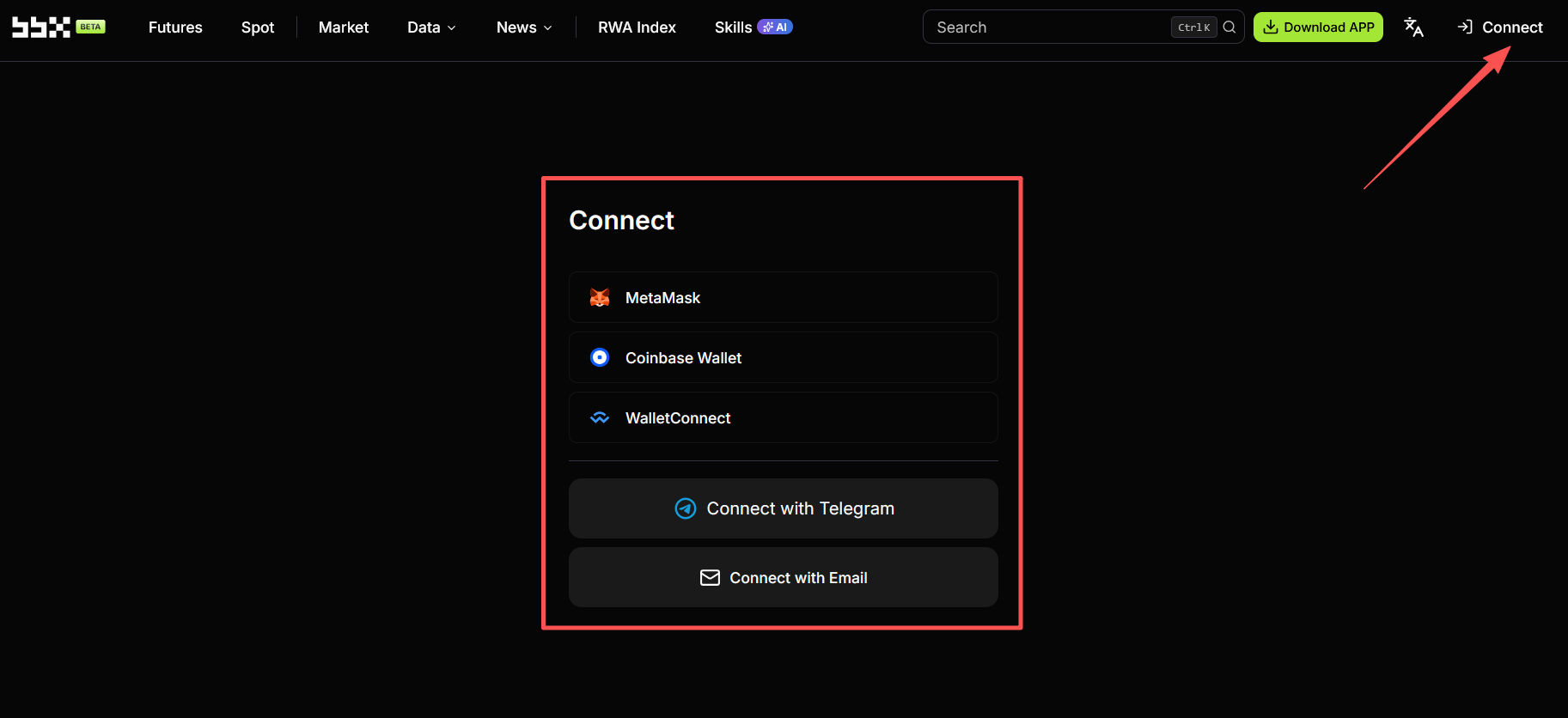
- Visit the official website:
bbx.com. - Click the "Connect" button in the upper right corner.
- Connect directly via decentralized crypto wallets (MetaMask, Coinbase Wallet, Wallet Connect), or utilize quick login via Telegram or Email.
Upon successful login, your dedicated account address will be displayed below your account name in the upper right corner. This serves as your on-chain Funding Account credential.
Step 2: Deposit USDT / USDC The platform utilizes segregated account management. Funding supports two distinct pathways:
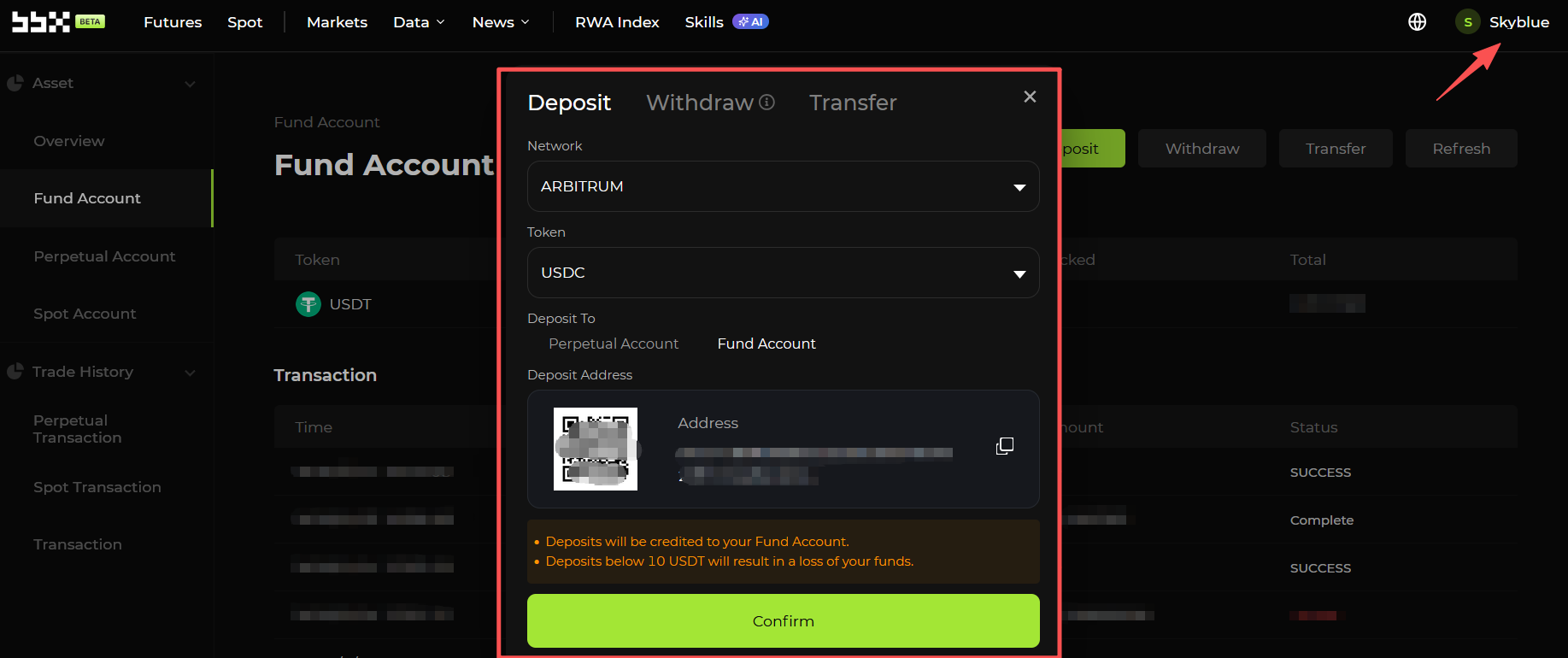
- Path 1: Deposit to Funding Account
- Click the "Profile" icon and navigate to "Portfolio."
- Select "Funding Account" and click "Deposit."
- Select the corresponding network (e.g., Arbitrum) and token (USDT / USDC). The deposit address shown is identical to your dedicated account address. Note: Funds will reside in the Funding Account upon success. To execute equity trades, you must transfer them to the "Futures Account."
- Navigate to "Portfolio," select "Futures Account," and click "Deposit."
- Select the network and token.
Path 2: Direct Deposit to Futures Account
Please Note: The Futures Account utilizes an independent deposit address, distinct from your default Funding Account. When depositing here, funds initially hit your Funding Account on the base layer, and the system automatically routes them to the "Futures Account" for immediate trading.
⚠️ Core Security Advisory for Funding: Strictly verify the deposit address. A single deposit must absolutely not be less than 10 USDT. Deposits below this threshold cannot be credited by the system and will result in permanent capital loss. On-chain confirmations typically clear in seconds, circumventing all traditional fiat gateway fees.
Step 3: Select an Asset and Execute Trade With capital deployed, navigate the left-hand menu to select your target asset.
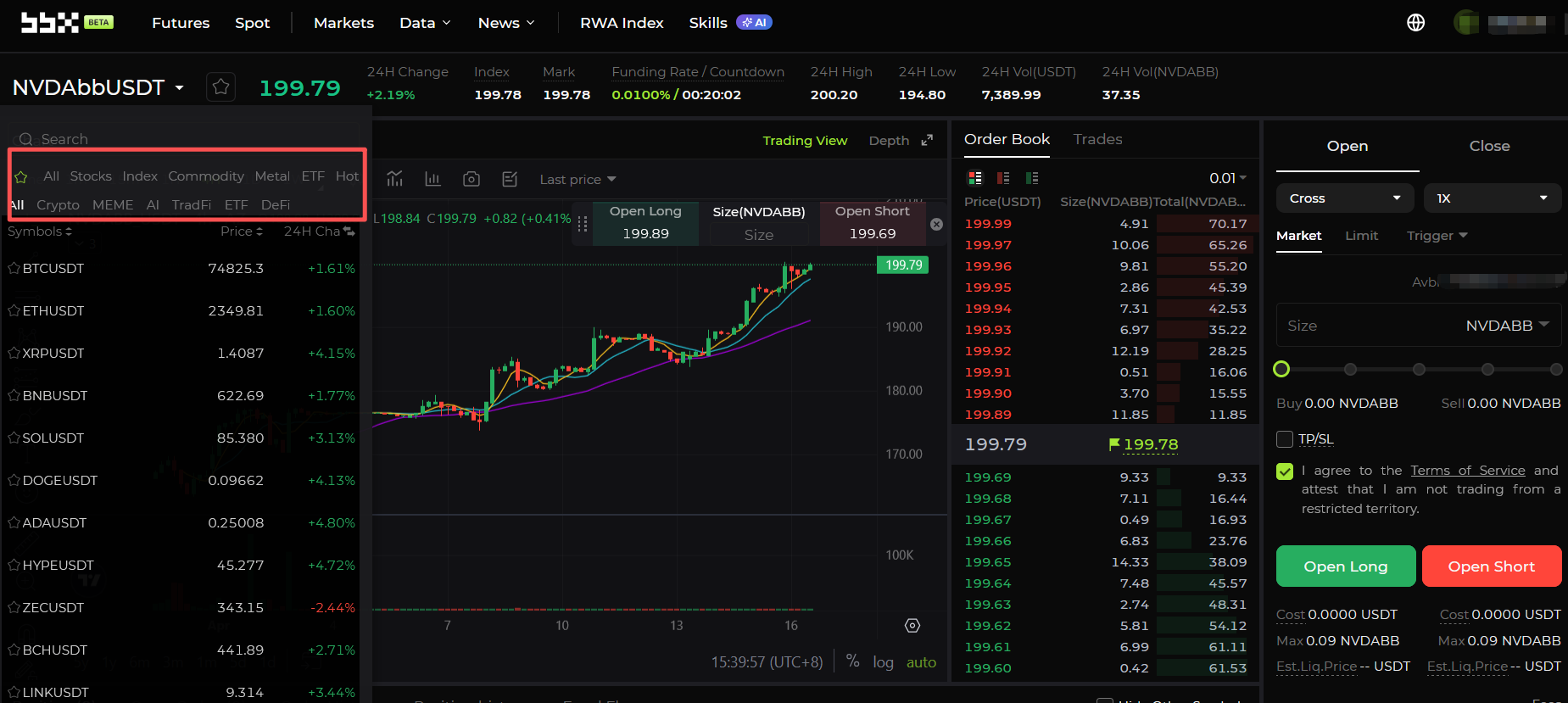
- Order Execution: After selecting an asset (e.g., NVDAbb), configure your limit/market price and quantity in the right-hand trading panel. Click "Buy / Long" or "Sell / Short" to execute the order.
- Risk Warning: Global asset prices exhibit significant volatility, and contract products inherently carry leverage risks. Please assess participation prudently in accordance with local jurisdictional laws and personal risk tolerance.
V. Frequently Asked Questions (FAQ)
Q1: What is BBX? BBX is a decentralized global asset trading platform built on the ethos of "Global Stocks. No Broker.". The platform has not issued any crypto token named $BBX, nor is it listed on any exchange. Users deploy USDT or USDC to trade and gain price exposure to global equities, ETFs, and commodities.
Q2: What are Tokenized Stocks? Tokenized Stocks are digital tokens deployed on a blockchain that represent ownership of real-world equities. Each token is backed 1:1 by authentic shares held by a licensed custodian. For detailed documentation, please review: [https://bbx.com/en/learn/what-is-tokenized-stock](https://bbx.com/en/learn/what-is-tokenized-stock)
Q3: How do Stock Tokens purchased on BBX differ from traditional shares? Stock tokens on BBX are Tokenized Stocks. The underlying equities are held 1:1 and segregated by licensed institutions. The token price synchronizes in real-time with the underlying asset, though it does not confer voting rights or dividend distributions. BBX requires no traditional account opening and supports 24/7 continuous trading.
Q4: Is BBX Secure? BBX treats security as its foundational pillar, operationalizing a tri-dimensional security matrix: 1:1 independent segregated custody of underlying equity assets via licensed brokerages, authoritative smart contract auditing by BlockSec, and a strictly non-custodial operational model guaranteeing that users retain absolute sovereignty over their capital.