
The Great Divergence: Intel’s AI Blowout vs. The Geopolitical Energy Brake
Intel's $0.29 EPS fuels a historic 16-day AI rally, yet Hormuz tensions push oil to $107. BBX Research analyzes the "Great Divergence": Can AI growth outrun the energy shock? Included: Technical targets for QQQ & BTC.

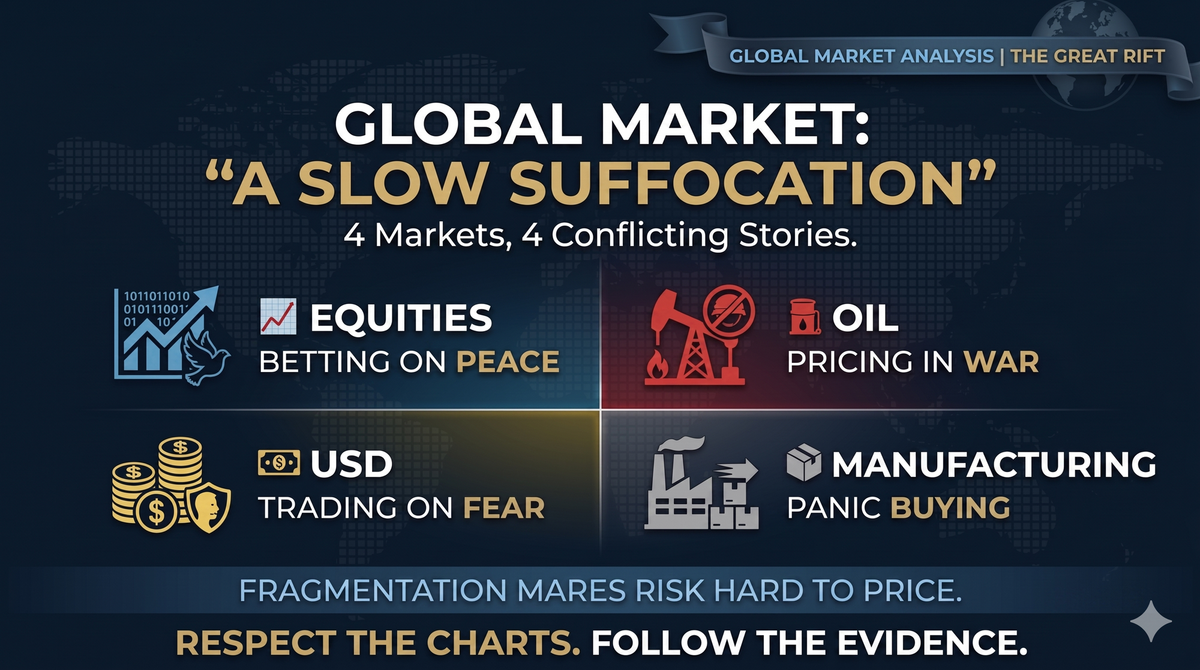
While the waters of the Strait of Hormuz are currently defined by the smoke of a "low-intensity maritime war," the atmosphere on Wall Street is one of pure euphoria. We are witnessing a historic split: a global economy facing a severe energy supply shock, countered by a semiconductor sector that refuses to stop climbing.
1. The Cruel Present: A Maritime Stalemate
Geopolitics has entered a dangerous phase of "testing the limits of coercion." Despite talk of extended ceasefires, the situation on the water has escalated.
- Hormuz Blockade: The Iranian Revolutionary Guard has begun seizing merchant ships, effectively paralyzing commercial shipping in the world’s most vital energy artery.
- The Global Pincer: The U.S. has expanded its maritime interdiction from the Persian Gulf to the Indian Ocean, intercepting Iranian tankers near Malaysia and Sri Lanka.
- The $107 Reality: Physical Brent Crude has already breached $107/barrel. With 10% of the world’s oil trapped in the Strait, the IMF warns that a prolonged conflict could drag global growth down to a recessionary 2%.
2. The Beautiful Future: Intel and the 16-Day Rally
While the energy market trades on a "cruel present," equity markets are trading on a "beautiful future" powered by silicon. The AI super-cycle isn't just a narrative—it is now backed by explosive earnings.
Intel ($INTC) Q1 2026: A 1,350% EPS Surprise
Intel’s latest earnings report has silenced the skeptics, serving as a proxy for the entire AI sector:
- Revenue: $13.6B ($1.4B beat over expectations).
- EPS (Non-GAAP): $0.29, obliterating the consensus estimate of $0.01.
- AI Dominance: Data Center & AI (DCAI) revenue surged 22%, while AI PCs now account for over 60% of Intel’s client CPU mix.
This performance propelled the stock up ~20% in post-market trading, extending the U.S. chip sector’s winning streak to 16 consecutive days—the longest in history.
3. Why the Market is Ignoring the War
The "split" occurs because Wall Street believes AI-driven productivity is more powerful than energy-driven inflation. The demand for compute is no longer speculative; it is "10/10" tangible. As users scale their workflows on Claude 3, OpenAI’s latest models, and Imagen 2, the infrastructure requirements are hitting a fever pitch.
The semiconductor sector is projected to grow 57% in 2026—more than double the growth rate of the broader tech industry. To the bulls, a $100 barrel of oil is a temporary friction, while AI is a permanent shift in the global production frontier.
Strategy: Technicals & Targets
Despite the optimism, the divergence between rising costs and rising stock prices eventually requires a "cross." We advise caution against "chasing the green."
- Nasdaq (QQQ): Currently overextended. We recommend waiting for a retest of the 20-day Moving Average (MA) for a more favorable risk/reward entry.
- Bitcoin (BTC): BTC is currently battling major resistance at $78,000 (the weekly 20-period MA). A clean break above last week’s high could quickly open the door to $80,000, though we expect volatility to mirror the fluctuations in the Persian Gulf.
Final Thought
Is this the ultimate decoupling, where AI productivity renders traditional energy constraints irrelevant? Or is the "Cruel Present" of $107 oil a gravity well that will eventually pull the "Beautiful Future" back to earth?
In the current environment, the most dangerous trade is assuming the 16-day rally can last forever without a macro reality check.
Disclaimer: This article is for informational purposes only and does not constitute financial, investment, or legal advice. Trading involves significant risk.