March 10th Market Watch: Middle East Tensions and the Liquidity Trap
Market Watch March 10: Tensions in Hormuz triggered a reversal as the S&P 500 tests support at 6,750. With liquidity fragile and systematic CTA selling mounting, investors must navigate a volatile landscape where political rhetoric meets structural exhaustion.

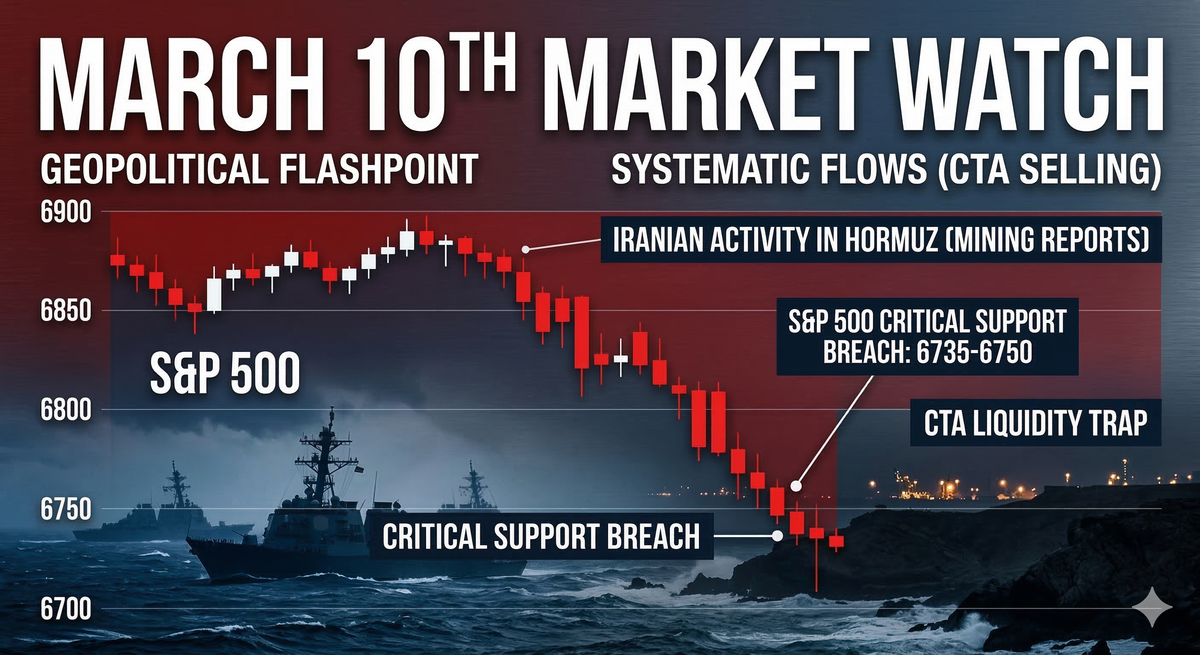
The market experienced a volatile session today as geopolitical headlines from the Middle East collided with fragile domestic liquidity. While early trading showed some resilience, a mid-afternoon wave of reports regarding Iranian activity in the Strait of Hormuz sent indices into a sharp reversal, highlighting just how sensitive the current environment remains to "headline risk."
Geopolitical Fog and the "Short-Term" Narrative
The primary catalyst for today’s intraday turbulence was reports from the U.S. intelligence community suggesting Iranian mining operations in the Strait of Hormuz, with estimates ranging between 2,000 and 6,000 mines. Despite conflicting reports and a retracted social media post from the U.S. Energy Secretary regarding naval escorts, the message is clear: the energy corridor remains a tinderbox.
President Trump has characterized the current military stance as a "short-term" action that will not conclude this week but is not intended to become a years-long conflict. For macro asset pricing, this distinction is vital. Markets can generally digest a multi-week military operation; they cannot easily price in a multi-year ground war. However, until a "unconditional surrender" or a clear de-escalation occurs, traders are maintaining a necessary risk premium.
The Liquidity Gap and CTA Pressure
Beyond the headlines, the internal structure of the market remains precarious. Goldman Sachs and JPMorgan trading desks have issued warnings that while political rhetoric can repair short-term sentiment, it cannot fix the underlying lack of liquidity.
According to Goldman’s models, the recent volatility has triggered risk-control mechanisms for CTAs (Commodity Trading Advisors). This means that for the next week to a month, CTAs are projected to be net sellers of equities regardless of whether the market moves up or down. We are looking at potentially record-breaking sell-side pressure from systematic flows, which could lead to a "free fall" scenario if buyers do not step in to absorb the volume.
Technical Levels to Watch
The S&P 500 is currently caught in a tug-of-war between the 6,850 resistance level—the final stretch of short-covering—and the 6,735–6,750 support zone.
- Support: A break below 6,750 could trigger a more violent, systemic sell-off.
- Resistance: Unless the index can consistently close above 6,900, institutional investors are unlikely to dismantle their defensive hedges.
- Deep Value Floor: Heavy put-wall activity remains steady around the 6,475 mark, suggesting that big money is still bracing for a potential secondary bottom.
Sector Spotlights: Healthcare and Defense Speculation
The healthcare sector faced significant headwinds today, led by a sharp decline in Centene (CNC). The company’s disclosure of a massive drop in Obamacare users—from 5.5 million down to 3.5 million—has signaled a broader slowdown in government-subsidized insurance growth.
Conversely, we are seeing speculative "Trump-linked" activity in the drone sector. News of a golf course operator pivoting into a drone enterprise via merger—reportedly with backing linked to the Trump family—saw shares surge. While these are high-volatility plays, they underscore the "White House-driven" nature of the current tape.
Final Outlook
The market has transitioned from extreme panic to a state of wary observation. The "fuel" from short-covering is largely exhausted, and without a fresh influx of long-side buyers, the path of least resistance remains a retest of recent lows. Investors should remain vigilant as we head into the weekend, keeping a close eye on both the Strait of Hormuz and the systematic sell-thresholds of major funds.