
$MU Ignites the AI Memory Cycle: Micron’s Earnings Reveal More Than Just a Beat
Micron’s latest earnings were not just another upside surprise. They may mark a repricing of the AI infrastructure cycle, with memory, HBM, DRAM and NAND becoming key signals for whether AI demand is truly slowing.


Excerpt:
Micron’s latest earnings were not just another upside surprise. They may mark a repricing of the AI infrastructure cycle, with memory, HBM, DRAM and NAND becoming key signals for whether AI demand is truly slowing.
Micron Technology ($MU) may have just delivered one of the most important AI data points of 2026.
The market usually watches Nvidia first, because GPUs sit at the center of AI training and inference. But if investors want to understand whether AI infrastructure demand is actually slowing, Micron is becoming just as important.
AI does not only need compute. It also needs high-bandwidth memory, DRAM, NAND, SSDs, data center storage, power, cooling, optical networking and semiconductor equipment.
The message from Micron’s latest earnings is clear:
The AI infrastructure cycle may still be early, and memory supply remains structurally tight.
The Numbers: A Clean Beat
Micron delivered a very strong fiscal Q3 2026:
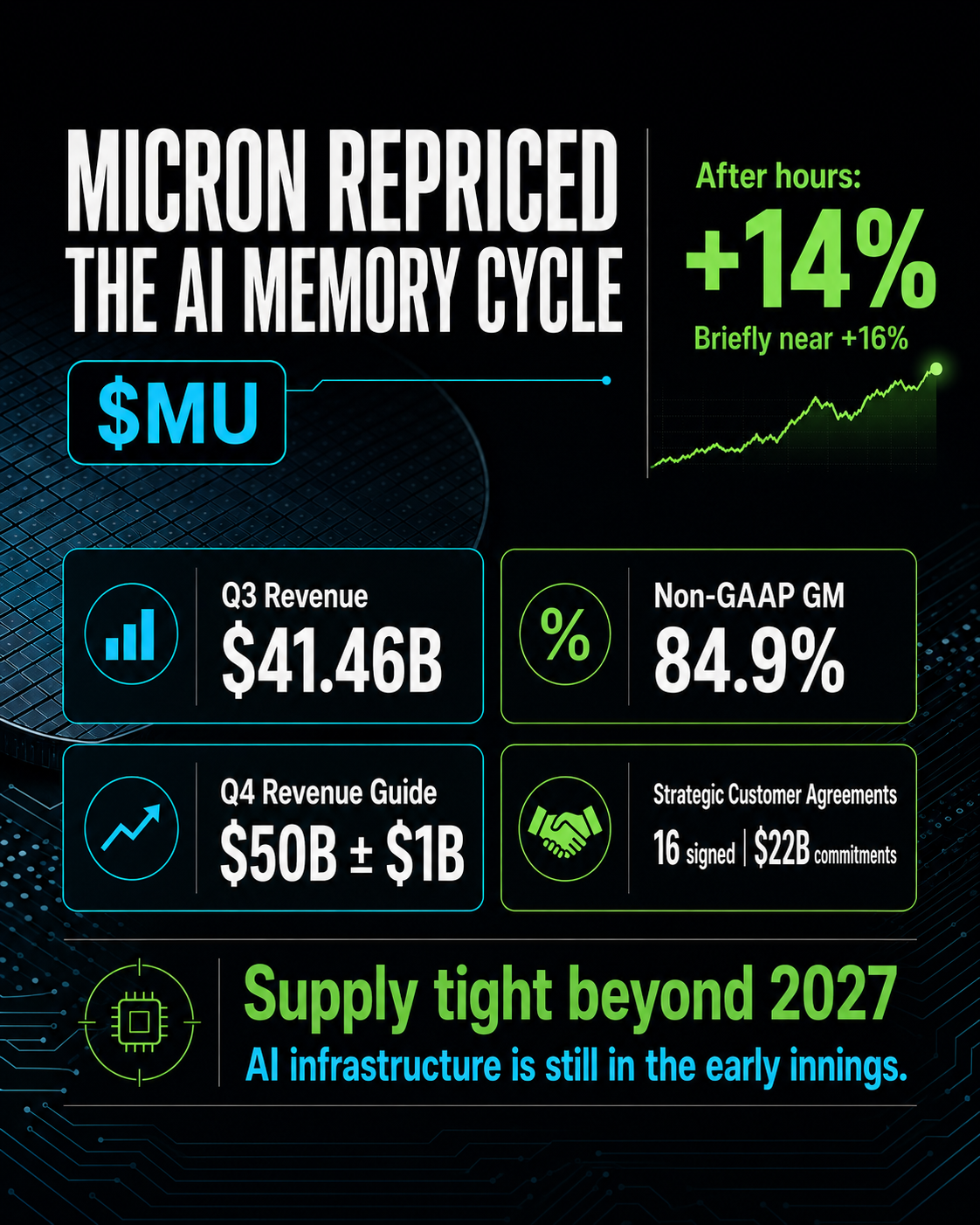
- Q3 revenue: $41.46B, up about 346% YoY
- Non-GAAP EPS: $25.11
- Non-GAAP gross margin: 84.9%
- Operating cash flow: $25.39B
- Adjusted free cash flow: $18.3B
The company’s Q4 outlook was even stronger:
- Q4 revenue guide: $50B ± $1B
- Q4 gross margin guide: approximately 86%
- Q4 Non-GAAP EPS guide: $31 ± $1
After the report, $MU jumped roughly 14% after hours, briefly approaching 16%. In some contract markets, the after-hours move extended to around 17%.
But the real story is not just the earnings beat.
The Bigger Signal: The AI Memory Cycle Is Still Early
Memory used to be viewed as a classic cyclical industry.
Demand rises. Suppliers expand capacity. Supply catches up. Prices fall. Margins compress. The cycle ends.
This time, Micron is sending a different signal.
The company now expects DRAM and NAND supply-demand conditions to remain tight beyond calendar 2027. More importantly, Micron still does not have clear visibility into when supply will fully catch up with demand.
That challenges the market’s fear that the AI buildout is already entering the late stage.
If AI data centers, edge AI, autonomous driving, robotics and on-device AI continue to scale, memory and storage demand may no longer behave like a traditional consumer electronics cycle. They may become part of a longer infrastructure cycle.
Strategic Customer Agreements: Customers Are Locking In Future Supply
One of the most important details in the report was Micron’s announcement that it has signed 16 Strategic Customer Agreements (SCAs).
These agreements span data center, consumer and automotive customers. Many include take-or-pay structures, price floors, long-term supply commitments and customer deposits or related financial commitments.
Micron expects these signed agreements to bring approximately $22B in customer deposits and related commitments.
This suggests customers are not simply rebuilding inventory.
They are trying to secure future supply.
In other words, hyperscalers and major customers do not appear to believe AI demand is cooling quickly. Their bigger concern is whether they can get enough memory and storage capacity over the next several years.
The Impact Goes Beyond Micron
If Micron’s view is right, the beneficiaries will not be limited to $MU.
The broader AI infrastructure stack could continue to benefit, including:
- HBM / DRAM / NAND
- Data center SSDs
- Semiconductor equipment
- Power and electrical systems
- Liquid cooling and thermal management
- Optical networking
- Data center construction
- Edge AI and on-device AI hardware
This is why Micron’s earnings matter so much for the AI trade.
The first phase of the AI trade was mostly about GPUs and compute.
The next phase may broaden into the infrastructure layer.
BBX View: The AI Trade May Move Higher, But Not in a Straight Line
In the short term, $MU has already moved sharply after hours. Chasing a large gap higher may not offer the best risk-reward, especially before the regular session confirms whether the move can hold.
Investors should watch whether Micron can avoid a post-earnings fade, whether semiconductor peers confirm the move, and whether the broader AI infrastructure complex trades together.
But from a medium- to long-term perspective, this report strengthens one key view:
AI infrastructure demand is not clearly slowing. It is broadening from GPUs into memory, storage, power, cooling and data centers.
The AI trade is unlikely to move in a straight line.
Markets will keep worrying about an AI bubble, excessive capex, supply catching up with demand and peak margins. But each strong earnings cycle and each real industry data point can reset expectations again.
Micron’s latest report may be one of those resets.
The AI Memory Cycle may still be just getting started.
Disclaimer
This article is for informational and educational purposes only and does not constitute financial, investment, trading, legal, tax, or other professional advice. Any market views, data, or analysis are not intended as a recommendation to buy, sell, or hold any asset, security, token, or financial instrument.
Digital assets, equities, and tokenized stocks involve significant risk, including price volatility and potential loss of principal. Readers should conduct their own research and consult qualified professional advisors before making any investment or trading decisions.
BBX does not guarantee the accuracy, completeness, or timeliness of the information provided and is not responsible for any losses arising from reliance on this content.