Oracle’s Earnings Revealed a Core Truth About the AI Boom
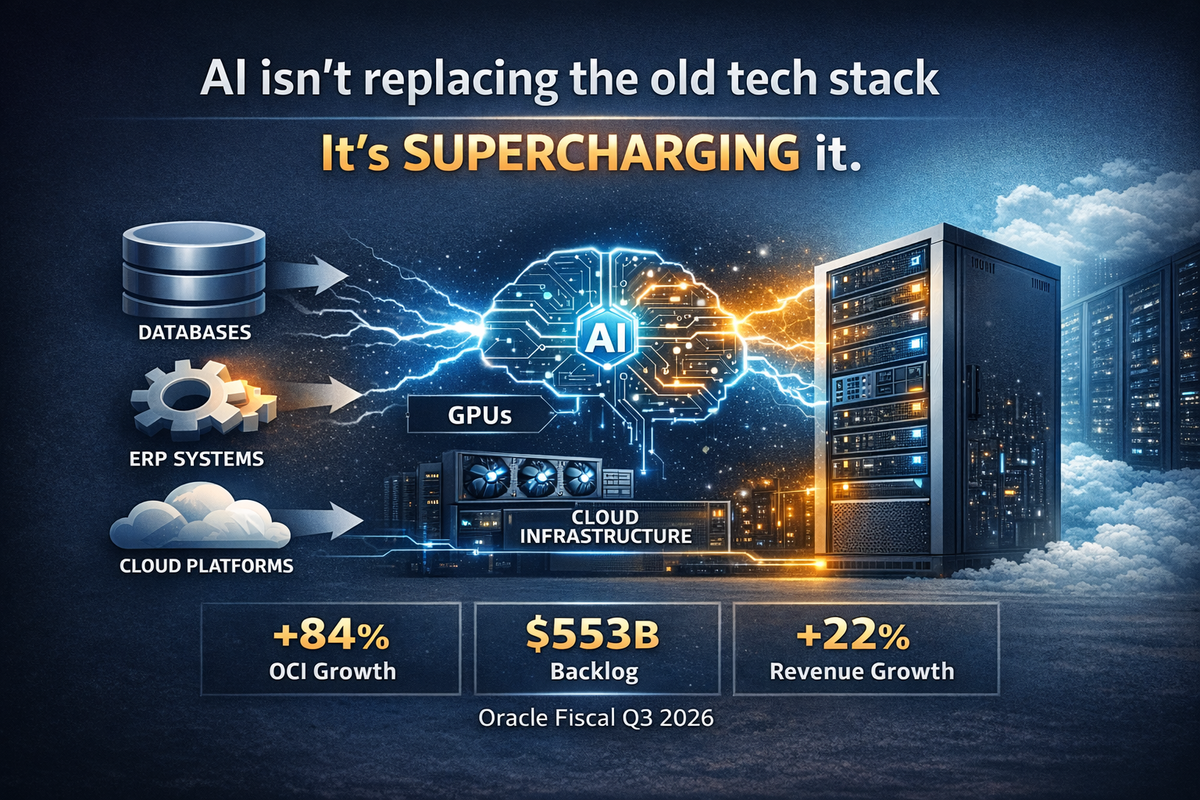
Oracle’s latest earnings reveal a key truth about the AI boom: AI isn’t replacing enterprise software—it’s being embedded into it. As companies add AI to databases, ERP systems, and cloud platforms, demand for compute and cloud infrastructure is surging.

Oracle’s latest quarterly results did more than beat expectations. They revealed something important about how AI is actually being adopted inside the real economy.
The popular narrative says AI will replace legacy software, overturn incumbents, and make large parts of the old enterprise stack obsolete. Oracle’s numbers suggest something different is happening, at least in this phase of the cycle.
AI is not replacing enterprise software.
It is being embedded into it.
That distinction matters.
The numbers were strong, but the signal underneath them was even stronger
Oracle reported fiscal Q3 2026 revenue of $17.2 billion, up 22% year over year. Cloud revenue reached $8.9 billion, up 44%, while Oracle Cloud Infrastructure grew 84% year over year. Remaining performance obligations, a key measure of contracted future revenue, surged to $553 billion, up 325% from a year earlier. Non-GAAP EPS came in at $1.79.
Markets treated those results as more than a simple quarterly beat. Oracle shares climbed roughly 8% after the earnings release, as investors took the report as evidence that enterprise AI demand remains very real and very monetizable.
But the most interesting takeaway was not just that Oracle grew fast.
It was why.
AI is being layered onto the old stack, not replacing it overnight
Companies are not throwing away their databases, ERP systems, cloud workflows, and enterprise applications. They are adding AI on top of them.
They still need systems of record. They still need secure enterprise data. They still need workflow software, compliance layers, integration tools, and cloud infrastructure. What AI changes is that those systems now require more inference, more storage, more orchestration, and far more compute. This interpretation is consistent with Oracle’s sharp OCI acceleration and massive jump in contracted backlog.
In other words, the first major commercial effect of AI is not destruction of the old stack.
It is expansion of the old stack.
That is why Oracle’s results matter beyond Oracle itself.
The AI boom is also an infrastructure boom
For years, the market’s AI discussion has centered on model companies and chip makers. Those remain important. But Oracle’s quarter is a reminder that AI adoption also creates a second-order winner set: cloud platforms, data center operators, database providers, and enterprise software vendors with deep installed bases. This is an inference from Oracle’s reported growth profile and management’s unchanged plan for $50 billion in fiscal 2026 capital expenditures.
That capex figure is especially telling. Oracle is not positioning for a temporary spike in experimentation. It is building for long-duration infrastructure demand. Reuters reported that investor concerns over the cost of Oracle’s AI expansion eased after the company paired that spending with much stronger backlog and revenue visibility.
This is the deeper lesson from the quarter:
The AI revolution is not just a software story. It is a cloud and infrastructure story.
Why this matters for investors
If AI adoption mainly arrived by replacing legacy enterprise software, the biggest winners would likely be a narrow set of AI-native application companies.
But if AI adoption first arrives through augmentation rather than replacement, the economics look different.
The early winners are likely to include companies that already sit at critical control points in enterprise technology: cloud providers, database owners, ERP vendors, and infrastructure platforms that can absorb rising AI workloads. Oracle’s quarter supports that view.
That does not mean all incumbents win automatically. It does mean the market may still be underestimating how much value can accrue to companies that help enterprises operationalize AI rather than merely experiment with it.
Oracle’s quarter may be a preview of the next phase
The market often talks about AI as if adoption were a single event.
In reality, it is more likely to unfold in stages.
First, AI gets embedded into existing systems.
Then, it automates more workflows.
Only later does it begin to fully replace portions of legacy software.
Oracle’s earnings suggest we are still firmly in phase one. Enterprises are not abandoning the old stack. They are making it more powerful, more data-intensive, and more compute-hungry. That reading is supported by Oracle’s cloud growth, backlog expansion, and continuing infrastructure buildout.
And that may be the most important truth the quarter revealed.
AI is not killing the old tech stack.
It is supercharging it.