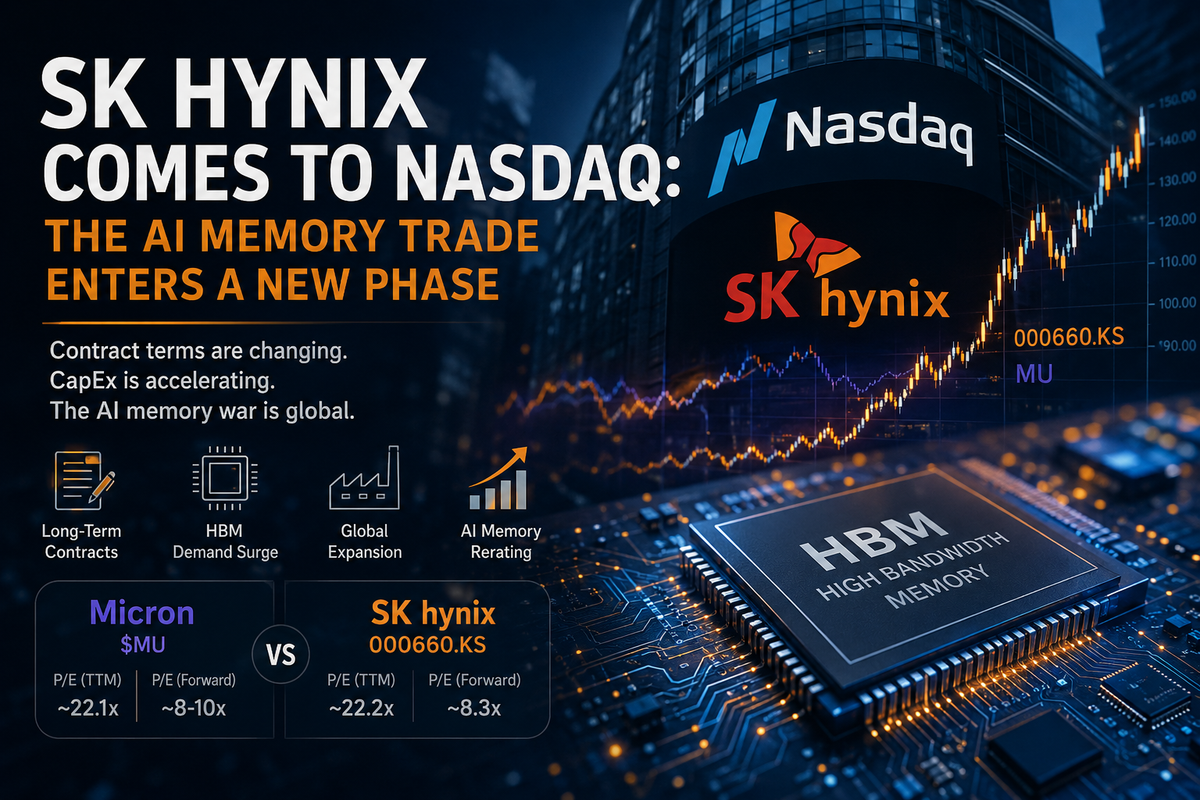
SK Hynix Comes to Nasdaq: The AI Memory Trade Enters a New Phase
SK Hynix’s planned Nasdaq ADR listing is more than a financing event. It marks a new phase for the AI memory trade, as HBM demand, long-term contract structures, global capacity expansion, and valuation rerating all converge.
1. Not Just Another Overseas Listing
SK Hynix’s planned Nasdaq ADR listing is not just another overseas share sale.
It is a signal that the AI memory trade is moving deeper into the center of global equity markets.
According to Reuters, SK Hynix launched a U.S. share sale to raise about 43 trillion won, or roughly $28 billion, through American Depositary Receipts on Nasdaq. The company plans to sell 17.79 million new shares, with 10 ADRs representing one common share.
The proceeds are expected to be used for chip factories in South Korea and semiconductor equipment, including EUV tools from ASML.
That alone would be enough to matter.
SK Hynix is one of the most important companies in the AI supply chain, especially in high-bandwidth memory, or HBM. The company is a key supplier of advanced memory chips used in AI systems by major customers such as Nvidia, Google, and other hyperscale AI infrastructure players.
But the bigger story is not simply that SK Hynix is coming to Nasdaq.
The bigger story is that memory is being repriced as AI infrastructure.
2. Memory Is No Longer Just a Commodity Cycle
For years, memory stocks were treated as deeply cyclical assets.
Investors worried about oversupply, inventory corrections, pricing collapses, and the classic boom-bust pattern in DRAM and NAND.
That framework has not disappeared. Memory is still cyclical. Pricing can still turn. Supply can still overshoot demand.
But AI has changed the balance of power.
The most important buyers in the world now need guaranteed memory supply to build AI infrastructure. Training clusters, inference systems, AI servers, and GPU platforms all depend on advanced memory availability.
That has made HBM and advanced DRAM less like commodity components and more like strategic bottleneck assets.
In the previous semiconductor cycle, memory suppliers often had to chase demand.
In this cycle, hyperscalers are chasing supply.
That is a very different market structure.
3. Contract Terms Are Starting to Change
One of the most important signals is not only in the equity market.
It is in the contract structure.
Recent market commentary and industry reports suggest that SK Hynix is changing how some long-term memory supply agreements are structured. The key point is that certain memory supply deals may no longer include traditional price caps, allowing contract prices to more fully reflect spot market spikes during shortages.
That matters because price caps protect buyers.
Removing those caps gives suppliers more upside when the market tightens.
Market commentary circulating among investors compares Micron’s Strategic Customer Agreements with SK Hynix’s newer Long-Term Agreements.
The comparison suggests:
Micron’s model still includes price floors, price ceilings, and binding volume commitments.
SK Hynix’s newer LTA structure may include no price cap, allowing pricing to better reflect spot market shortages.
SK Hynix’s agreements may also be extending from the traditional one-year term toward three-to-five-year terms.
Some reports also suggest advance payments from hyperscale customers, potentially in the form of upfront cash deposits.
These details should be treated carefully. The exact commercial terms are not fully disclosed by the companies, so they should be described as reported industry information, not confirmed contractual disclosure.
But the direction is clear:
Memory suppliers are gaining pricing power.
4. The Micron vs. SK Hynix Contrast
This is where the Micron comparison becomes important.
Micron is also one of the biggest beneficiaries of the AI memory cycle. The company has become a core U.S.-listed way to trade HBM, DRAM recovery, and AI server memory demand.
But the two companies may be positioned differently in the current contract cycle.
Micron appears to be leaning more on strategic customer agreements with defined pricing structures, including floors, ceilings, and take-or-pay provisions.
SK Hynix, according to recent industry commentary, may be moving toward more flexible long-term agreements that allow the company to participate more directly in spot price strength during shortages.
This difference matters because investors are no longer only asking:
“Who has the best HBM product?”
They are also asking:
“Who captures the economics of shortage better?”
If AI memory demand remains tight, the company with more flexible pricing may enjoy greater earnings upside.
That is why SK Hynix’s ADR listing is so important.
It gives U.S. investors a more direct way to trade not only HBM demand, but also HBM pricing power.
5. Micron Is Expanding Too
Micron is not standing still.
The company has broken ground on a major AI memory expansion in Hiroshima, Japan. The project is reportedly worth around $9.3 billion, backed by up to $3.1 billion in Japanese government support.
The facility is expected to produce next-generation HBM for AI chips, with production expected to start around summer 2028.
This confirms the broader industry message:
The AI memory trade is not a one-company story.
It is becoming a global capital expenditure race.
SK Hynix is raising capital through Nasdaq ADRs.
Micron is expanding in Japan.
Samsung is still a major force in memory and advanced semiconductor manufacturing.
ASML, Applied Materials, Lam Research, and KLA are tied to the equipment side of this capacity expansion.
And hyperscalers such as Nvidia, Google, Microsoft, Meta, and Amazon sit on the demand side.
The entire AI memory value chain is being repriced.
6. Valuation: The Gap Is Not Just About P/E
The valuation comparison between Micron and SK Hynix is more nuanced than many investors assume.
It is tempting to say that SK Hynix is much cheaper than Micron.
But on trailing earnings, the gap is not necessarily dramatic.
Micron currently trades around 22x trailing earnings, while SK Hynix also trades around 22x–23x trailing earnings, depending on the data source.
Forward multiples are much lower for both companies, reflecting expectations that earnings will rise sharply as the AI memory cycle strengthens.
Micron is commonly discussed around the high-single-digit to low-double-digit forward P/E range.
SK Hynix is also shown around the 8x forward earnings range by some market data providers.
So the story is not simply:
“SK Hynix is much cheaper than Micron.”
The better framing is:
The valuation gap is no longer just about earnings multiples. It is about access, liquidity, index inclusion, and whether U.S. investors begin to price SK Hynix as a core AI infrastructure asset rather than a Korea-listed cyclical memory stock.
That is the real ADR story.
A Nasdaq listing can reduce the accessibility discount.
It can broaden SK Hynix’s investor base.
It can make the stock easier to trade for U.S. funds, retail investors, AI infrastructure investors, and semiconductor-focused portfolios.
And over time, it may allow the market to compare SK Hynix more directly with Micron, Nvidia suppliers, and the broader U.S. AI hardware complex.
7. The New AI Memory Basket
For investors, SK Hynix’s Nasdaq listing could help create a cleaner AI memory basket.
That basket may include:
Micron for U.S.-listed memory exposure.
SK Hynix for HBM leadership and Nvidia-linked supply chain exposure.
Samsung for broader Korean semiconductor exposure.
ASML, Applied Materials, Lam Research, and KLA for semiconductor equipment and capacity expansion.
Nvidia, Google, Microsoft, Meta, and Amazon for the hyperscale demand side.
SOXL and semiconductor ETFs for leveraged or basket-style exposure to the broader semiconductor cycle.
This is why the listing matters beyond SK Hynix itself.
It gives global investors another liquid way to express a view on AI memory.
The market is no longer only trading Nvidia’s GPUs.
It is trading the entire AI infrastructure stack.
Compute.
Memory.
Networking.
Power.
Cooling.
Equipment.
Advanced packaging.
And among those, memory is becoming one of the most important bottlenecks.
8. The Key Risk: Crowded Trade, Cyclical Asset
None of this means the trade is risk-free.
SK Hynix shares have already rallied sharply.
Micron has also become one of the strongest AI hardware trades in the U.S. market.
The more obvious the AI memory story becomes, the more crowded the trade can get.
There are still real risks:
New share issuance can dilute existing shareholders.
HBM demand may remain strong, but expectations are already high.
If AI capex slows, memory stocks can reprice quickly.
If capacity additions arrive faster than expected, pricing power could weaken.
If Nvidia or hyperscaler demand expectations cool, the entire AI memory complex could come under pressure.
Memory is becoming more strategic.
But it has not stopped being cyclical.
That tension is exactly why the trade is interesting.
9. Conclusion: AI Memory Moves to the Main Stage
SK Hynix’s planned Nasdaq ADR listing is not just a financing event.
It is part of a bigger shift.
AI memory is moving from a niche semiconductor sub-theme to one of the central battlegrounds in global markets.
Contract structures are changing.
Customers are committing earlier.
Governments are subsidizing capacity.
Memory suppliers are gaining pricing power.
And global investors are looking for cleaner ways to trade the theme.
Micron has already become the main U.S.-listed AI memory stock.
Now SK Hynix is preparing to enter the same arena through Nasdaq ADRs.
The key question from here is not whether AI memory matters.
That is already clear.
The real question is whether the market will continue to value memory companies like cyclical commodity suppliers, or start valuing them more like essential AI infrastructure platforms with multi-year contracted demand.
SK Hynix’s Nasdaq listing, reported changes in long-term contract pricing, and Micron’s Japan HBM expansion all point in the same direction:
AI memory is becoming one of the most important trades in global markets.
And the trade is no longer only happening in Seoul.
It is coming to Nasdaq.
Disclaimer
This article is for informational purposes only and does not constitute financial, investment, or trading advice. Any discussion of stocks, ADRs, ETFs, valuation multiples, or market trends is based on publicly available information and market commentary at the time of writing and may change without notice.
Semiconductor and AI-related equities can be highly volatile and cyclical. Readers should conduct their own research and consult a qualified financial advisor before making any investment decisions. The author and/or affiliated entities may have exposure to, or business interests related to, some of the companies, sectors, or assets mentioned.