Stop Riding the Profit Rollercoaster: An Institutional Guide to Dynamic Trade Management and Trailing Stops
Watching floating profits turn into losses is the most agonizing experience in trading. Master institutional Trade Management by Scaling Out, moving to Break-Even, and utilizing Structural Trailing Stops to lock in gains and let your runners ride risk-free.

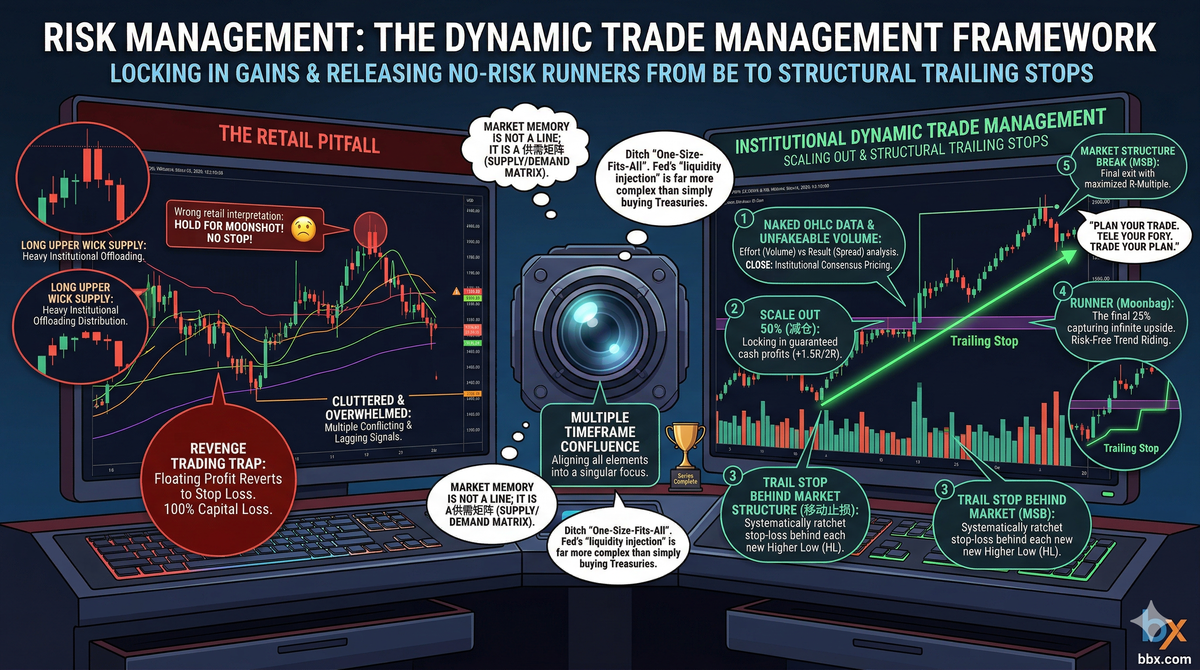
TL;DR (Core Summary): Nailing the perfect entry is only the beginning of a trade; Trade Management dictates your ultimate bottom line.Moving to Break-Even (BE): When the price moves 1R in your favor (a profit equal to your initial risk amount), your first priority is capital preservation. Move your hard stop-loss to your entry price.Scaling Out: Never attempt to exit 100% of your position at the absolute top. Secure partial profits (e.g., 50%) at your first target, leaving the remainder to capture the infinite upside of a trend.Structural Trailing Stops: Ditch rigid, percentage-based trailing stops. Utilize Market Structure to systematically trail your stop-loss just behind newly formed "Higher Lows (HL)."
Introduction: Why Do Your Floating Profits Always Turn Into Losses?
Imagine this scenario: After executing a flawless 5-step technical analysis, you buy a stock at $100 and place your hard stop at $95 (Your Risk, or 1R = $5). Exactly as you predicted, the price surges to $110 (You are now floating a 2R profit = $10). Euphoria sets in. You begin to fantasize that it will hit $150. However, the very next day, a macroeconomic shock hits the market. The price plummets in a straight line, slicing right through your $95 stop-loss.
Not only did you regurgitate your $10 profit back to the market, but you also suffered a $5 loss. This massive psychological whiplash is the leading cause of destructive Revenge Trading among retail participants.
What went wrong? You treated "paper profits" as if the cash was already in your bank account. In the institutional dictionary, until a position is closed, the floating numbers on your screen belong strictly to the market. To survive this brutal zero-sum game and actually keep the money you make, you must establish ruthless Dynamic Trade Management rules.
I. The First Line of Defense: Moving to Break-Even (BE)
The first rule of trading is survival; making money is only the second.
After you open a position, if the price rapidly moves in your anticipated direction and achieves a 1R profit (e.g., if your stop was 50 pips wide, the price is now 50 pips in profit), you must execute your first mechanical action: Move your original hard stop-loss to your exact entry price (or slightly above it to cover commissions).
- The Psychological Edge: This action is known as Moving to Break-Even (BE). Once completed, this position is officially a "Risk-Free Trade." The absolute worst-case scenario is now a scratch (zero loss). Your psychological stress instantly drops to zero, allowing you to observe the subsequent price action with ice-cold objectivity.
II. Securing the Victory: Scaling Out
The greatest delusion among retail traders is the obsession with selling 100% of their shares at the exact, absolute peak. Statistically, this is impossible. Elite traders utilize a Scaling Out strategy—selling into strength.
The Classic Institutional 1-2-3 Scaling Model:
- Target 1 (Typically at 1.5R, 2R, or the first major Resistance Zone): When the price reaches this level, close 50% of your position.
- The Logic: You have now recouped your initial risk amount in cold, hard cash. Paired with your Break-Even stop, this trade is not only risk-free, but it is now mathematically guaranteed to be profitable regardless of what happens next.
- Target 2 (A macro resistance level, e.g., 3R or 4R): When the price hits this zone, close 50% of your remaining position (which equals 25% of your total initial size).
- The "Runner" (Moonbag): You are now holding the final 25% of your position. Do not set a fixed take-profit target for this piece! As long as the macro trend is intact, grip it tightly. In trading, the legendary 10R or 20R windfall profits are almost entirely generated by these "runners" riding parabolic trends to their absolute extremes.
III. Letting Profits Run: The Structural Trailing Stop
So, how exactly do we manage that final "Runner" position? This is where we deploy the ultimate weapon we learned in the Market Structure lesson.
Do not use the lazy "fixed point/percentage" trailing stop feature built into retail trading platforms. Normal market volatility will effortlessly chop you out. A true trailing stop must be dynamically anchored to objective candlestick structure.
The Structural Trailing Stop Rule:
- In a healthy uptrend, the price will continuously print Higher Highs (HH) and Higher Lows (HL).
- Every time the price breaks a previous HH and confirms a brand new Higher Low (HL), you treat it like climbing a staircase: Manually move your stop-loss order up, placing it just below this newly minted HL.
- As long as the "staircase" market structure remains intact, your stop-loss will continuously ratchet upward, locking in a larger and larger portion of your open profits.
- Eventually, the market will experience a Market Structure Break (MSB), breaching the final HL. Your trailing stop will be triggered, and you will calmly exit the market with massive, fully realized gains.
Conclusion: Making Trading "Boring" and Safe
Think back to your past trades: Staring obsessively at the screen, refusing to sell when it's up, panicking when it drops, and spending your entire day agonizing between fear and greed.
Now, imagine hardcoding these three rules into your Execution SOP: "Move to BE at 1R," "Scale out 50% at Target 1," and "Trail stop behind Market Structure." You will suddenly find that trading becomes incredibly relaxing—even "boring."
You have pre-planned every possible contingency. Wherever the market goes, you simply execute the corresponding protocol. You no longer need to guess where the top is; you simply follow the structural footprints, methodically locking your profits in a vault step-by-step. Accept uncertainty, manage the risk relentlessly, and the profits will inevitably take care of themselves.
Disclaimer: This report is for informational purposes only and does not constitute financial advice.