The $1 Trillion Manifesto: NVIDIA’s GTC "Super Bowl" and the Looming Institutional Sell-Off
NVIDIA’s GTC manifesto eyes $1T in revenue by 2027, but a $100B institutional sell-off and supply chain limits provide a stark reality check. Explore the shift to AI utilities, the impact of falling oil in the Strait of Hormuz, and the looming deleveraging event in our 3/17 Market Watch.

Date: March 17, 2026 Market Sentiment: Cautious Optimism vs. Structural Volatility
The King’s Proclamation: NVIDIA’s Shift to "AI Utility"
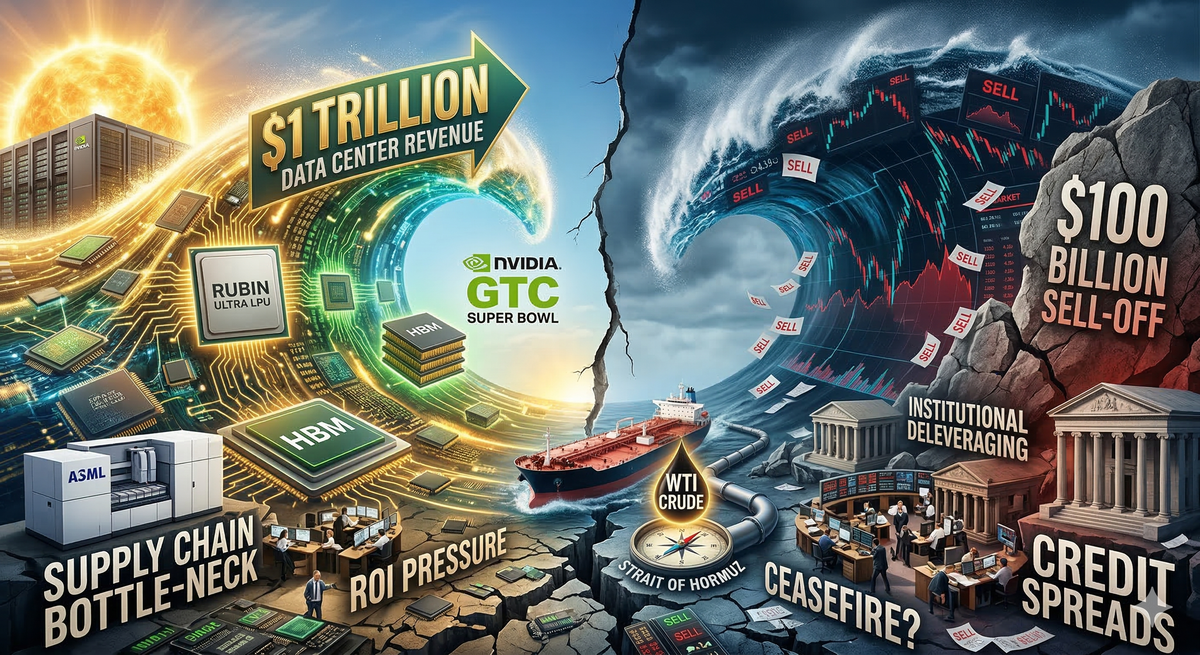
At this year's GTC conference—often dubbed the "Super Bowl of AI"—Jensen Huang delivered a bombshell: a roadmap to hit $1 trillion in data center revenue between 2025 and 2027. This isn't just about selling chips anymore; it’s a total pivot toward becoming the "water and power company" of the AI era.
Key Technical Takeaways:
- The Roadmap: Following the Blackwell (GB200) series, NVIDIA introduced the Rubin Ultra and the Vera architecture prototype, maintaining a 2-to-3-year lead over competitors.
- The LPU Revolution: A new Language Processing Unit (LPU) designed for inference is reportedly 10x faster than the H100 with sub-0.1s latency. OpenAI has already signed on as a primary customer.
- The Ecosystem Lock-in: By collaborating with Intel (CPU-GPU orchestration), Cisco (Ethernet deployment), and Nokia (6G/AI-RAN), NVIDIA is building a "full-stack" moat that makes switching costs nearly insurmountable for developers.
The Reality Check: Supply Chains and Physical Limits
Despite the visionary rhetoric, the market reacted with a "sell the news" pullback. Why the hesitation?
- Lithography Bottlenecks: The global production of high-end lithography machines (ASML) is capped at roughly 70–100 units per year. Building a single massive AI data center requires 3.5 of these machines, effectively hard-capping NVIDIA’s growth speed.
- Memory Constraints: By 2026, an estimated 30% of AI capital expenditure will shift toward HBM (High Bandwidth Memory), potentially cannibalizing the budget for logic chips.
- The ROI Question: Tech giants like Amazon have seen capital expenditures soar to $100 billion. Analysts are now scrutinizing whether AI applications can generate enough revenue to justify this massive infrastructure spend.
Macro Watch: Energy, Geopolitics, and the "Escort Mission"
The energy sector provided a relief valve for the broader market today. WTI crude fell over 4%, dipping toward the $80 level.
- The Iran Factor: The U.S. Treasury has signaled a "tacit approval" for Iranian tankers to move through the Strait of Hormuz to prevent a global supply shock.
- Coalition Forces: Plans are underway for a multi-nation maritime alliance—including Japan and the UK—to secure shipping lanes, though NATO remains hesitant to get formally involved.
- Expert Outlook: Some analysts predict a 60% chance of a ceasefire within two weeks, suggesting that oil prices could "drop like a rolling stone" once hostilities cease.
Institutional Warning: The $100 Billion Sell-Off
While retail sentiment remains fixated on AI headlines, Goldman Sachs and other institutional desks are waving a red flag regarding systemic deleveraging.
- CTA Liquidation: Trend-following strategies (CTAs) have already dumped $50 billion in global equities over the past week.
- Future Pressure: Data suggests an additional $70 billion to $100 billion in sell-side pressure remains to be released over the next month.
- Technical Levels: If geopolitical risks escalate or credit markets tighten, the S&P 500 could see a further 5-6% correction, testing the 6,300 support level.
The Bottom Line
NVIDIA’s $1 trillion target is a long-term reality, not a bubble, but the path there is blocked by physical supply constraints and institutional profit-taking. For investors, the next few weeks will be a "stress test" of the AI industrial revolution.
Watch the oil prices and credit spreads—they will tell you when the bottom is truly in.
Disclaimer: This article is for informational purposes only and does not constitute financial advice. The stock market involves significant risk.