The Four Deadly Transmission Chains of a Geopolitical Shock
Geopolitical shocks do not remain regional for long. They move through oil, logistics, inflation, and financial conditions—until every market is forced to reprice. The current crisis is not just a war story. It is a transmission-chain story.

For a while, investors treated the latest Middle East escalation as a headline risk—dangerous, dramatic, but ultimately containable. That is the wrong framework.
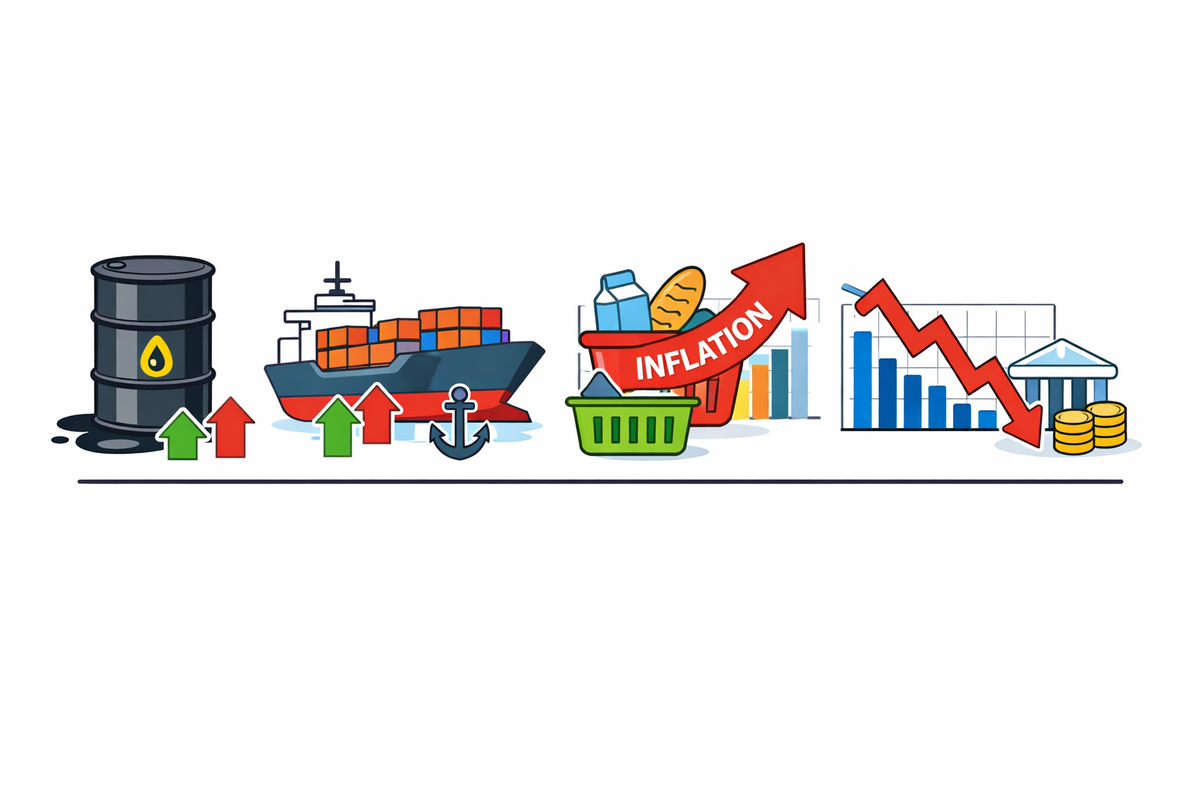
What markets are confronting is not a single event, but a multi-channel macro transmission shock. The most useful way to understand it is through four deadly chains: energy, logistics, inflation, and risk pricing. Once those four channels begin to reinforce one another, the story stops being “regional conflict” and becomes a global asset-pricing problem. That is the real message behind the current crisis.
The reason this matters is simple. The Strait of Hormuz is not just another shipping route. The IEA says that in 2025, about 20 million barrels per day of crude oil and oil products moved through it, equal to roughly 25% of the world’s seaborne oil trade, while the EIA similarly estimates flows around 20% of global petroleum liquids consumption. Alternative routes exist, but the IEA says bypass capacity is only about 3.5 to 5.5 million barrels per day, which means rerouting cannot fully offset a serious disruption.
That is why the first transmission chain is the most obvious one: oil.
When a strategic chokepoint is impaired, the initial reaction is not subtle. Brent surged back toward and above the $100 level, briefly touching $119.50 earlier this week, according to Reuters, while Goldman Sachs raised its March average Brent forecast to above $100. The IEA called the current disruption the largest oil supply disruption in history, estimating that global supply in March could fall by 8 million barrels per day, even after emergency policy responses.
But the oil story is not just about the commodity price. It is about what higher oil does next.
That brings us to the second chain: shipping and logistics.
Even before the physical supply picture is fully known, risk perception itself can function like a blockade. Reuters reports that marine war-risk premiums surged sharply, with some hull coverage jumping from around 0.25% to 3% of vessel value in a week, implying roughly $7.5 million of insurance cost on a typical tanker worth $200 million to $300 million. Earlier reports also showed war-risk premiums rising from around 0.2% to as high as 1% in just days, while insurers began cancelling coverage and commercial vessels were stranded or rerouted. That means the cost of energy does not merely rise at the source; it compounds through transport, insurance, and delay.
This is where many investors underestimate the problem. They think, “Oil up hurts consumers.” True, but incomplete. A shipping shock also hits aviation, chemicals, manufacturing, and trade finance. Reuters reports airlines are already raising fares and reworking networks as jet fuel surges; Air France-KLM alone said it would increase long-haul economy fares by 50 euros round-trip, while some routes in Asia saw extreme fare spikes as fuel and routing stress intensified.
The third chain is where the macro damage becomes more persistent: inflation.
The IMF has offered a blunt rule of thumb: if oil prices rise 10% and stay elevated through most of the year, that can add roughly 40 basis points to global headline inflation and cut global output by 0.1% to 0.2%. This is exactly why an energy shock is so dangerous late in the inflation cycle. It doesn’t have to be large enough to cause a global recession on its own. It only has to be large enough to keep inflation sticky while simultaneously weakening demand. That is the classic stagflation trap.
And once inflation expectations become unstable, the fourth chain activates: financial conditions and risk pricing.
Markets then have to reprice not just commodities, but the entire future path of policy rates, earnings multiples, credit spreads, and growth assumptions. Reuters noted that investors are increasingly discussing a return to a 1970s-style stagflation setup. In Europe, a Reuters poll of economists found inflation risks rising enough that markets began pricing possible ECB tightening later this year, even as baseline growth remains soft. In the United States and globally, the pattern is familiar: energy up, yields volatile, cyclicals wobble, long-duration assets lose support, and central banks are denied the flexibility that markets had hoped for.
This is the real reason geopolitical shocks matter far beyond energy stocks.
They reshape the discount rate.
If investors believe a conflict is temporary, markets can absorb it. If they conclude the shock will feed into inflation, delay rate cuts, and compress margins across transport, industry, and consumption, then valuation support weakens quickly. That is why these events often begin as commodity moves and end as broader equity corrections. Reuters reported that when the conflict intensified, Wall Street initially slumped as oil jumped and stagflation fears resurfaced, before intermittent hopes of de-escalation produced sharp reversals. In other words, markets are not confused; they are toggling between two competing macro regimes: brief disruption versus prolonged inflationary stress.
There is another point that deserves more attention: policy responses can cushion, but not fully neutralize, a transmission shock.
The IEA has announced a 400 million barrel emergency stock release, the largest in its history, and governments are studying shipping and energy contingency measures. That matters. But strategic reserves buy time; they do not repeal geopolitics. Nor do they instantly repair insurance markets, restore risk appetite, or bring down the embedded geopolitical premium in freight and fuel. If the market starts to believe that disruption will recur even after any near-term reopening, then part of the premium becomes structural rather than temporary.
So how should serious investors think about this?
First, stop framing it as a binary question—war or peace. That is too simplistic. The more relevant question is: how much of the transmission mechanism is already embedded? Once oil, logistics, inflation expectations, and financial conditions all move in sequence, the damage can persist even after the headlines cool.
Second, distinguish between headline volatility and macro persistence. Oil can pull back sharply on any ceasefire rumor. Equities can bounce on one reassuring statement from policymakers. But if insurers remain cautious, airlines continue repricing, and central banks remain constrained, then the aftershocks outlive the news cycle.
Third, understand what tends to underperform in this regime: long-duration growth, fuel-sensitive transport, margin-thin cyclicals, and any business model that relies on cheap global logistics or imminent monetary easing. By contrast, relative resilience tends to show up in energy producers, select commodity-linked cash-flow assets, and businesses with pricing power strong enough to pass through cost shocks. That last point is not ideology. It is simple operating leverage math in an inflationary supply shock. The market may still rally tactically, but the burden of proof shifts.
The biggest mistake now is to dismiss this as temporary noise because markets have become desensitized to geopolitical headlines. Investors have learned, often correctly, that many geopolitical spikes fade. But that heuristic fails when a conflict strikes a core energy chokepoint and then spills into shipping, inflation, and rates.
That is when a “regional event” becomes a global macro event.
And that is why the current crisis should not be read as a one-line story about war. It should be read as a map of transmission chains. Oil is the spark. Shipping is the amplifier. Inflation is the policy problem. Financial conditions are the final destination.
When all four chains are active at once, markets are no longer trading news. They are repricing reality.