The Invisible Drain on Your Trading System: Deconstructing the Fatal Mechanics of Overtrading and Revenge Exposure
Why is your account bleeding despite a solid win rate? We deconstruct the frictional costs of "Overtrading" and the death spiral of "Revenge Trading" (Tilt) through behavioral finance, teaching you how to build institutional-grade circuit breakers.

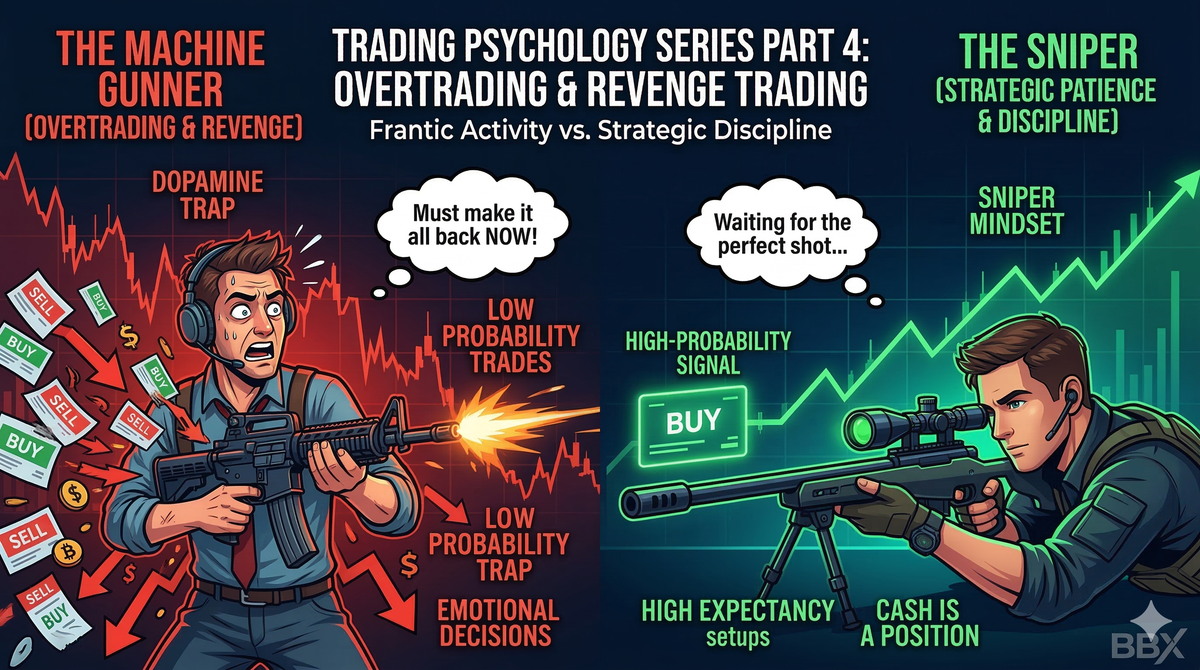
TL;DR (Core Summary): In the arena of financial trading, the belief that "hard work pays off" is a fatal cognitive trap. Trading frequency and account equity often share a strong negative correlation.Overtrading: At its core, this is a Dopamine-driven behavioral bias. Driven by the need to "feel involved," traders force their way into Negative Expected Value (Negative EV) setups, only to have their capital slowly devoured by Frictional Costs.Revenge Trading: Borrowing from professional poker terminology, this is known as going on "Tilt." After suffering an unexpected loss or a string of stop-outs, the brain's amygdala hijacks logic. Traders abandon all Risk Parameters, attempting to "make it all back in one trade" via heavy sizing—the absolute fastest route to a blown account.Institutional Restructuring: True Alpha is generated through waiting. Establishing the mindset that "Cash is a strategic position" and enforcing a hard Daily Loss Limit (DLL) circuit breaker are the mandatory steps to crossing the chasm from amateur to professional.
Introduction: Shattering the Retail Illusion of "Hustle Culture"
In the traditional industrial era and corporate management, the underlying logic is deeply ingrained: "Labor hours equal output value." Writing one more line of code or making one more sales call typically translates to higher returns.
However, dragging this "hustle culture" mentality into the capital markets is a recipe for disaster. Many retail traders feel a profound sense of guilt—a feeling of "wasting time"—if they haven't put on a position for the day. They stare at the screens for hours on end, attempting to catch every single tick and candlestick fluctuation.
The brutal statistical truth is this: The financial market is not an ATM that pays you an hourly wage. When there are no High-Probability Setups that align with your trading system, every forced pull of the trigger does not generate positive returns; it merely actively increases your account's Risk Exposure.
I. Frequency Out of Control (Overtrading): The Dopamine-Hijacked "EV Destroyer"
Overtrading may masquerade as diligence, but its underlying driver has nothing to do with executing a strategy—it is purely about satisfying neurotransmitter cravings for stimulation.
- The Dopamine Addiction Loop: The exact moment a trader hits the "Buy Market" button, the brain's reward center floods with dopamine, generating a powerful anticipation of potential profits. This thrill of "being in the casino" is highly addictive. To maintain this high, traders continuously lower their entry criteria, degrading a rigorous trading system into blind, coin-flip gambling.
- The Ignored "Frictional Costs": Even if your strategy possesses a slight statistical edge, high-frequency, meaningless trades act as an invisible vacuum for your capital.
- Explicit Costs: The compounding drag of Commissions and Spreads on every single transaction.
- Implicit Costs: The hidden tax of Slippage on rapid entries and exits, coupled with the severe depletion of your mental focus.
- Self-Dilution of Win Rate: Suppose your core trading system only generates 3 Positive EV signals per week. If you force 20 trades just to "stay busy," those additional 17 Sub-optimal Trades will bring a dismal win rate and a terrible risk/reward ratio, completely wiping out the profits generated by your 3 core setups.
II. The "Tilt" State and Revenge Trading: The Death Spiral of Emotional Exposure
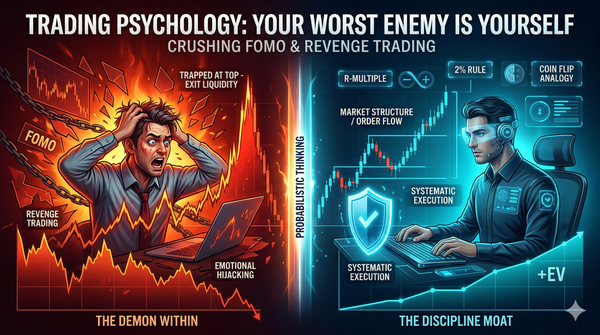
If overtrading is a dull knife slowly bleeding your account dry, revenge trading is a lethal dose of poison. In professional quantitative trading and high-stakes poker circles, this total psychological collapse is referred to as Tilt.
- The Trigger Mechanism: Bruised Ego and Loss Aversion Revenge trading typically erupts after a supposedly "sure-thing" trade gets stopped out, or after enduring a frustrating losing streak. At this point, the trader's Cognitive Dissonance peaks. The brain misinterprets a normal "probabilistic drawdown" as a deliberate, personal attack by the market.
- The Total Collapse of Risk Parameters: Desperate to immediately fill the hole in their P&L and soothe their bruised ego, the trader completely discards the "1% Fixed Risk Model" we mastered in the previous chapter. They will:
- Aggressively initiate a Reversing Position at the exact same price level.
- Blindly crank up their Leverage Ratio in a frantic bid to "make it back in one shot."
- Outright delete their Hard Stop-Loss Orders.
- The Fatal Consequence: At this stage, the trade is entirely divorced from fundamental or technical logic; it has degenerated into pure Emotional Catharsis. This massive risk exposure, taken under a state of extreme irrationality, is the direct catalyst for over 90% of Account Blowouts.
III. Institutional Intervention: Reconstructing the "Sniper" Model and Absolute Discipline
Professional traders survive in this ruthless zero-sum game over the long term not because they possess magical forecasting abilities, but because they have built defense mechanisms designed to physically short-circuit human biological weaknesses.
1. Strategic Redefinition: "Cash is a Position"
This is the ultimate watershed separating amateurs from professionals. You must hardwire this concept into your psyche: When market trends are chaotic, volatility is compressing, or system signals are absent, holding a 100% Cash Position is the absolute optimal trading strategy. Actively passing on subpar setups and protecting your capital from unnecessary attrition is, in itself, generating outsized returns.
2. Forging the "Sniper Mindset"
Discard the aimless "spray and pray" tactic of the machine gunner and cultivate the extreme patience of a sniper. Establish draconian Entry Filters, capping your weekly or even monthly trade frequency to a very low threshold. When you acutely realize your "ammunition" is strictly limited, you will automatically tune out the ambiguous market noise. You will only pull the trigger when the win rate and risk/reward ratio present an overwhelming Asymmetric Edge.
3. Establishing Hard Circuit Breakers
Willpower alone is entirely useless against a violent physiological urge like "Tilt." You must implement objective Physical Isolation Rules:
- Daily Loss Limit (DLL): Explicitly define the maximum allowable drawdown for your account in a single day (e.g., 2% of total capital). The absolute second this red line is breached, you must force-close your trading terminal and physically disconnect from the internet.
- The Consecutive Loss Breaker: If you suffer 3 consecutive stop-outs—regardless of whether you've hit your DLL—you must enforce a mandatory 24-hour trading ban. Flush the gambler's adrenaline out of your system, and re-evaluate the market structure with a clear head the next day.
Conclusion
In the brutal ecosystem of capital markets, "Less is More" is an ironclad law.
Exceptional trading performance is usually the byproduct of 99% agonizingly boring, patient waiting, followed by 1% emotionless, decisive execution. Eradicate dopamine-driven overtrading, and strangle emotion-fueled revenge exposure in its crib. Only when you learn to control your hands like a machine—and comfortably sit on the sidelines when you lack an edge—will you have truly crossed the threshold into professional trading.
Disclaimer: This report is for informational purposes only and does not constitute financial advice.