The Productivity Leap: Why Cathie Wood Believes We Are on the Verge of a Wealth Explosion
Cathie Wood signals a "Productivity Leap": US GDP grew 2.2% in 2025 despite stagnant employment. This suggests AI is driving a structural shift, jumping productivity from 2% to 5%. From Robotaxis to 10x asset efficiency, we are at the inflection point of an AI-led wealth explosion.

In the fog of the macroeconomy, we are often distracted by noise: tariff panics, geopolitical tensions, and government shutdowns. However, if you peel back these layers and observe the subtle shifts in underlying data, a startling conclusion emerges.
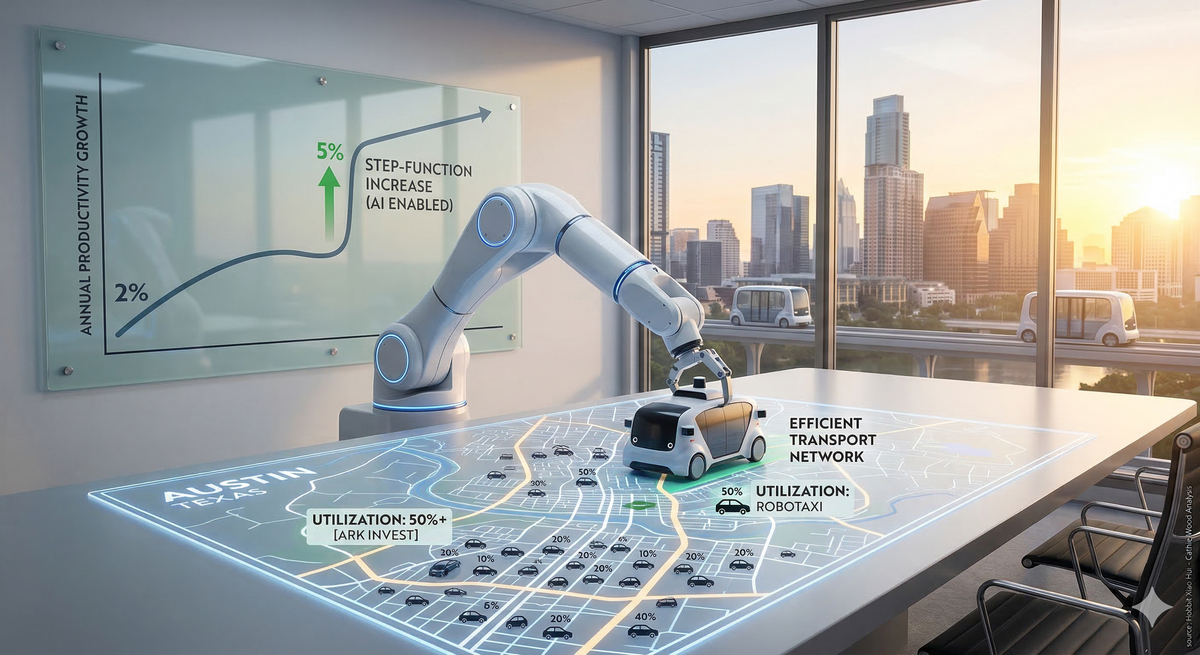
Cathie Wood, founder of ARK Invest, pointed out in her latest market share: U.S. productivity growth is preparing to jump from an average of 2% per year to 5%. This is not just a numerical tick; it is a structural inflection point powerful enough to silence those questioning the ROI of AI.
1. Vanishing Jobs vs. Growing GDP: The Truth Behind the Data
A bizarre phenomenon occurred in the 2025 U.S. employment data.
According to initial government statistics, the job market appeared robust. But after repeated downward revisions, the truth surfaced:
- In 2025, the U.S. added only 181,000 jobs for the entire year.
- This means an average of only 15,000 jobs per month—far below the 150,000 to 200,000 needed just to keep pace with population growth.
Yet, while employment nearly stagnated, the U.S. GDP still grew by 2.2% for the year.
Fewer people are working, but they are doing more, and the output is wealthier. Cathie Wood believes there is only one explanation for this contradiction: a massive surge in employee efficiency. This "step-function increase in productivity" is proof that AI is finally leaving its mark on macro data.
2. Robotaxi: The Asset Efficiency Revolution from 5% to 50%
To help us visualize this productivity revolution, Wood uses the automotive industry as a benchmark.
Traditional analysts argue that car sales haven't returned to 2021 peaks because demand hasn't saturated. Wood argues this framework is obsolete:
- The Inefficiency of Private Cars: A typical car sits idle in a garage 95% of the time, with a utilization rate of only 4%–5%.
- The Robotaxi Revolution: Autonomous taxis operate around the clock, with utilization rates reaching 50% or higher—ten times that of a private car.
According to ARK’s research, just 200,000 Robotaxis could satisfy the entire transportation demand of downtown Austin, which currently houses millions of private cars. By 2035, the cost per mile for autonomous travel is expected to drop to $0.25, roughly 11 times cheaper than owning and operating a private car.
The essence of this revolution isn't about manufacturing more things; it’s about using software to make existing assets exponentially more productive.
3. AI Investment is a Business Decision, Not a Gamble
Currently, global tech giants are pouring $500 billion to $700 billion into AI infrastructure.
While many fear a "Dot-com Bubble 2.0," Wood counters that these investments are calculated business decisions made by the world's smartest capital allocators—Google, Amazon, Microsoft—after rigorous internal testing and ROI projections.
The lesson from the 90s wasn't that the internet was useless, but that valuations were too high and the timing was too early. Today, AI is already generating real commercial value. The gap between shrinking employment numbers and steady output is the smoking gun that AI is making the workforce more effective.
Conclusion: The Inflection Point is Here
The ROI on AI is not linear. It involves a massive input phase, a waiting period where returns are invisible, and finally, an explosive surge in gains.
Despite the "Wall of Worry" facing the market, the underlying transformation in productivity is providing the market with the "courage" to ignore the noise and continue reaching new highs.
If you understand this logic, you realize that the real productivity revolution has only just begun.