The Wall Street Earnings Season Survival Guide: Decoding 10-Ks, 10-Qs, and Earnings Calls
Why do stocks crash even after reporting record profits? Uncover the hidden rules of Wall Street's Earnings Season. Learn the difference between 10-K and 10-Q SEC filings, how to read the MD&A, and why "Forward Guidance" is the ultimate stock mover on bbx.com.

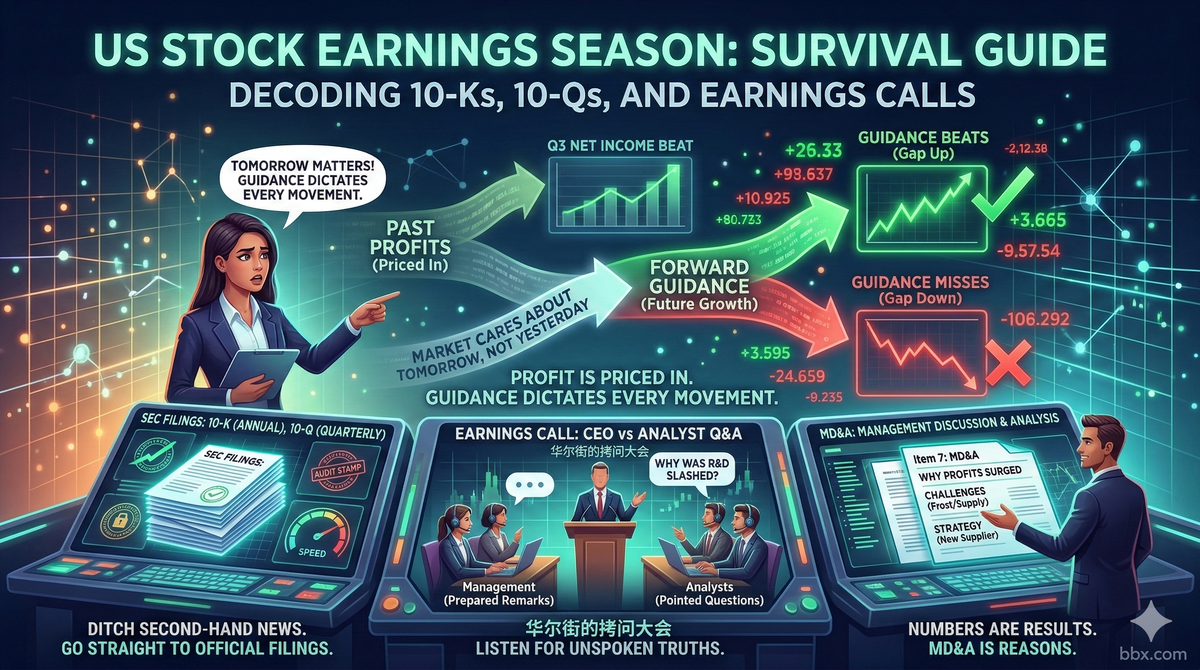
TL;DR (Quick Answer): Trading on Wall Street using second-hand news alerts is a recipe for disaster. To survive Earnings Season, you must learn to read the official filings submitted to the SEC (Securities and Exchange Commission):10-K (Annual) vs. 10-Q (Quarterly): The 10-K is a company's comprehensive, audited annual physical exam. The 10-Q is the unaudited, fast-tracked quarterly blood pressure check.MD&A (Management's Discussion and Analysis): The most valuable text in any earnings report. Don't just look at the raw numbers; this is where management officially explains why they made or lost money.The Earnings Call: The live battlefield where Wall Street analysts grill the CEO and CFO to uncover hidden red flags not mentioned in the press release.Forward Guidance: The single most important factor that decides if a stock skyrockets or crashes on earnings day. The market doesn't care how much money you made yesterday; it only cares how much you will make tomorrow.
Introduction: Welcome to Wall Street's "Earnings Season"
The US stock market operates on a highly volatile, adrenaline-pumping cycle known as Earnings Season. Typically kicking off in the middle of the first month of every quarter (January, April, July, and October), publicly traded companies release their financial report cards for the previous three months.
In the days surrounding an earnings release, a stock's implied volatility explodes. It is incredibly common to see a stock gap up 15% or get cut in half overnight. To seize opportunities and avoid blowing up your account during this period, you must master Wall Street's three primary intelligence weapons: Official SEC Filings, Management's Narrative, and the Live Earnings Call.
Weapon 1: Ditch Second-Hand News, Go Straight to the 10-K and 10-Q
Many novice retail investors rely on 50-word push notifications from financial apps (e.g., "Apple Q3 Revenue Beats Estimates") and blindly hit the buy button. This is extremely dangerous. News headlines are designed to generate clicks; they often highlight the good, bury the bad, and omit lethal details.
Where should you go for the unvarnished truth? The company's Investor Relations (IR) webpage or the SEC's EDGAR database.
You need to familiarize yourself with two crucial ticker codes:
- The 10-K (Annual Report): Filed once a year, this is the most hardcore, comprehensive document available. It includes the "Big Three" financial statements we learned about, a deep dive into the business model, every single potential "Risk Factor," and executive compensation. Crucially, the 10-K must be strictly audited by an independent third-party accounting firm, making fraud exceedingly difficult. Think of it as the company's annual, full-body MRI.
- The 10-Q (Quarterly Report): Filed at the end of the first three quarters. It is significantly shorter than the 10-K and focuses on providing updated financial data. Note: The 10-Q is typically Unaudited. It prioritizes speed over exhaustive detail. Think of it as a routine quarterly check-up.
Weapon 2: The MD&A — Decoding Management's "Flexes" and "Excuses"
Opening a 10-K that spans hundreds of pages of dense English and endless data tables is intimidating. Beginners often don't know where to start.
The BBX Pro Hack: Go straight to the table of contents and click on Item 7: Management’s Discussion and Analysis of Financial Condition and Results of Operations (MD&A). This is the absolute goldmine of the entire report and should be read word-for-word.
- The Lemonade Stand Analogy: Let's say your financial statements show that your Gross Margin plummeted from 60% to 30% this year. Looking purely at the numbers, investors would panic and sell. But in the MD&A, you (the CEO) provide the context: "Gross margins contracted primarily due to a rare frost that doubled the wholesale price of lemons. However, our overall sales volume grew by 20%, and we have just secured a new, low-cost supplier for the next five years."
- The Core Value: Financial numbers are cold "Results"; the MD&A provides the "Reasons" behind those results. Here, management explains the drivers of revenue growth, supply chain bottlenecks, foreign exchange headwinds, and future strategic shifts. A skilled investor reads between the lines to determine if management is taking accountability for poor performance or simply blaming the macroeconomic environment.
Weapon 3: The Earnings Call and the Ultimate Catalyst: "Guidance"
After the press release drops, the real drama begins. Usually, within a few hours of publishing the numbers, the company hosts a live, globally broadcast Earnings Call.
This is the closest retail investors will ever get to the top minds on Wall Street. The call is split into two halves:
- Prepared Remarks: The CEO and CFO read from a script, highlighting the quarter's victories and painting a rosy picture of the future.
- The Q&A Session: This is where the magic happens! Senior analysts from elite investment banks (like Goldman Sachs or Morgan Stanley) take turns asking questions. Their questions are often pointed and aggressive (e.g., "You mentioned a delay in shipping your new flagship product. Is this truly a supply chain issue, or are you failing to resolve core engineering flaws?"). By listening to the Q&A, you immediately discover exactly what institutional money is worried about.
The Ultimate Secret: Forward Guidance Dictates Everything
Novice traders often scream in frustration: "This company just announced that net income surged by 50%! Why did the stock instantly crash 20% on the open?!"
The answer boils down to two words: Expectations and Guidance. The stock market is a forward-looking discounting mechanism. How much money a company made last quarter is already reflected in yesterday's stock price (Wall Street calls this being "Priced In"). Institutional investors only care about how much money you will make next quarter.
- What is Guidance? During the press release or earnings call, management issues a forecast for the upcoming quarter or fiscal year (e.g., "We expect Q4 revenue to be in the range of $1.0 billion to $1.1 billion").
- The Truth Behind the Crash: If a company crushes its Q3 earnings (the past is great), but management issues Negative Guidance stating that macroeconomic headwinds will cause Q4 revenue to drop sharply (the future is bleak), Wall Street will hit the sell button without hesitation. On earnings day, Forward Guidance holds absolute veto power over the stock price!
Interactive Case Study: You Be the Portfolio Manager
Imagine today is the earnings day for BBX Tech Corp. You receive the following three pieces of core intelligence:
- Last Quarter's Results: Revenue hit $5.0 Billion, Net Income hit $1.0 Billion. (A massive beat on both top and bottom lines compared to Wall Street estimates).
- MD&A Detail: Management notes that the surge in net income was primarily driven by a 20% slash in Research & Development (R&D) expenses, not by explosive sales of their core product.
- Q4 Forward Guidance: Due to a major client canceling orders, management expects next quarter's revenue to be only $3.5 Billion. (Severely missing Wall Street's expectation of $4.5 Billion).
Question: After this earnings report drops, will BBX Tech Corp's stock skyrocket or crash?
[BBX Expert Analysis]: It will absolutely crash—and crash hard! While their past report card (revenue and profit) looks stunning, it is a dangerous illusion of "borrowing from the future" (slashing R&D boosts short-term profits but destroys long-term competitiveness). More fatally, their Forward Guidance completely bombed, instantly destroying Wall Street's future valuation models for the company. Always remember: Earnings play the future. If guidance is poor, past glory is just worthless paper!
Disclaimer: This report is for informational purposes only and does not constitute financial advice.