Whale Watch: "Asymmetric Master" in the Death Corner — The $5.4M HFT Short Squeeze Trap
Whale Watch: The "Asymmetric Master" is in the Death Corner! 🚨 An HFT whale with $2.82M equity is suffocating under a $5.4M short with only 0.88% margin left.

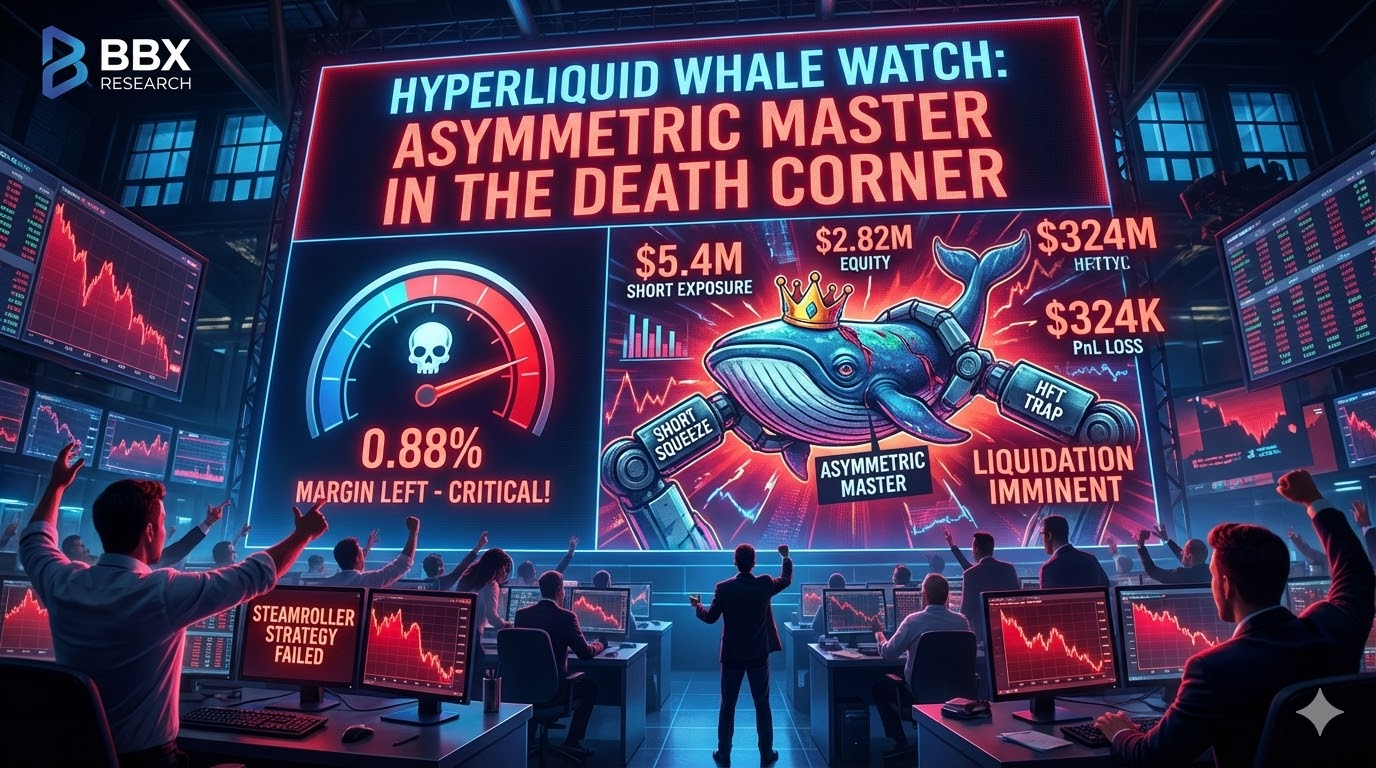
Alpha Signals Report: BBX Research has flagged a critical "Liquidity Exhaustion" event involving whale address 0x3fc5...c0c1. Despite a $2.82M total equity, this "Asymmetric Master" has fallen into the Account Isolation Trap. With $2.06M locked in Spot, the Perpetual (Perp) account is suffocating under a $5.43M short position with a lethal 0.88% Free Margin ($6,658). BBX Data API analysis reveals a High-Frequency Trading (HFT) model failing to mean-revert, turning a high-win-rate algorithm into a prime target for an institutional Short Squeeze.1. Balance Sheet Anatomy: Wealth on a Tightrope
Unlike retail gamblers, the asset structure of 0x3fc5 suggests an institutional-grade Delta Neutral or Spot-Perp Arbitrage model gone wrong. The BBX Data API highlights a massive structural imbalance:
- Spot-Perp Isolation: Over $2.06 million sits safely in the Spot wallet, while the high-stakes Perp arena is left with only $759k in equity.
- Aggressive Exposure: Using that $759k, the whale has levered up to a $5.43M notional short, pushing effective Perp leverage to a dangerous 7.15x.
- The HFT Engine: With 25,580 closed trades in a single week and an 81.25% win rate, this is a classic "Steamroller Strategy"—picking up pennies until a unilateral trend breaks the algorithm.
2. The Fatal Achilles' Heel: The 0.88% Margin Trap
The ultimate nightmare for a quantitative volatility strategy is a market that refuses to mean-revert. The BBX terminal shows a cliff-dive 1-Week PnL of -$324,081.68, with a Max Drawdown spiking to 40.43%.
The Dead Zone
- 🚨 Free Margin Available: $6,658.35 (0.88%)
- The Reality: The liquid cash required to sustain this $5.43M short formation has dwindled to less than $7,000.
- The Risk: Even a micro-pump in price will vaporize this buffer. At this stage, the whale has surrendered all agency to the exchange's Liquidation Engine.
3. Market Mechanics: The "Account Isolation" Trap
Why doesn't the whale move the $2M Spot to save the Perp? BBX Research identifies two core reasons:
- Liquidity Lock: The $2.06M in Spot may be staked or tied in DeFi contracts, making it impossible to transfer in the millisecond timeframe required to halt a liquidation.
- Liquidity Hunting: A short account with <1% margin is a "blood in the water" signal for Market Makers. Institutional HFTs can detect this fragility and engineer a Short Squeeze—deliberately pushing prices up to trigger forced buy-ins of that $5.4M short to fuel a parabolic move.
4. Strategy Alpha: Lessons from the Dark Forest
The "Asymmetric Master's" current distress provides a priceless survival guide for the 2026 market:
- The Win-Rate Illusion: An 81.25% win rate means nothing if a single trend breakout can incinerate all accumulated profits.
- Liquidity is King: Never allow derivative Free Margin to drop below 20%. When it hits 0.88%, you are no longer a trader; you are Exit Liquidity.
- Hedge the Hedge: Ensure that your "Safe" capital (Spot) is instantly accessible to your "Risk" capital (Perp) to avoid being picked off by snipers.
🛡️ FAQ: HFT Failures & Liquidation Dynamics
Q1: What is a "Steamroller Strategy" in HFT? A: It refers to strategies (like Grid Trading) that perform exceptionally well in ranging markets but face catastrophic "wipeout risk" during a strong unilateral trend. The trader "picks up pennies" until the "steamroller" (the trend) runs them over.
Q2: How does BBX identify "Account Isolation"? A: By utilizing the BBX Open API, we aggregate a single ENS or wallet's holdings across Spot, Perp, and Staking sub-accounts. When we see a massive Delta imbalance between sub-accounts, it flags a structural risk.
Q3: Can a $5.4M short liquidation cause a market-wide crash? A: On a high-liquidity pair, it may only cause a localized wick. However, on a thinned-out order book, a $5.4M forced buy-back can trigger a Liquidation Cascade, hitting the stop-losses of other traders and accelerating an upward price spike.