What are Moving Averages (MA/EMA)? Decoding the "Lifeline" of Market Trends
What are Moving Averages (MA and EMA)? They are the foundation of trend following in technical analysis. Learn how to use SMA, EMA, the Golden Cross, and dynamic support to build a winning trading strategy on bbx.com.

TL;DR (Quick Answer):
Whether you are looking at the MACD or Bollinger Bands, their underlying calculation logic stems from a single, foundational indicator: the Moving Average (MA). It is the oldest and most essential tool for Trend Following.The Two Core Schools: The SMA (Simple Moving Average) reacts smoothly and serves as the ultimate anchor for macro bull/bear cycles; the EMA (Exponential Moving Average) reacts swiftly, acting as the precision weapon for short-term traders hunting for exact entry/exit points.The Golden Rule: Moving average crossovers signal trend changes. When the price is trading above an upward-sloping moving average, only look for long (buy) setups. When the price is trading below a downward-sloping moving average, only look for short (sell) setups. Never fight the moving average!
1. What is a Moving Average? The Market's "Noise-Canceling Headphones"
When staring at a live trading screen, daily candlestick charts are chaotic. They are filled with institutional shakeouts, fake breakouts, and retail panic selling. If you only focus on daily price spikes and plunges, you will quickly lose your sense of direction.
- Core Definition: A Moving Average (MA) calculates the average price of an asset over a specific period and connects these averages into a smooth line. This effectively filters out the "noise" of daily price volatility, revealing the true, underlying macro trend of the market.
- The Physics Analogy: Think of market prices like the ocean tide.
- The daily, erratic candlesticks are the crashing waves—they go up and down rapidly, confusing the eye.
- The moving average is what you get if you calculate the average reach of those waves over the last hour and draw a line on the sand. This line instantly tells you whether the tide is currently "coming in (bullish trend)" or "going out (bearish trend)."
2. SMA vs. EMA: Which Weapon Should You Choose?
On any trading platform, the two most commonly used moving averages have fundamentally different mathematical logics. Understanding this difference is step one in building a professional trading system.
1. The SMA (Simple Moving Average)
This is the most traditional and basic moving average. Its logic is egalitarian: all data points are created equal.
- The Formula:

- (In simple terms: the sum of the closing prices over the past $n$ days, divided by $n$.)
- Practical Characteristics: The price from 100 days ago carries the exact same weight as yesterday's price. This makes the SMA act like a massive aircraft carrier—it turns very slowly. While it is not ideal for short-term timing, it is unparalleled for identifying long-term macro support and resistance levels.
2. The EMA (Exponential Moving Average)
To solve the "lagging" issue of the SMA, Wall Street quants introduced the EMA.
- Core Logic: An unexpected earnings report from yesterday obviously impacts today's price much more than a news headline from 100 days ago! Therefore, the EMA uses an exponentially weighted calculation, assigning significantly more weight to recent prices.
- Practical Characteristics: The EMA handles like a speedboat. It is highly sensitive to recent price reversals, helping short-term traders jump on a new trend earlier or escape a top before the crash accelerates.
3. Practical Application: Building a Trading System on bbx.com
By pulling up moving averages on the advanced charts at bbx.com and mastering these three core tactics, you will outperform 80% of retail traders who trade purely on intuition.
Tactic 1: The Trend's "Moat" (Dynamic Support & Resistance)
Static, horizontal support levels are easily broken. Moving averages, however, offer dynamic (trailing) barriers.
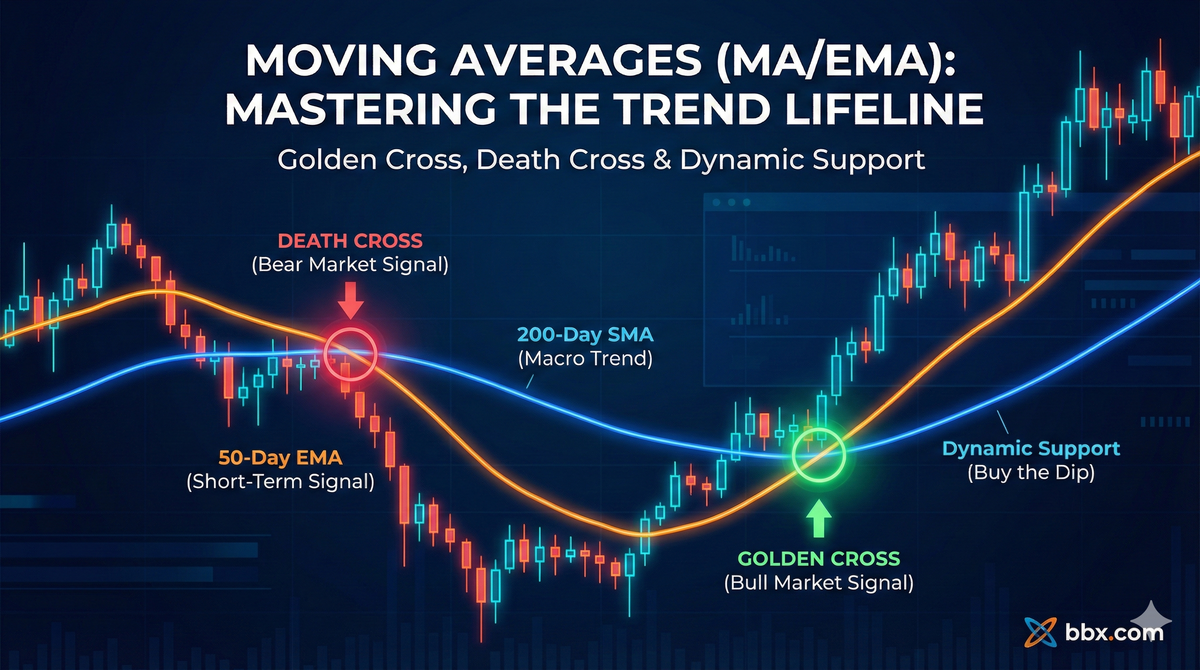
- Buy the Dip: In a strong uptrend, the 20 EMA or 50 SMA acts like an invisible hand pushing the price higher. Every time the price pulls back, touches the moving average, and holds without breaking, it offers a prime, trend-following buy entry.
- Trend Breakdown: The moment the price breaks below this core moving average on heavy volume, and the moving average begins to slope downward, the trend's moat has been breached. Bulls must mercilessly cut losses and exit.
Tactic 2: Crossovers (The Golden Cross & Death Cross)
These are the epic technical signals most beloved by mainstream financial media. They typically utilize a combination of the 50-day moving average (short-term) and the 200-day moving average (long-term).
- The Golden Cross: Occurs when the 50-day MA crosses up and over the 200-day MA. Wall Street universally recognizes this as the confirmation signal that a massive, long-term bull market has begun.
- The Death Cross: Occurs when the 50-day MA crosses down and under the 200-day MA. This is a severe warning that liquidity is drying up and a prolonged bear market has arrived. Institutional capital usually flees upon this signal.
Tactic 3: Bullish Alignment (The Trend Follower's Dream)
When you open a chart and see the short-term, medium-term, and long-term moving averages fanning out upward in perfect, stair-step sequence (e.g., Price > 20 EMA > 50 EMA > 200 SMA), this is known as "Bullish Alignment."
- Trading Discipline: When a chart is in Bullish Alignment, you only look to buy the dips. You absolutely never attempt to counter-trade by shorting the top! The trend is your friend until the end.
4. Advanced Tactics & Traps: Separating Pros from Amateurs
No indicator is perfect. Moving averages harbor two fatal flaws that can liquidate a novice's account if not actively managed.
Fatal Flaw 1: It is a "Lagging Indicator"
Moving averages are calculated based on historical price data that has already occurred. By the time the 50-day and 200-day lines actually form a "Golden Cross," the explosive first leg of the bottom rally is usually already over.
- The Solution: The purpose of a moving average is never to help you "buy the absolute bottom." Its job is to "confirm the certainty of a trend." Professional traders gladly sacrifice the head and the tail of a move to safely capture the meat in the middle.
Fatal Flaw 2: The "Whipsaw Trap" in Ranging Markets
- The Phenomenon: When the market loses macro direction and enters a sideways, choppy range, the short, medium, and long-term moving averages will flatten out and twist together like braided rope.
- The Brutal Reality: If you mechanically trade "buy on crossovers, sell on cross-unders" during this phase, you will constantly buy the local top and sell the local bottom. You will get violently "whipsawed" by the market, bleeding your account dry through trading fees and slippage.
- The Discipline: Never rely on moving averages in a sideways market! When the market is chopping sideways, you must switch to oscillators like Bollinger Bands or the RSI to buy support and sell resistance.
5. Frequently Asked Questions (FAQ)
Q: With so many moving averages, which periods should I actually use?
A: Wall Street institutions and algorithmic trading bots universally monitor a few specific "lifelines." We highly recommend retail traders stick to these standards:
- 20-Period MA (EMA): The short-term swing trader's baseline for judging monthly momentum.
- 50-Period MA (SMA/EMA): The mid-term trend's moat, often acting as the ultimate defense line against institutional shakeouts.
- 200-Period MA (SMA): The absolute Bull/Bear dividing line! Whenever an asset is trading below its 200-day moving average, massive mutual funds are often mandated by their risk management protocols to liquidate positions or halt buying.
Q: When trading Bitcoin or other cryptocurrencies, should I use the SMA or EMA?
A: In the crypto markets, it is highly recommended to prioritize the EMA (Exponential Moving Average). Crypto trades 24/7 without circuit breakers and is violently affected by sudden news events. Because the EMA applies greater weight to recent prices, its hyper-sensitivity helps you escape crashes or catch explosive breakouts much faster than the sluggish SMA.
Explore the Future of RWA with BBX Trade US/HK equities directly with stablecoins.
website: https://bbx.com/
X: https://x.com/bbx_official
Telegram: https://t.me/bbxcommunity
Discord: https://discord.com/invite/TAypgax4v9
Disclaimer: This report is for informational purposes only and does not constitute financial advice.