What is Dividend Yield? The Secret to Passive Income
What is Dividend Yield? It is the #1 metric for passive income investors. This guide explains the calculation formula, how to analyze Payout Ratios for safety, and how to spot dangerous "Yield Traps" on bbx.com.

TL;DR (Quick Answer):
Dividend Yield measures the annual cash return you get for every dollar invested in a stock.The Analogy: Think of it as the "Interest Rate" on your stock portfolio.The Formula:The Value: It acts as a "Safety Net" in bear markets and a "Wealth Accelerator" in bull markets.
1. What is Dividend Yield?
In the stock market, your returns come from two sources: Capital Gains (price appreciation) and Dividends (cash payouts). Dividend Yield is the metric that measures the attractiveness of that cash payout.
- Core Definition: It represents the "Real Cash" return. Unlike capital gains, which are just "paper wealth" until you sell, dividends are hard cash deposited into your brokerage account.
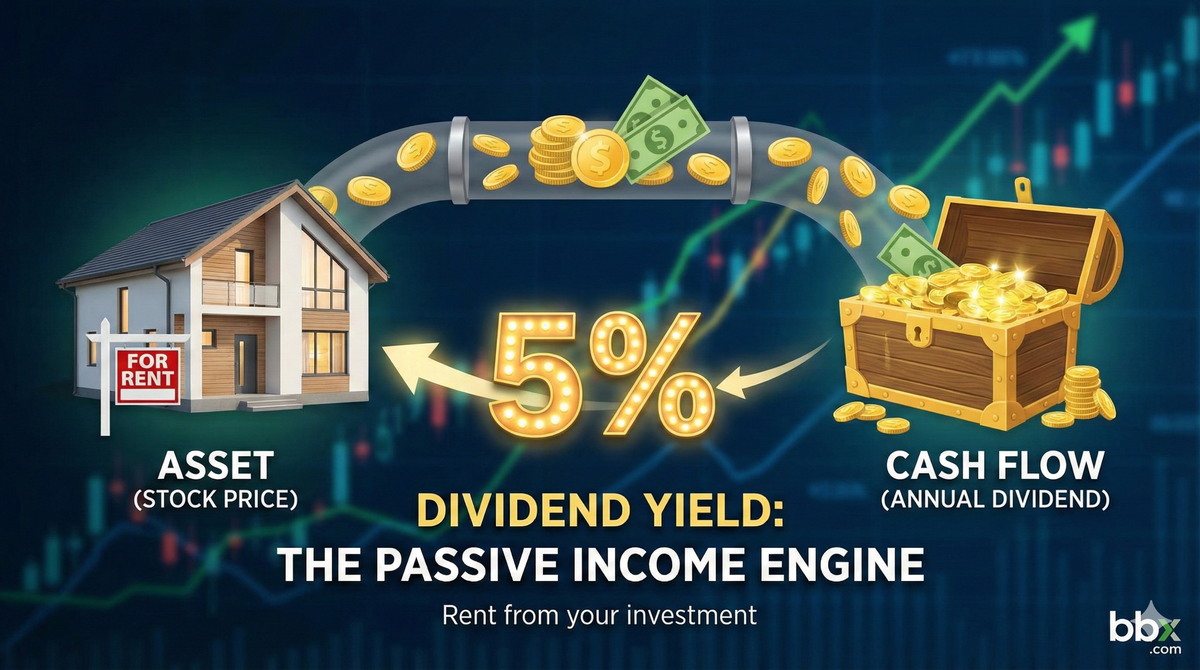
- The Real Estate Analogy:Investing in stocks is like buying a rental property.
- Stock Price: The market value of the house (e.g., $1,000,000).
- Dividend: The annual rent you collect (e.g., $50,000).
- Dividend Yield: $50,000 / $1,000,000 = 5%.
- The Takeaway: Even if the house price doesn't rise, you still earn a steady 5% return. This is the essence of Passive Income.
2. The Math & Critical Metrics
The Basic Formula
Calculating yield is simple, but remember that the denominator is the current stock price, which changes every second.

Advanced: The Payout Ratio (The Safety Valve)
A high yield is useless if the company goes bankrupt paying it. You must check the Payout Ratio.

- < 60% (Safe): The company distributes about half its profit and retains the rest for growth. The dividend is likely sustainable.
- > 100% (Danger Zone): Red Flag! The company is paying out more than it earns. This means they are burning cash reserves or borrowing money to pay shareholders. This is unsustainable and often precedes a Dividend Cut.
3. Practical Strategies: Building an Income Portfolio
On bbx.com, dividend investors generally fall into two camps:
Strategy A: The High Yield Chaser
- Goal: Maximum immediate cash flow.
- Targets: REITs (Real Estate Investment Trusts), Utilities, Energy Majors, Telecoms.
- Profile: Yields typically range from 4% to 8%. These stocks usually have lower volatility, making them ideal for retirees needing income to live on.
Strategy B: The Dividend Growth Investor
- Goal: Protecting purchasing power against inflation.
- Targets: Dividend Aristocrats. These are elite companies (like Coca-Cola, Johnson & Johnson) that have raised their dividends for 25+ consecutive years.
- Profile: Starting yields may be lower (1.5% - 3%), but as the dividend grows, your Yield on Cost becomes massive over time.
The Secret Weapon: DRIP (Dividend Reinvestment Plan)
Don't spend your dividends on coffee! Turn on DRIP. This automatically uses your cash dividends to buy more shares of the stock. This is the fastest way to trigger the Snowball Effect of compound interest.
4. The "Yield Trap" (How to Avoid Losing Money)
This is the #1 mistake new investors make. Never buy a stock just because the yield looks incredibly high.
The Mechanism of the Trap
Remember the math:

When a company is in trouble, its stock price usually crashes first.
- The Scenario: Company A's stock drops from $100 to $50 due to a looming crisis. The dividend hasn't been cut yet (e.g., $5).
- The Illusion: The yield mathematically spikes from 5% to 10%.
- The Reality: That 10% is a mirage. The market has sold off the stock because smart money expects the dividend to be cut or eliminated soon.
- Rule of Thumb: If a yield looks too good to be true (e.g., >10% for a non-REIT), it is likely a trap, not a bargain.
5. Frequently Asked Questions (FAQ)
Q: What is the Ex-Dividend Date?
A: This is the "cut-off" date for eligibility.
- Buy BEFORE this date: You get the upcoming dividend payment.
- Buy ON or AFTER this date: The dividend goes to the previous owner, not you.
Q: Is a higher dividend yield always better?
A: Absolutely not. Extremely high yields often signal distress or a declining business model. The "sweet spot" for healthy, growing companies is typically between 2% and 5%, supported by a safe Payout Ratio (<60%).
Q: Do I have to pay taxes on dividends?
A: Yes. In most jurisdictions (like the US), dividends are taxable. However, holding the stock for a certain period may qualify you for the lower "Qualified Dividend" tax rate, rather than the higher ordinary income tax rate.
Explore the Future of RWA with BBX Trade US/HK equities directly with stablecoins.
website: https://bbx.com/
X: https://x.com/bbx_official
Telegram: https://t.me/bbxcommunity
Discord: https://discord.com/invite/TAypgax4v9