What is EPS? The Engine Driving Stock Prices
What is EPS? Earnings Per Share is the primary gauge of corporate profitability and the foundation of the P/E ratio. Discover the critical difference between Basic and Diluted EPS and how share buybacks impact valuation.

TL;DR (Quick Answer):
Earnings Per Share (EPS) represents the portion of a company's net profit allocated to each outstanding share of common stock. It is Wall Street's primary gauge of profitability.Rising EPS = The strongest driver of long-term stock price appreciation.Formula: Net Income / Shares Outstanding.
1. What is EPS?
If you can only look at one metric to determine a company's financial health, make it EPS. It bridges the gap between "Corporate Profit" and "Your Share."
- Core Definition: EPS tells you exactly how much money the company earned for your specific share of stock.
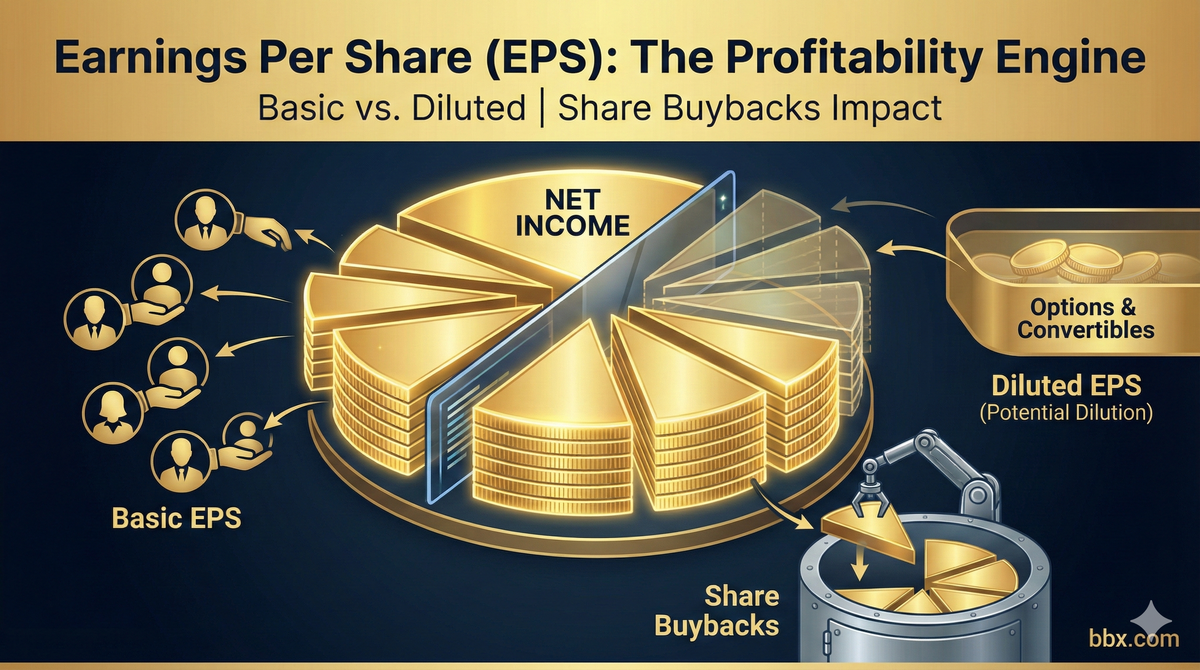
- The "Pizza Pie" Analogy:Think of Net Income as a large Pizza.
- Shares Outstanding: The number of slices the pizza is cut into.
- EPS: The amount of topping on each slice.
- If the pizza gets bigger (Higher Profit), or if the chef cuts fewer slices (Share Buybacks), the amount of topping per slice (EPS) increases, making that slice more valuable.
2. The Math: Basic vs. Diluted
When analyzing earnings reports on bbx.com, you will encounter two EPS figures. Distinguishing between them is critical to avoid being misled.
A. Basic EPS
The simplest calculation, ignoring potential dilution.

- Note: Preferred dividends must be subtracted because that money belongs to preferred shareholders, not common stockholders.
B. Diluted EPS (The Real Number)
This is the standard for institutional pricing. It assumes a "Worst-Case Scenario" where all convertible securities (e.g., employee stock options, convertible bonds, warrants) are turned into stock.

Why Diluted EPS matters more:
It reveals the true floor of profitability. If a company issues massive amounts of stock options to executives, your ownership percentage—and your claim on profits—will shrink (dilute) when those options are exercised.
3. Practical Application: How to Interpret EPS
1. Trend is King
Do not focus solely on the absolute number (whether EPS is $5 or $0.5 is relative). Focus on the Growth Rate.
- Quality Stocks: Consistent EPS growth over 3–5 years (e.g., 15% YoY growth).
- Value Traps: Erratic earnings or consecutive years of negative EPS.
2. Spotting "Financial Engineering"
Sometimes, a company's Net Income is flat, yet EPS rises. How? Through Share Buybacks.
- Mechanism: The company buys its own stock to reduce the denominator (Shares Outstanding).
- BBX Strategy: If EPS growth is driven entirely by buybacks while Revenue is stagnant, this is often a sign of "low-quality growth" or a lack of investment opportunities.
3. The Foundation of Valuation
EPS is the denominator of the Price-to-Earnings (P/E) Ratio.

If EPS drops while the stock price remains constant, the P/E ratio spikes, making the stock expensive overnight.
4. Risks & Common Pitfalls
- Non-Recurring Items:A company might sell a factory for a $100M profit, causing EPS to spike for one quarter. This is not sustainable. Investors should look at "Adjusted EPS", which excludes one-time gains and losses.
- The Negative EPS Trap:For early-stage growth companies (like early Amazon or Tesla), negative EPS is acceptable as they reinvest for growth. However, for mature blue-chip companies (like Coca-Cola), negative EPS is a major red flag indicating fundamental distress.
5. Frequently Asked Questions (FAQ)
Q: Is Diluted EPS always lower than Basic EPS?
A: Yes (or equal). Because the calculation adds potential shares to the denominator, the resulting Earnings Per Share will mathematically be smaller. A large gap between Basic and Diluted EPS indicates high potential dilution risk.
Q: Does higher EPS always mean a higher stock price?
A: Not necessarily. EPS is an absolute number. The stock price depends on the valuation multiple (P/E) the market assigns to it. Company A with $10 EPS in a dying industry might trade lower than Company B with $1 EPS in a booming tech sector.
Q: What is an "Earnings Beat"?
A: Wall Street analysts publish consensus estimates for EPS. If a company reports actual EPS higher than the estimate, it "beats" expectations, often triggering a short-term price rally.
Explore the Future of RWA with BBX Trade US/HK equities directly with stablecoins.
website: https://bbx.com/
X: https://x.com/bbx_official
Telegram: https://t.me/bbxcommunity
Discord: https://discord.com/invite/TAypgax4v9