What is Free Cash Flow (FCF)? The Ultimate Truth Serum for Corporate Earnings
What is Free Cash Flow (FCF)? It is the ultimate metric for measuring a company's true profitability. This guide explains how to calculate FCF, the critical difference between cash and net income, and how to use FCF Yield on bbx.com.

TL;DR (Quick Answer):
There is a famous saying on Wall Street: "Profit is an opinion, cash is a fact."
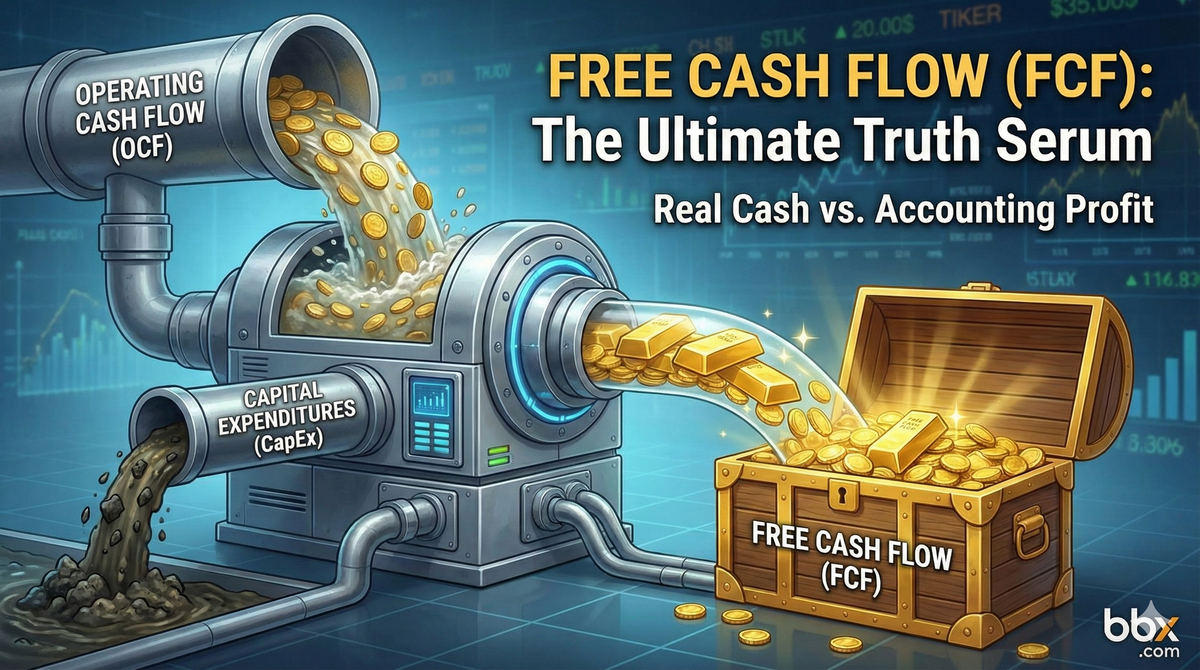
Free Cash Flow (FCF) is the cold, hard cash left over after a company pays for its operating expenses and the capital expenditures (CapEx) required to maintain or expand its business.The Investment Value: FCF is the only true source of funding for dividend payouts, share buybacks, debt reduction, or strategic acquisitions. It is the ultimate litmus test for identifying a genuine "money-printing machine."
The Core Formula:

1. What is Free Cash Flow (FCF)?
When reading an earnings report, Net Income (Profit) is usually the headline number and the foundation of the P/E ratio. However, Net Income is based on Accrual Accounting. This means it includes a massive amount of "paper profits"—revenue booked for sales where the cash hasn't actually been collected yet, along with unpaid bills.
Free Cash Flow (FCF) strips away all accounting assumptions. It only looks at the actual cash entering and leaving the corporate bank account.
- Core Definition: FCF measures how much cash a company can extract from its operations and return to shareholders without degrading its long-term business prospects.
- The Personal Finance Analogy:Think of a company's financials like your own household budget:
- Revenue: Your gross monthly salary before taxes (e.g., $10,000).
- Net Income: Your take-home pay after taxes (e.g., $8,000). Can you spend all $8,000 on stocks or vacations? No.
- Capital Expenditures (CapEx): Your rigid, mandatory living expenses like rent, groceries, utilities, and your car payment (e.g., $5,000).
- Free Cash Flow (FCF): $\$8,000 - \$5,000 = \mathbf{\$3,000}$. This $3,000 is your true "discretionary income." You can freely use it to invest, save, or travel. For a corporation, this exact pool of money determines whether it can sustainably pay you dividends.
2. The Math & Mechanics: Tracing the Cash
To calculate FCF, we must bypass the Income Statement and dive straight into the Statement of Cash Flows.
The Fundamental Equation

Breaking Down the Components:
- Operating Cash Flow (OCF): The net cash generated from the company's core business activities. If a company ships a product but the customer pays with an IOU (Accounts Receivable), that money is not included in OCF until the check clears.
- Capital Expenditures (CapEx): The heavy-lifting costs required to keep the business alive. This includes buying new machinery, upgrading factories, or purchasing server infrastructure. A company cannot simply distribute this money to shareholders, or it will lose its competitive edge next year.
3. Practical Application: Finding "Cash Cows" on bbx.com
When conducting fundamental analysis on bbx.com, astute investors leverage two powerful weapons derived from FCF:
Weapon 1: Free Cash Flow Yield (FCF Yield)
This is a far more rigorous valuation metric than the P/E ratio. It measures the true "cash return" you get at the current stock price.

- The Strategy: If a company has a seemingly low P/E ratio (looks cheap) but a dismal or negative FCF Yield, it's likely a Value Trap. The profits are merely accounting illusions not translating into cash. Generally, mature companies boasting an FCF Yield > 5% offer a massive margin of safety for investors.
Weapon 2: The Dividend Safety Valve
Connecting this to our previous guide on Dividend Yield: the cash to pay dividends must come from FCF.
- Healthy Status: Total Annual Dividends Paid < Total Annual FCF.
- Red Flag Status: Total Annual Dividends Paid > Total Annual FCF. This means the company is borrowing money or selling assets just to maintain its dividend payout. This is functionally a corporate Ponzi scheme, and the stock is at high risk of a brutal dividend cut.
4. Risks & Traps: The Illusion of "Paper Wealth"
1. The Fatal Divergence Between Profit and Cash
- The Red Flag: An earnings report shows Net Income surging by 50%, EPS is soaring, and the market is cheering. But when you check the Cash Flow Statement, FCF is deeply negative.
- The Reality: The company might be aggressively stuffing distribution channels, leading to a massive spike in Accounts Receivable (booking sales but collecting no cash), or stockpiling unsellable Inventory. Some of the biggest corporate frauds in history (like Enron) began with this exact, glaring divergence between Net Income and Free Cash Flow.
2. Is Negative FCF Always a Bad Thing? (The Growth Stock Exception)
For early-stage SaaS, AI chip designers, or biotech startups (think early Amazon or Tesla), negative FCF is completely normal.
- The Reason: To capture market share, they are funneling all operating cash (and billions in venture capital) directly into massive CapEx (R&D, gigafactories, data centers).
- The Strategy: For hyper-growth stocks, a temporary, strategic cash burn is acceptable. In these cases, investors should pivot to monitoring Revenue Growth and the Cash on Hand (balance sheet liquidity) to ensure the company can survive its cash-burning phase without going bankrupt.
5. Frequently Asked Questions (FAQ)
Q: Why do Warren Buffett and Charlie Munger hate EBITDA but love FCF?
A: EBITDA (Earnings Before Interest, Taxes, Depreciation, and Amortization) is widely used by Wall Street, but it explicitly ignores CapEx. Buffett famously quipped, "Does management think the tooth fairy pays for capital expenditures?" Machinery breaks and factories age; those depreciation costs require real cash to replace. EBITDA wildly exaggerates profitability, making FCF the only honest metric.
Q: What does management actually do with a massive pile of Free Cash Flow?
A: Abundant FCF grants a company ultimate "strategic optionality." They typically deploy it in four ways: 1) Paying Cash Dividends to reward shareholders; 2) Buying Back Stock, which reduces share count and passively boosts the value of your remaining shares; 3) Paying Down Debt, bulletproofing the balance sheet; 4) Executing Strategic M&A (Mergers & Acquisitions) to buy out competitors during market downturns.
Explore the Future of RWA with BBX Trade US/HK equities directly with stablecoins.
website: https://bbx.com/
X: https://x.com/bbx_official
Telegram: https://t.me/bbxcommunity
Discord: https://discord.com/invite/TAypgax4v9