What is Return on Equity (ROE)? The Ultimate Measure of Corporate Efficiency
What is Return on Equity (ROE)? It is the ultimate metric for measuring corporate efficiency. This guide explains the calculation formula, the DuPont Analysis, and how to spot high-quality "compounders" on bbx.com.

TL;DR (Quick Answer):
Return on Equity (ROE) measures how effectively a company's management uses shareholders' capital to generate net profit. It is the ultimate gauge of capital efficiency.The Formula:The Golden Rule: Companies that consistently maintain an ROE of 15% - 20% are often high-quality "compounders" with wide economic moats—the type Warren Buffett loves.
1. What is ROE?
In the world of finance, Earnings Per Share (EPS) tells you how much money a company made. ROE tells you how efficiently they made it. It is the litmus test for management's ability to allocate capital.
Why Is It Critical?
As Warren Buffett famously noted, "The primary test of managerial economic performance is the achievement of a high earnings rate on equity capital employed."
- The Logic: Investors shouldn't just care about the absolute profit number; they should care about the return on invested capital.
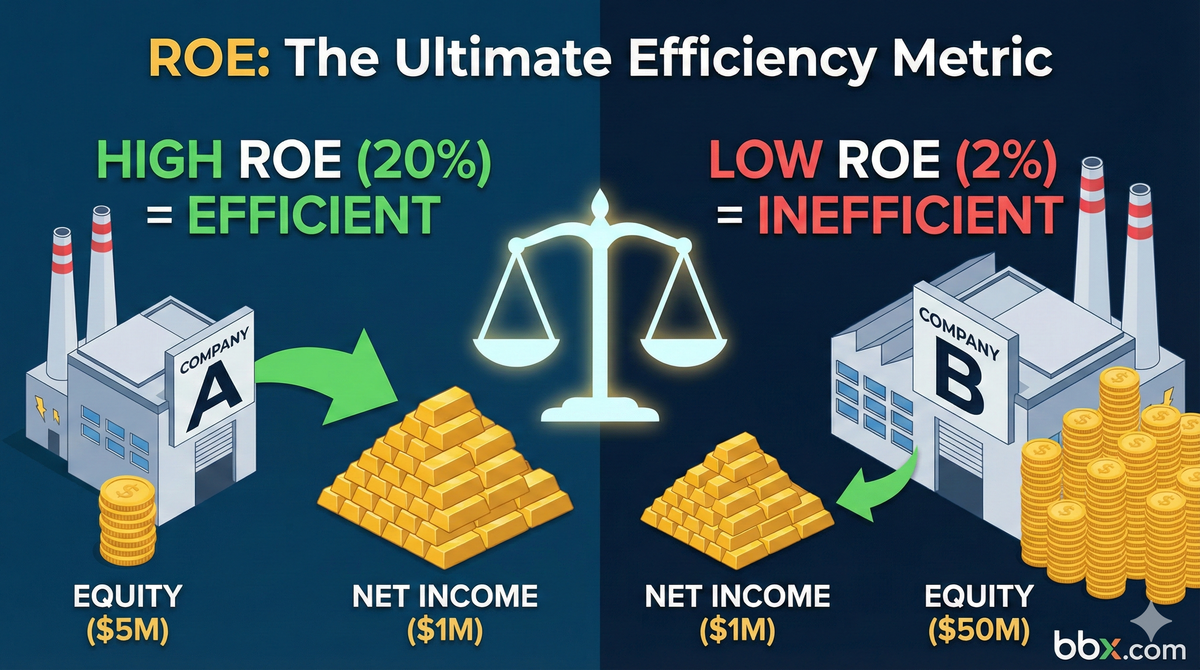
- The Business Analogy: Imagine two companies (A and B) that both generate $1 million in Net Profit.
- Company A: Shareholders invested $5 million. ROE = 20%.
- Company B: Shareholders invested $50 million. ROE = 2%.
- The Verdict: Although profits are identical, Company A is a superior "compounding machine," while Company B is failing to beat a standard savings account. High ROE means doing more with less.
2. The Math & DuPont Analysis
The Basic Formula
The simplest way to calculate ROE is:

Advanced: DuPont Analysis (The Professional's Tool)
To understand what is driving ROE, Wall Street uses the DuPont Analysis to decompose the metric into three drivers:

- Net Profit Margin:
- Meaning: Is the product lucrative? How much profit is made on every $100 of sales?
- Archetype: The Luxury Model (e.g., Hermes/Apple: High Margin, Lower Volume).
- Asset Turnover:
- Meaning: How fast is inventory moving? How efficiently are assets used?
- Archetype: The Retail Model (e.g., Walmart/Amazon: Razor-thin margins, extreme speed).
- Financial Leverage (Equity Multiplier):
- Meaning: How much debt is being used to fuel growth?
- Archetype: The Banking/Real Estate Model (Using other people's money to amplify returns).
3. Practical Application: Filtering Stocks on bbx.com
When using the stock screener on bbx.com, ROE serves as the dividing line between "mediocre" and "magnificent."
Threshold Guide
| ROE Range | Rating | Interpretation |
| < 10% | Mediocre | The return is often below the company's Weighted Average Cost of Capital (WACC). Long-term holding usually results in underperforming the market. |
| 15% - 20% | Excellent | The "Sweet Spot." Most long-term compounders (e.g., Coca-Cola, Costco) consistently operate in this range. |
| > 30% | Extreme / Red Flag | Caution: Returns this high are rarely sustainable. They often indicate extreme Financial Leverage (High Debt) rather than operational brilliance. Always check the debt levels. |
The Strategy: Hunting for "Compounders"
Do not look at just one year of data. Look for companies with ROE > 15% for 5-10 consecutive years. This consistency proves the company has a durable Economic Moat that protects its margins from competitors.
4. Risks: The "Leverage Trap"
High ROE is not always good. This is the most common trap for novice investors: Debt-Fueled ROE.
The Mechanism
According to the DuPont formula, increasing Financial Leverage (borrowing money) mathematically boosts ROE.
- The Scenario: A struggling company with falling profits might borrow billions to buy back its own stock. This drastically reduces the denominator (Shareholders' Equity). Consequently, ROE skyrockets to 50% or 100%.
- The Reality: This is "Financial Engineering," not operational growth. It masks a fragile balance sheet teetering on insolvency.
How to Avoid the Trap?
Always cross-reference ROE with ROA (Return on Assets).
- If ROE is massive (e.g., 40%) but ROA is tiny (e.g., 1%), the high return is entirely driven by Debt. In a rising interest rate environment, these companies are highly vulnerable.
5. Frequently Asked Questions (FAQ)
Q: What is the difference between ROE and ROA?
A: ROE considers only shareholder capital (a smaller denominator), reflecting the return to owners. ROA considers total capital including debt. ROE is crucial for banking/finance stocks, while ROA is better for capital-intensive industries (manufacturing) to strip out the effects of leverage.
Q: Why do some high-growth tech stocks have low ROE?
A: Companies in hyper-growth phases (like early Amazon or Tesla) reinvest heavily in R&D and expansion, often suppressing Net Income (the numerator). For these companies, Revenue Growth and Gross Margins are better metrics than ROE.
Q: How do share buybacks affect ROE?
A: Buybacks reduce the number of outstanding shares and total equity. Assuming Net Income stays flat, buybacks will mathematically increase ROE. Investors must determine if this increase is due to efficient capital allocation or simply an accounting trick to boost executive bonuses.
Explore the Future of RWA with BBX Trade US/HK equities directly with stablecoins.
website: https://bbx.com/
X: https://x.com/bbx_official
Telegram: https://t.me/bbxcommunity
Discord: https://discord.com/invite/TAypgax4v9