What is the Current Ratio? The Ultimate Litmus Test for Short-Term Survival
What is the Current Ratio? It is a crucial metric for evaluating a company's short-term liquidity. This guide explains how to calculate the Current Ratio and Quick Ratio, assess financial health, and avoid cash flow crises on bbx.com.

TL;DR (Quick Answer):
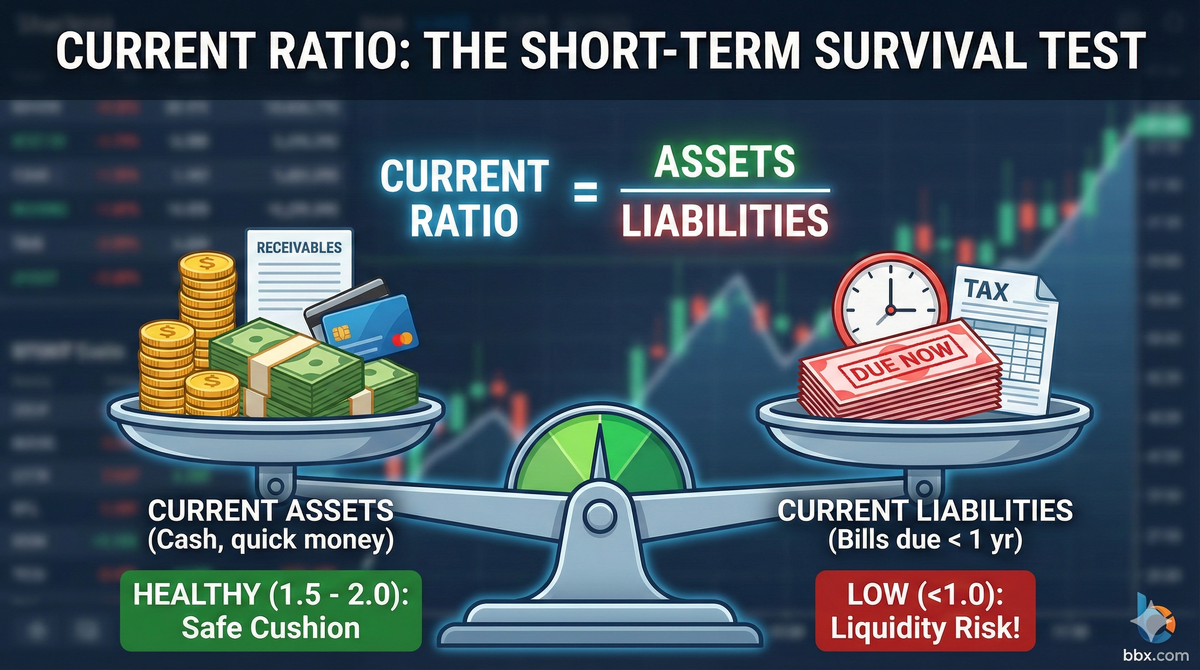
There is an old Wall Street adage: "Revenue is vanity, profit is sanity, but cash is reality." > The Current Ratio measures a company's ability to pay off its short-term obligations (due within a year) using its short-term assets (convertible to cash within a year).
The Core Formula:

- The Golden Rule: A Current Ratio between 1.5 and 2.0 is generally considered ideal. A ratio below 1.0 warns that the company is dangerously close to a liquidity crunch; conversely, a ratio that is too high (e.g., > 3.0) suggests management is hoarding "lazy cash" and operating inefficiently.
1. What is the Current Ratio? Beware the "Asset Rich, Cash Poor" Trap
In our previous guide, we discussed the Debt-to-Equity (D/E) Ratio, which evaluates long-term bankruptcy risk. But in the ruthless world of business, a long runway means nothing if you trip on the first step. Many companies boast massive long-term wealth—vast real estate, heavy machinery, and valuable patents—yet file for Chapter 11 bankruptcy overnight simply because they missed a multi-million dollar interest payment or couldn't pay their suppliers.
The Current Ratio is a company's "short-term survival index." It ignores the 5-year grand vision and asks a brutal question: Can you make payroll next month?
- Core Definition: It is the premier metric for evaluating Short-Term Liquidity. It tests whether a company has enough "fast cash" on hand if all its short-term creditors suddenly knocked on the door demanding payment.
- The Millionaire's Dilemma (Analogy): * Imagine you own a mansion worth $10,000,000 (Long-Term Asset), but your checking account only has $500 (Current Asset).
- Suddenly, you suffer a medical emergency requiring an immediate $2,000 out-of-pocket payment (Current Liability).
- Your "Current Ratio" in this moment is 500 / 2000 = 0.25.
- The result? Even though you are a multi-millionaire on paper, you face a severe existential crisis because you cannot liquidate a mansion in 60 seconds to pay a hospital bill. This is a classic Liquidity Crisis.
2. The Math & The "Acid-Test" (Quick Ratio)
To calculate the Current Ratio, we must extract the "Current" line items from the Balance Sheet.
The Baseline Defense: The Current Ratio

- Current Assets: Assets expected to be converted into cash within one year (or one operating cycle). This primarily includes Cash & Cash Equivalents, Short-Term Investments, Accounts Receivable (money owed by customers), and Inventory.
- Current Liabilities: Obligations that must be paid off within one year. This includes Short-Term Debt, Accounts Payable (money owed to suppliers), and Accrued Wages & Taxes.
The Ultimate Floor: The Quick Ratio (Acid-Test Ratio)
In practice, astute credit analysts often find the Current Ratio too lenient.
- The Flaw: Current Assets include Inventory. If the economy plunges into a recession, a warehouse full of out-of-season clothing or rusting steel might be utterly unsellable. Counting dead inventory as "lifesaving cash" is self-deception.
- The Solution: We introduce the Quick Ratio (often called the Acid-Test Ratio), which ruthlessly strips the most illiquid asset—Inventory—out of the numerator.

- The Rule of Thumb: If a company's Quick Ratio is > 1.0, it means that even if it fails to sell a single piece of inventory, it still has enough hard cash and receivables to pay off every short-term debt. This offers immense peace of mind.
3. Practical Application: Evaluating Safety on bbx.com
When screening stocks for fundamental landmines on bbx.com, keep these liquidity benchmarks and industry exceptions in mind:
Finding the "Goldilocks Zone"
- < 1.0 (Red Flag): The company is operating with a working capital deficit. It relies heavily on "rolling over debt." If macroeconomic credit conditions tighten (banks stop lending), the company could collapse instantly.
- 1.5 - 2.0 (Green Light): The company has an ample financial cushion. This is the ideal safety zone for manufacturing and traditional retail sectors.
The Retail Exception: Why Walmart and Amazon are Safe at < 1.0
If you look up giants like Walmart or Amazon, you will notice their Current Ratios constantly hover around 0.8 to 0.9. Are they on the verge of bankruptcy?
Absolutely not! In fact, this reflects their terrifying commercial dominance.
As retail apex predators, they hold absolute bargaining power over their suppliers. They can aggressively delay paying their bills (resulting in massive Accounts Payable, which inflates Current Liabilities), while simultaneously collecting cash instantly from consumers at the checkout counter. This brilliant Negative Working Capital model allows them to safely operate with a Current Ratio below 1.0 without breaking a sweat.
4. The Trap: Is a Higher Current Ratio Always Better?
This is the most common pitfall for novice investors.
- The Trap: If you screen for stocks and find a company with a staggering Current Ratio of 4.0 or 5.0, you might think, "This company is bulletproof!"
- The Reality: In corporate finance, capital has an opportunity cost. Current Assets are mostly "Cash" and "Inventory." If this ratio is unusually high, it usually exposes severe management incompetence:
- Bloated Inventory: The warehouse is stuffed with obsolete, unsellable products.
- "Lazy Cash": Management is sitting on billions in cash because they lack the vision to invest in high-return expansion projects, yet they stubbornly refuse to return it to shareholders via dividends or buybacks.
- The Verdict: An excessively high Current Ratio isn't a bulletproof vest; it's a glaring sign of poor asset utilization and a massive waste of shareholder equity.
5. Frequently Asked Questions (FAQ)
Q: Why do analysts always look at the Quick Ratio alongside the Current Ratio?
A: Because "Inventory" is the most opaque and depreciable asset on the balance sheet. The Quick Ratio acts as a stress test. If a company boasts a Current Ratio of 2.0 (looks healthy) but a Quick Ratio of 0.5, it reveals that its "health" is entirely propped up by a mountain of inventory. Its true margin of safety against a sudden shock is dangerously thin.
Q: Can a company artificially manipulate (fake) its Current Ratio?
A: Yes, quite easily. Just before the end of a fiscal quarter, management will often engage in "Window Dressing" to make the balance sheet look prettier for Wall Street. For example, they might take out a 5-year long-term loan (which doesn't count as a Current Liability) and use that cash to immediately pay off short-term debts. The numerator stays roughly the same, but the denominator shrinks, causing the Current Ratio to artificially spike. Always look at historical trends over multiple quarters, rather than a single static snapshot.
Explore the Future of RWA with BBX Trade US/HK equities directly with stablecoins.
website: https://bbx.com/
X: https://x.com/bbx_official
Telegram: https://t.me/bbxcommunity
Discord: https://discord.com/invite/TAypgax4v9