What is the Debt-to-Equity (D/E) Ratio? The Ultimate Barometer of Corporate Survival
What is the Debt-to-Equity (D/E) Ratio? It is the ultimate metric for assessing corporate financial health. Learn how to calculate D/E, understand capital structure, and avoid high-leverage bankruptcy risks on bbx.com.

TL;DR (Quick Answer):
In the financial markets, "staying alive" always trumps "maximizing profits."
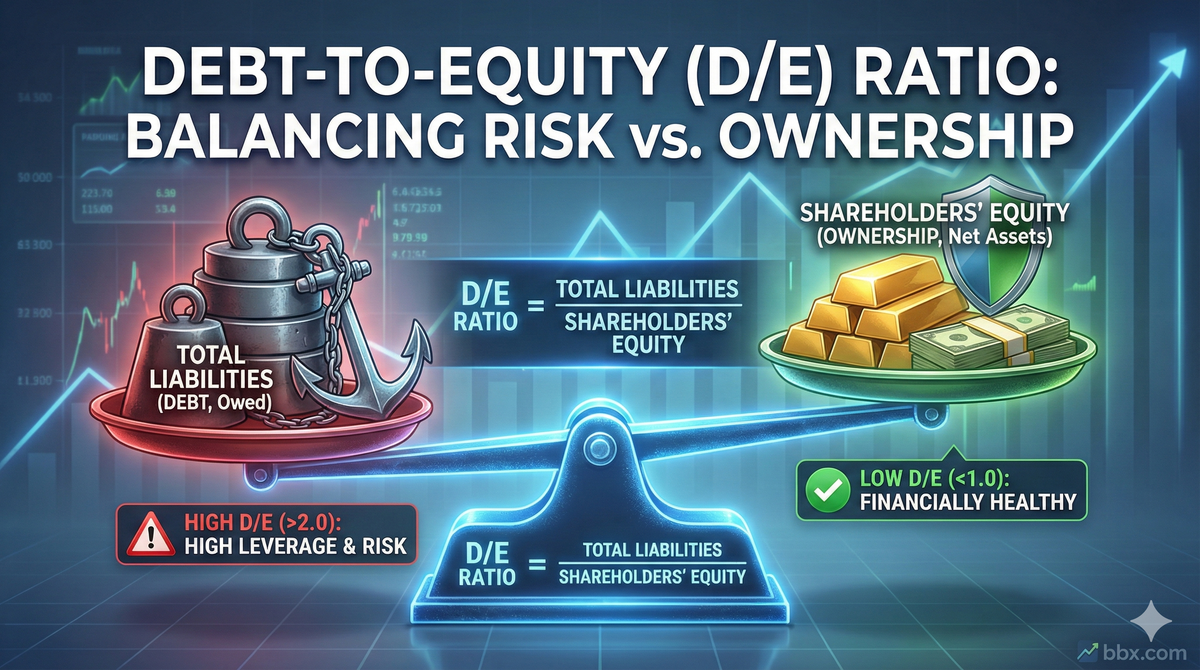
The Debt-to-Equity (D/E) Ratio measures how much "borrowed money" (Total Liabilities) a company uses to finance its operations relative to the "owners' money" (Shareholders' Equity).The Core Formula:The Golden Rule: Leverage is a double-edged sword. A high D/E ratio significantly increases a company's bankruptcy risk during economic downturns; however, during a booming economy, that same leverage can exponentially amplify a shareholder's Return on Equity (ROE).
1. What is the D/E Ratio? Spotting the "Ticking Time Bomb"
When we use the P/E ratio to hunt for bargains and the PEG ratio to find growth, we often overlook a fatal reality: Profits are an accounting opinion, but debt is a hard obligation. A company can report billions in net income, but if it defaults on a multi-million dollar short-term loan today, it instantly triggers a Liquidity Crisis that can end in bankruptcy court.
The D/E Ratio is the ultimate "health check" for a company's balance sheet. It reveals whether management is growing the business sustainably with actual equity, or walking a tightrope fueled by reckless borrowing.
- Core Definition: The D/E ratio measures a company's Capital Structure. It illustrates the proportion of financing that comes from creditors (banks, bondholders) versus shareholders (investors like you).
- The Real Estate Analogy: Think of running a company like taking out a mortgage.
- Suppose you want to buy a $1,000,000 house.
- Conservative (Low D/E): You put down $800,000 of your own money (Equity) and borrow only $200,000 from the bank (Debt). Your $D/E = \$200,000 / \$800,000 = \mathbf{0.25}$. Even if housing prices crash or you temporarily lose your job, your monthly payments are easily manageable. The bank can't touch you.
- Aggressive (High D/E): Driven by greed, you only put down $100,000 and borrow $900,000. Your $D/E = \$900,000 / \$100,000 = \mathbf{9.0}$. The moment you miss a single paycheck (i.e., the company's cash flow dries up), the bank forecloses on your house. This is the extreme fragility of high leverage.
2. The Math: Deconstructing the Balance Sheet
To calculate the D/E ratio accurately, we must dive into the company's Balance Sheet.
The Basic Formula

Breaking Down the Components:
- Total Liabilities: Everything the company owes to outside parties. This includes both long-term debt (like corporate bonds and mortgages) and short-term obligations (like debt maturing within a year and accounts payable to suppliers).
- Shareholders' Equity: The company's total assets minus its total liabilities. This represents the true net worth that belongs to the shareholders (also known as "Book Value").
3. Practical Application: Evaluating Risk on bbx.com
When screening stocks on bbx.com, remember that evaluating a D/E ratio without industry context is useless. You must blend absolute rules of thumb with relative industry benchmarks.
Absolute vs. Relative Standards
- The General Rule of Thumb: Typically, a D/E < 1.0 is considered relatively safe, indicating that the company is funded more by its owners than by creditors. A D/E > 2.0 is often flagged as a high-risk warning sign.
- Industry Context is Everything (Crucial):
- Capital-Intensive Sectors (Naturally High D/E): Banks, insurance, real estate, utilities, and airlines. These industries inherently require massive amounts of capital to buy land, aircraft, or manage cash flows. Their normal D/E ratios often range from 1.5 to 3.0 (and much higher for banks).
- Asset-Light Sectors (Naturally Low D/E): Software (SaaS), big tech, and biotech. They generate revenue through code and intellectual property, requiring no heavy physical assets to be leveraged. Their normal D/E is usually < 0.5. If a software company's D/E suddenly spikes to 1.5, it is a massive red flag.
- The Takeaway: Only compare a company's D/E ratio to its direct competitors within the same industry.
4. Risks & Traps: The Backlash of Leverage
Trap 1: Is Zero Debt (D/E = 0) Always the Best?
Absolutely not. Moderate debt is a hallmark of intelligent corporate finance.
If a company can borrow from a bank at a 4% interest rate and invest that cash into a new project yielding a 15% return, it creates positive Financial Leverage, massively creating value for shareholders. If a mature company maintains a D/E of 0, it means management is overly conservative, completely wasting the leverage effect of cheap capital. This usually results in a suboptimal Weighted Average Cost of Capital (WACC).
Trap 2: The Macroeconomic "Death Spiral"
This is the ultimate nightmare for highly leveraged companies. When the broader economy enters a rate-hiking cycle (e.g., aggressive rate increases by the Federal Reserve):
- The company's previously issued low-interest debt begins to mature.
- When the company is forced to refinance (roll over its debt), the new interest rates might spike from 3% to 7%.
- This crushing Interest Expense instantly devours operating profits, draining the company's Free Cash Flow (FCF). To survive, the company is forced into a fire sale of its core assets, ultimately spiraling toward bankruptcy.
Advanced Perspective: The ROE Illusion
Recall the Return on Equity (ROE) metric we covered earlier?
According to the DuPont Analysis:

When a company's core business stagnates, management can artificially inflate its ROE by recklessly borrowing money (increasing the D/E ratio, thus maxing out the Equity Multiplier). This creates an illusion of prosperity built on a mountain of debt. When you spot an exceptionally high ROE, your very first step should be to check the D/E ratio to ensure those returns aren't just "borrowed."
5. Frequently Asked Questions (FAQ)
Q: Which is a bigger threat to a company: Short-Term Debt or Long-Term Debt?
A: Generally, Short-Term Debt poses a much more immediate and lethal threat. If a company has massive obligations due within the next 12 months but lacks the cash or cash equivalents on hand, it faces imminent default. This is why you must always analyze the D/E ratio in tandem with liquidity metrics like the Current Ratio.
Q: How do you calculate D/E if a company has negative Shareholders' Equity?
A: When a company's Total Liabilities exceed its Total Assets, Shareholders' Equity becomes negative (meaning the company is technically insolvent). While you can mathematically calculate a negative D/E ratio, it loses all valuation meaning. This indicates the company is essentially bankrupt on paper. Unless there is an imminent capital injection or debt restructuring, retail investors should steer clear immediately.
Explore the Future of RWA with BBX Trade US/HK equities directly with stablecoins.
website: https://bbx.com/
X: https://x.com/bbx_official
Telegram: https://t.me/bbxcommunity
Discord: https://discord.com/invite/TAypgax4v9