What is the Price-to-Book (P/B) Ratio? The Ultimate Gauge of Liquidation Value
What is the Price-to-Book (P/B) Ratio? It is a crucial valuation metric for finding undervalued assets. This guide explains how to calculate Book Value, the difference between true bargains and value traps, and how to use P/B on bbx.com.

TL;DR (Quick Answer):
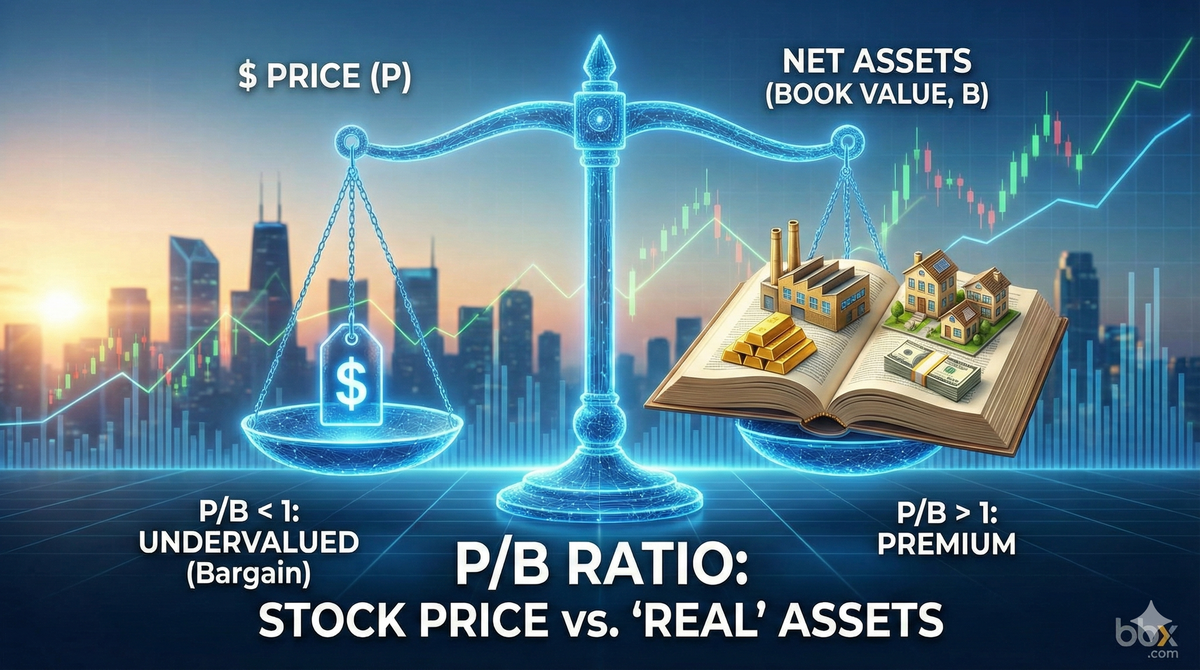
The Price-to-Book (P/B) Ratio compares a company's current market stock price to its Book Value per Share (net assets). It tells you how much of a premium you are paying for every $1 of the company's "hard assets."The Core Formula:The Golden Rule: When P/B < 1, the stock is trading at a discount to its accounting liquidation value. This can be the ultimate "deep value" buying opportunity, or a massive warning sign known as a Value Trap.
1. What is the P/B Ratio?
In fundamental analysis, if the P/E Ratio measures a company's "future earnings power" (which is uncertain), the P/B Ratio measures "what the company currently owns" (its hard floor). It is the cornerstone of Benjamin Graham's (Warren Buffett's mentor) legendary "cigar-butt" investing philosophy.
- Core Definition: P/B gauges the market's valuation of a company's balance sheet. It answers a drastic question: If the company went bankrupt today, liquidated all its factories, equipment, and inventory, and paid off all its debts, how much cash would be left for shareholders?
- The Rideshare Analogy:Imagine buying a used rideshare fleet company.
- The P/E Perspective: How much daily net profit can this fleet generate? (Focuses on Earnings Power).
- The P/B Perspective: If the rideshare business fails, and you simply sell all the cars for scrap or on the used market, how much money is left after paying off the bank loans? (Focuses on Asset Floor).
- The Takeaway: If the asking price for the entire business is lower than the scrap value of its cars (P/B < 1), it is generally an investment with a massive Margin of Safety.
2. The Math: Deconstructing "Book Value"
To accurately understand P/B, we must look directly at the Balance Sheet.
The Basic Formula

What Exactly is "Book Value"?
Book Value (or Shareholders' Equity) is the denominator of the P/B ratio. Its calculation is extremely straightforward:

- Total Assets: Everything of value the company owns (cash, real estate, machinery, inventory).
- Total Liabilities: Everything the company owes to others (bank loans, accounts payable, corporate bonds).
- Net Assets (Equity): What remains for the shareholders after subtracting liabilities from assets.
3. Practical Application: Using P/B on bbx.com
When screening stocks on bbx.com, remember that the P/B ratio is not a one-size-fits-all metric. Applying it to the wrong sector will generate fatal false signals.
Sector Applicability (Crucial)
- ✅ Perfect Match: Financials and Heavy IndustriesBanks, insurance, real estate, steel, and shipping. These companies are driven by highly tangible assets ("bricks and mortar" or hard cash), and their financial assets are marked-to-market. Here, Book Value is highly reliable.
- ❌ Terrible Match: Tech, Software, and ServicesFor companies like Apple, Microsoft, or consulting firms, their core assets are Intangible Assets—algorithms, patents, brand equity, and human capital. These do not show up accurately on a balance sheet. Consequently, tech stocks routinely trade at astronomical P/B ratios (e.g., 10x to 30x). Valuing a tech company using P/B is essentially meaningless.
The Golden Combo: P/B + ROE
Smart investors never look at P/B in isolation. The most classic value investing strategy is hunting for the "Low P/B + High ROE" mismatch:
- P/B < 1.5 AND ROE > 15%: The Dream Combo! This indicates that the company's assets are on sale, yet the management is highly efficient at generating profit from those assets. This usually occurs during market panics and presents a generational buying opportunity.
4. Risks: The Deadly "Value Trap"
The most fatal mistake novice investors make is blindly buying a stock just because it trades below its book value (P/B < 1), thinking they found a bargain. This is often a Value Trap.
Why would discounted assets be a bad buy?
- Toxic Assets:A $100 million Book Value on paper does not mean $100 million in reality. For example, $50 million of inventory might be obsolete electronics that nobody wants, or $50 million in accounts receivable might belong to clients who have already gone bankrupt. Once these assets face impairment charges, the true Book Value collapses, causing the P/B to spike.
- The Bleeding "Zombie Company":A heavy machinery company might have a massive asset base (P/B < 1), but due to industry overcapacity, it suffers massive net losses every year. These continuous losses rapidly burn through the company's equity. You aren't buying discounted assets; you are buying a sinking ship.
5. Frequently Asked Questions (FAQ)
Q: Can the P/B Ratio be negative?
A: Yes. When a company's Total Liabilities exceed its Total Assets, its Book Value becomes negative. This means the company is technically insolvent. At this point, the P/B ratio loses its valuation meaning, and the stock carries an extreme risk of bankruptcy or delisting. Retail investors should avoid these stocks entirely.
Q: Which is better to use: P/E or P/B?
A: They offer different perspectives and complement each other. P/E (Price-to-Earnings) is better for evaluating asset-light companies with stable earnings. P/B (Price-to-Book) is ideal for valuing asset-heavy companies with highly cyclical earnings (where P/E might be distorted during a recession), focusing on the liquidation floor and margin of safety.
Explore the Future of RWA with BBX Trade US/HK equities directly with stablecoins.
website: https://bbx.com/
X: https://x.com/bbx_official
Telegram: https://t.me/bbxcommunity
Discord: https://discord.com/invite/TAypgax4v9