What is the VIX? The Market's "Fear Gauge" Explained
Is the market about to crash? The VIX Index holds the answer. Learn to use the "Fear Gauge" to hedge your portfolio and discover why holding volatility ETFs long-term is a guaranteed way to lose money.

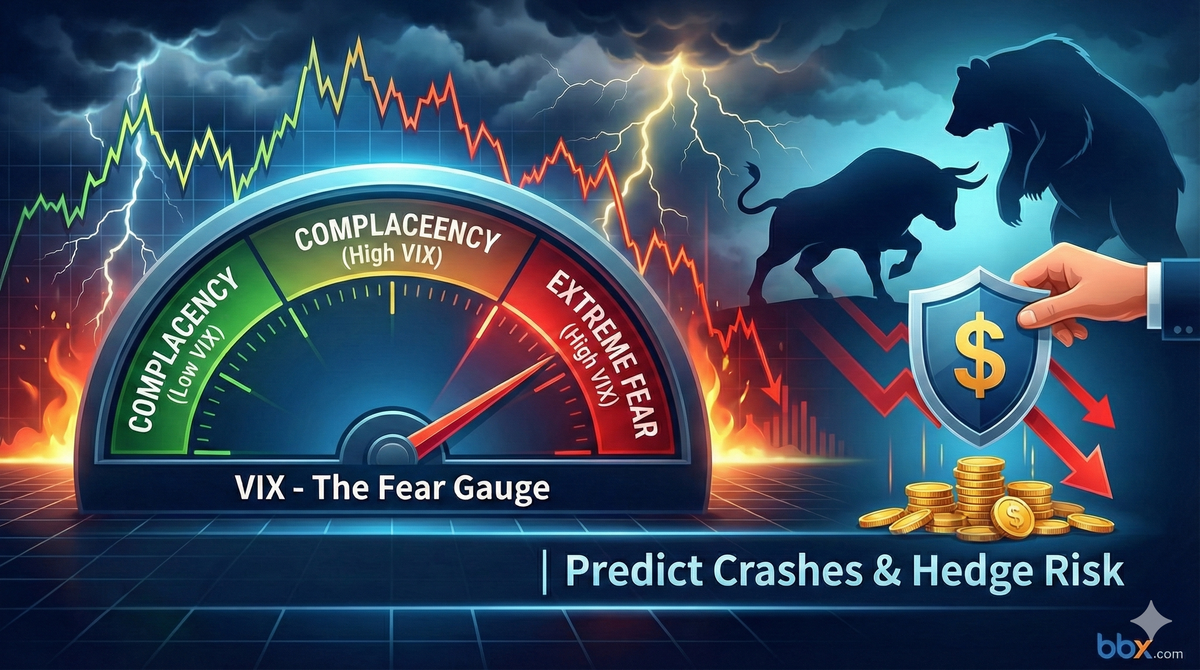
TL;DR (Quick Answer):
The CBOE Volatility Index (VIX), widely known as the "Fear Gauge," is the premier benchmark for stock market volatility. It measures the market's expectation of 30-day forward-looking volatility based on S&P 500 index options. It does not measure past movement; rather, it reflects the "insurance premiums" investors are paying to protect their portfolios. High VIX signals panic and uncertainty; Low VIX signals complacency or stability.
1. What is the VIX?
Created by the Chicago Board Options Exchange (CBOE) in 1993, the VIX is the global standard for gauging market sentiment.
- Core Definition: The VIX measures Implied Volatility (IV). It quantifies how much market participants are willing to pay for S&P 500 (SPX) Options to hedge their risk.
- The "Insurance" Analogy: Think of the VIX as the price of catastrophe insurance.
- When the weather is sunny (a steady bull market), nobody feels the need for insurance. Premiums are cheap, so the VIX is low.
- When a hurricane warning is issued (market crash fears), everyone rushes to buy protection. Premiums skyrocket, and the VIX spikes.
2. The Math: How It’s Calculated
The VIX calculation moved away from the Black-Scholes model in 2003 to a Model-Free approach. It aggregates the weighted prices of a wide range of Out-of-the-Money (OTM) puts and calls.

Decoding the Variables:
- $T$ (Time to Expiration): The calculation is weighted to reflect a constant 30-day maturity.
- $K_i$ (Strike Price): The strike price of the $i^{th}$ out-of-the-money option. The VIX captures the entire "volatility smile."
- $Q(K_i)$ (Price of Option): The midpoint price of the option. This is the heart of the formula—the more expensive the options, the higher the VIX.
- $F$ (Forward Index Level): The forward price level of the S&P 500.
Pro Insight:
The formula naturally gives more weight to OTM Puts (downside protection). This explains why the VIX reacts much more violently to market crashes (panic buying of puts) than to market rallies.
3. Practical Application: How to Trade the VIX
For traders on bbx.com engaging in macro hedging or trend analysis, the VIX typically maintains a strong negative correlation (-0.7 to -0.8) with the S&P 500.
The VIX Threshold Guide
| VIX Level | Market State | Investor Sentiment | Trading Strategy |
| < 15 | Complacency | Extreme optimism; risk is ignored. | Caution: The market may be overextended. Puts are cheap; it is an ideal time to hedge long portfolios. |
| 15 - 20 | Normal | Stable sentiment; orderly price action. | Neutral: Standard trend-following strategies apply. Focus on fundamentals. |
| 20 - 30 | Elevated (Fear) | Rising anxiety; increased turbulence. | Defensive: Reduce leverage. Rotate into cash or defensive sectors (Utilities, Staples). |
| > 35 | Panic (Capitulation) | Irrational selling; crisis mode. | Contrarian: Often marks the point of "max pain." Historically, this signals a major buying opportunity for long-term investors. |
The Trader's Adage
"When the VIX is high, it's time to buy. When the VIX is low, look out below."
4. Critical Risks & Common Pitfalls
Even sophisticated traders often lose money on volatility products due to structural misunderstandings:
- Non-Directional Nature:The VIX measures the magnitude of expected movement, not the direction. While a VIX spike usually correlates with a market drop, an explosive upside rally can theoretically push the VIX higher (as call options become expensive), though this is rare.
- Mean Reversion:Unlike a stock, which can go to zero or infinity, the VIX is mean-reverting. It tends to oscillate around its long-term average (approx. 19-20).
- The Takeaway: Never hold a long VIX position indefinitely, and be extremely cautious shorting it when it is already at multi-year lows (e.g., below 12).
- The "Contango Trap" in ETFs:This is the most dangerous pitfall. Many retail investors buy ETFs like VXX or UVXY hoping to hold them long-term.
- The Reality: The VIX futures market is usually in Contango (future months are more expensive than the current month). The ETF manager must constantly "sell low (expiring futures) and buy high (next month's futures)." This negative roll yield destroys the ETF's value over time. These products are strictly for short-term hedging, not investing.
5. Frequently Asked Questions (FAQ)
Q: Can I buy the VIX index directly?
A: No. The VIX is a mathematical statistic, not a tradable asset. You cannot buy "shares" of the VIX. You can only trade VIX Futures, VIX Options, or Exchange Traded Products (ETPs) like VXX or VIXY.
Q: What constitutes a market "Crash" in VIX terms?
A: generally, a VIX reading above 40 indicates extreme panic or a crash. For context: The VIX hit 80 during the 2008 Financial Crisis and peaked at 82 during the March 2020 COVID-19 sell-off.
Q: Why does the VIX sometimes rise when the market rises?
A: This is known as Divergence. It occurs when the market is rallying, but investors are nervous about an imminent reversal, leading them to buy stocks and puts simultaneously. This is often a bearish signal indicating a market top may be forming.
Explore the Future of RWA with BBX Trade US/HK equities directly with stablecoins.
website: https://bbx.com/
X: https://x.com/bbx_official
Telegram: https://t.me/bbxcommunity
Discord: https://discord.com/invite/TAypgax4v9