When Earnings Stop Working: The AI Sector’s February Reckoning
The AI technical tsunami is hitting a "shoot first" phase. Explore why record margins at $APP and surging orders at $CSCO triggered a market sell-off, and how the "HALO" (Heavy Assets, Low Obsolescence) framework is becoming the ultimate hedge in 2026.

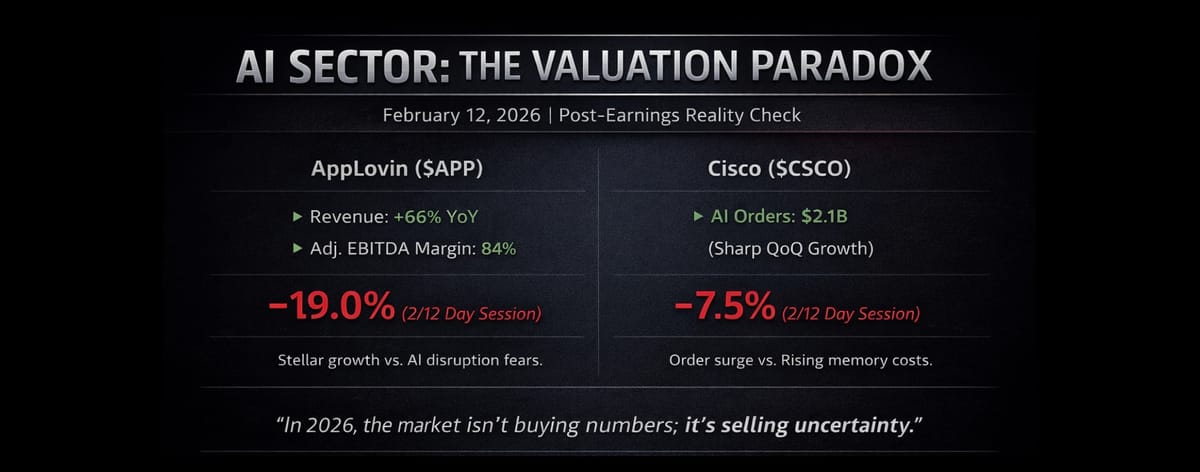
February 12, 2026 | Post-Earnings Market Review
1. A Market That Sells First, Thinks Later
The February 12 selloff across AI-linked equities marks a clear shift in market behavior.We are no longer in a regime where strong earnings automatically translate into higher valuations.Instead, we are seeing:
A “Sell First, Analyze Later” market.
In this environment, investors are de-risking first — and asking questions later — as uncertainty around AI disruption, capital intensity, and competitive moats continues to grow.This is not a liquidity crisis.
It is a confidence and narrative crisis.
2. AppLovin ($APP): When Strong Fundamentals Are Not Enough
AppLovin delivered one of the strongest earnings reports in the sector:
- Revenue: +66% YoY
- Adjusted EBITDA Margin: 84%
By traditional standards, this was a textbook “beat-and-raise” quarter.Yet the stock fell nearly 19% in a single session.Why?Because the market is no longer pricing growth alone.
It is pricing moat durability in an AI-driven ecosystem.Investors are questioning:
- How sustainable are app monetization models?
- How exposed are ad-tech platforms to AI-driven disintermediation?
- Will generative AI compress margins over time?
Stellar numbers could not offset structural concerns.
3. Cisco ($CSCO): Demand Is Real, Costs Are Rising
On the hardware side, Cisco presented a different version of the same dilemma.Key highlights:
- AI-related orders: $2.1B
- Strong quarter-over-quarter acceleration
Enterprise and hyperscaler demand for AI infrastructure remains robust.However, rising memory and component costs are squeezing margins.The result:Revenue visibility improved, but profitability expectations weakened.This reflects a broader theme in AI hardware:
The arms race is intensifying — and it is becoming more expensive to compete.
With hyperscale capex approaching historical highs, cost discipline is becoming as important as growth.
4. Contagion Beyond Pure AI Stocks
The “AI scare” is no longer confined to software and semiconductors.Logistics and services firms such as $CHRW also saw sharp declines, reflecting fears of automation and AI-driven efficiency gains.This suggests that:AI risk is now being priced as a systemic factor, not a sector-specific issue.Markets are reassessing entire business models.
5. From Disruptors to Enablers: A Structural Rotation
One important shift is emerging beneath the volatility:Capital is slowly rotating away from speculative “AI Disruptors” and toward proven “AI Enablers.”Disruptors:
- High growth
- Unclear monetization
- Heavy narrative dependence
Enablers:
- Infrastructure
- Platforms
- Embedded enterprise adoption
- Demonstrable ROI
In a higher-rate, higher-volatility environment, durability matters more than vision.
6. The Macro Overlay: CPI Still Matters
This repricing is happening under tight macro constraints.Inflation data, especially CPI, remains a key catalyst for risk assets.The next directional move in AI equities will likely depend on:
- Inflation trends
- Rate expectations
- Liquidity conditions
- Risk appetite
Without a clear easing signal, valuation multiples will remain under pressure.
7. The Current Regime: “Sell First, Analyze Later”
We are currently operating in a “Sell First, Analyze Later” regime.Characteristics:
- Earnings beats are discounted
- Forward guidance is scrutinized aggressively
- Narrative risk dominates valuation
- Volatility clusters
This is typical of late-cycle and transition phases.Not a collapse — a recalibration.
8. Strategy: Positioning for the Next Phase
In this environment, investors should prioritize:
- Cash flow durability
- Proven AI monetization
- Balance sheet strength
- Pricing power
- Embedded enterprise demand
Rather than chasing the next breakthrough story, focus on companies that already generate measurable returns from AI deployment.
9. Final Thought
The AI shockwave is spreading across traditional sectors. After Anthropic’s latest tools disrupted software workflows, fear is now hitting offices, property, and logistics.
We’re in a “sell first, ask later” market — even minor disappointments trigger aggressive de-risking. Capital is rotating toward Treasuries and “AI-insensitive” real-economy plays.
Enter HALO stocks: Heavy Assets, Low Obsolescence.
In 2026, the market isn’t buying numbers.It is buying confidence.And selling uncertainty.Until narrative stability returns, volatility will remain the price of participation.