Why Do You Still Lose Money Despite Knowing the Indicators? Unmasking the Twin Demons of Trading Psychology
Know all the technical indicators but still buy at the top and sell at the bottom? Uncover the root causes of retail losses: FOMO and Panic Selling. Learn to conquer your emotions and execute your trading plan like a machine on bbx.com.

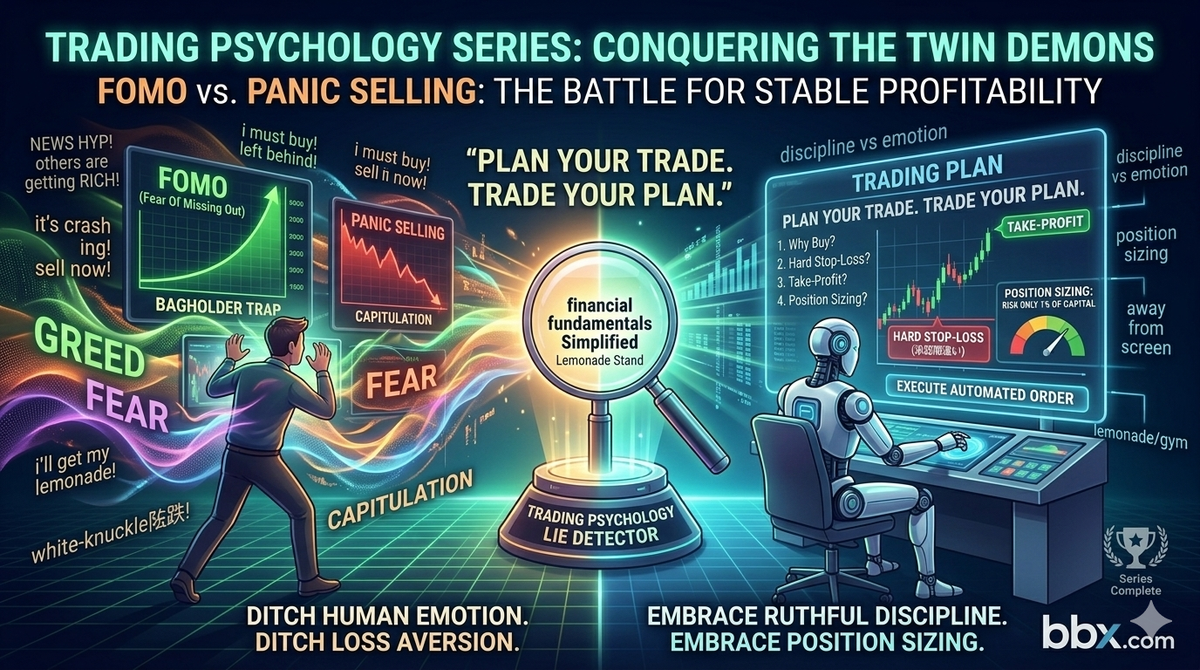
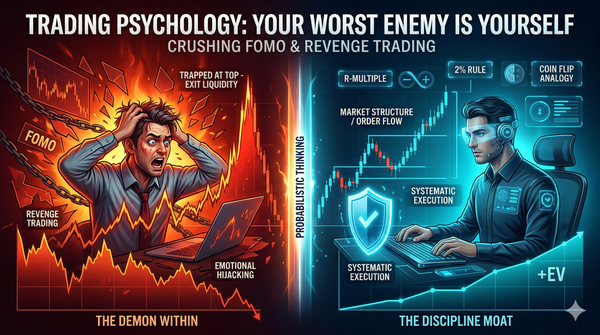
TL;DR (Quick Answer): In the financial markets, your biggest enemy isn't the market makers, nor is it Wall Street. It's yourself. Over 90% of retail trading losses can be boiled down to being hijacked by two emotional extremes:FOMO Driven by Greed: Watching others get rich hurts more than losing your own money. Seduced by a massive green candle, you throw logic out the window and buy at the absolute peak.Panic Selling Driven by Fear: Faced with mounting paper losses and a barrage of negative news, your mental defenses shatter, causing you to capitulate and sell your shares right before the dawn of a massive reversal.The Antidote: Trading is not about intuition; it's about ruthless discipline. "Plan your trade, and trade your plan." You must train yourself to execute like an emotionless machine.
Introduction: Why Do You Always "Buy the Top and Sell the Bottom"?
Have you ever experienced this bizarre phenomenon? You watch a stock for weeks, but you're too scared to pull the trigger. Finally, one day, it surges 15%. Your group chats are flooded with screenshots of massive gains, and you just can't take it anymore. You go all-in. The exact second you hit "Buy" marks the historical top.
Subsequently, the stock bleeds for half a month. Your portfolio is slashed in half, and staring at those red numbers keeps you awake at night. Finally, on a morning of brutal market-wide sell-offs, you despairingly click "Liquidate All." The very next day, the stock stages a miraculous V-shaped recovery.
Do you think institutional algorithms are specifically hunting your $5,000 account? Absolutely not. It's simply because your emotional rhythm perfectly triggered the predictable traps of human nature. Institutional "Smart Money" actively exploits these exact psychological weaknesses to harvest retail capital.
Today, we are going to dissect the two mental demons that are stripping retail investors of their wealth.
Demon 1: FOMO (Fear Of Missing Out) — The Root of Becoming a "Bagholder"
FOMO (Fear Of Missing Out) is a highly fatal contagion, especially prevalent in the crypto and tech stock arenas.
- The Psychological Trigger: When an asset (like Tesla or a trending Meme coin) goes parabolic, your initial reaction is skepticism. But as the price climbs higher, media hype explodes, and your coworker—who knows absolutely nothing about stocks—brags about making 20%, your mindset fractures. You are no longer thinking, "What is the intrinsic value of this company?" Instead, you are terrified: "If I don't buy in right now, I'm going to be left behind by a generational wealth transfer!"
- The Market Maker's Script: This phase of extreme, irrational euphoria is exactly what we call a "Blow-off Top" in technical analysis. While retail traders are blinded by FOMO and rushing in with hard-earned cash, rational institutions are quietly distributing their shares, handing you the baton at the finish line.
- The Fatal Consequence: If you buy at the peak of a bubble based on luck, you are mathematically guaranteed to lose it all on skill when the bubble inevitably pops.
Demon 2: Panic Selling — Capitulating Right Before Dawn
In behavioral finance, there is a famous concept known as "Loss Aversion": The psychological pain humans feel from losing $10,000 is far more intense than the joy experienced from gaining $10,000.
- The Psychological Trigger: When a stock you bought drops 10%, you play dead (refusing to cut losses, hoping it bounces back). When it drops 30%, the financial news starts pumping out articles calling it "a terrible company." When it plunges 50% amidst a broader market crash, your psychological defenses completely shatter. To end the daily, agonizing mental torture of watching your money evaporate, you close your eyes and hit "Sell," just to buy yourself some peace of mind.
- The Market Maker's Script: Moments of extreme panic are usually accompanied by a "Volume Capitulation." Retail investors surrender their bloody shares in total despair. Institutional capital (Smart Money) steps in at this exact moment, utilizing the massive liquidity provided by retail panic to aggressively accumulate shares at rock-bottom prices.
- The Fatal Consequence: The perfect "Sell Low." You white-knuckled your way through a grueling, months-long downtrend, only to voluntarily kick yourself out of the game just one second before the true market reversal.
The BBX Antidote: How to Turn Yourself Into a "Trading Robot"
To beat Wall Street, you must first defeat your own amygdala (the brain's emotional processing center). Here are the three ironclad rules professional traders use to neutralize emotions:
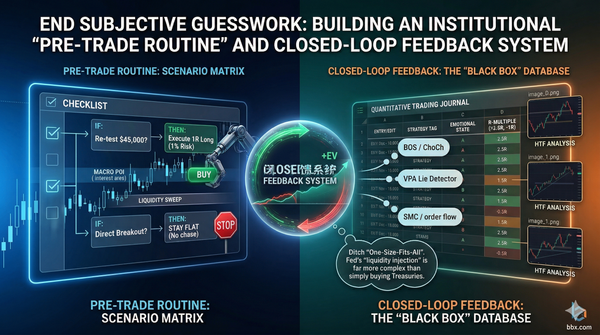
1. Pre-Trade: Write Down Your "Script" (The Trading Plan)
Never, ever make trading decisions while staring at flickering, live charts during market hours! Before executing any trade, pull out a piece of paper and write this down:
- Why am I buying? (e.g., "The moving averages just formed a Golden Cross, and the fundamental report shows robust Free Cash Flow.")
- Where do I admit I'm wrong? (Stop-Loss): (e.g., "If it breaks below the 200-day MA, my thesis is invalidated. I will exit immediately, regardless of the dollar amount lost.")
- Where do I take profits? (Take-Profit): (e.g., "When it hits historical resistance, I will sell 50% of my position to lock in gains.") No plan, no trade. Period.
2. Mid-Trade: Position Sizing Dictates Your Mindset
Why do you panic? Because you bought too much! If you have a $100,000 account but borrow on margin to buy $500,000 worth of stock, a mere 2% dip will cause your heart rate to spike. If you only risk $1,000 to test a thesis, you will just shrug off a 20% drop, allowing you to rationally assess whether the technical setup is truly broken. Never expose an amount of capital to the market that will cost you your sleep.
3. Post-Trade: Step Away from the Screen
Micromanaging your trades and constantly checking the ticker is the ultimate catalyst for FOMO and Panic. Every microscopic tick of the market will toy with your nerves. Input your hard Stop-Loss and Take-Profit orders into your brokerage platform, close the app, go grab a lemonade, hit the gym, and live your life. Let the market act out the script you've already written.
Disclaimer: This report is for informational purposes only and does not constitute financial advice.