Why Is Cutting Losses So Hard? The Art of the Stop-Loss and Admitting Defeat to the Market
"It's not a loss until you sell." Unmask the deadly psychological trap of the Sunk Cost Fallacy. Learn how to treat Stop-Losses as business insurance and master fixed-percentage and technical support methods to protect your capital on bbx.com.

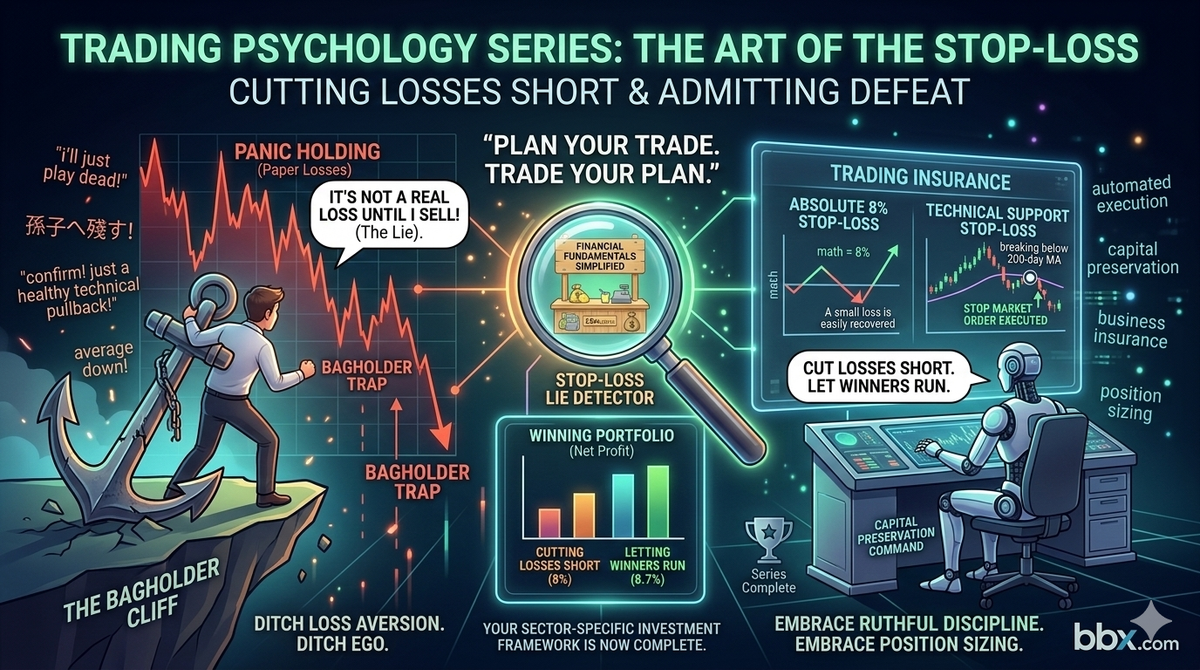
TL;DR (Quick Answer): The essence of profitable trading is not achieving a 100% win rate; it is cutting your losses short and letting your winners run.The Psychological Trap: Most retail traders fall victim to the "Sunk Cost Fallacy," believing the ultimate lie: "It's not a real loss until I sell." Stubbornly holding onto losing positions (bagholding) is the number one cause of blown-up accounts.The Mindset Shift: Never view a Stop-Loss as the humiliation of "being wrong." Instead, treat it as a mandatory "business insurance premium" paid to survive in a market full of uncertainties.The Scientific Method: Stop trading on 'gut feeling.' The exact second you enter a trade, you must place an automated Stop-Loss order based on a fixed percentage (e.g., an 8% max loss) or a key technical support level (e.g., breaking below the 200-day moving average). Let the machine execute your discipline and bypass human weakness.
Introduction: The Deadly Illusion of "It's Only a Paper Loss"
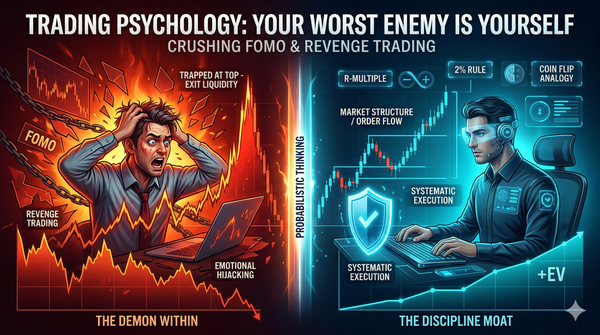
Every trader who has ever watched their portfolio get cut in half has gone through this exact psychological lifecycle: You buy a stock brimming with confidence. The next day, it drops 5%. You tell yourself: "It's just a healthy technical pullback. The fundamentals haven't changed. I'll sell when it bounces back." A week later, it's down 15%. Anxiety creeps in: "It's too late to sell now. I'll just wait for it to hit support and average down to lower my cost basis." A month later, it's down 40%. You are completely numb: "Whatever. I'll just play dead. I'm a long-term value investor now. I'll leave these shares to my grandkids."
Why are we always so eager to lock in tiny profits, yet display an unnatural, superhuman level of patience when it comes to sitting on massive losses?
The Psychological Truth: You Are Hostage to the "Sunk Cost Fallacy"
In behavioral economics, this destructive behavior is driven by the Sunk Cost Fallacy and Confirmation Bias.
The moment you buy a stock, your brain loses its objectivity. You will instinctively scour the internet for bullish news to prove that "your thesis is still correct." Once the stock price drops, triggering a stop-loss means you have to psychologically admit: "I was wrong. I made a foolish decision."
To escape the pain of admitting defeat, the human brain activates a defense mechanism, whispering the ultimate lie: "As long as you don't hit the sell button, it's just floating paper losses. You haven't actually lost any real money."
The brutal reality: The market does not care about your ego. A single, uncontrolled loss is more than enough to wipe out the hard-earned profits of ten successful trades.
The Mindset Shift: A Stop-Loss Isn't a Penalty, It's "Insurance"
The biggest difference between professional traders and retail amateurs lies in how they define a "Stop-Loss."
- The Retail Perspective: Stop-Loss = Losing money = I am a loser = Psychological pain.
- The Professional Perspective: Stop-Loss = The cost of doing business = The seatbelt on a racecar = Commercial insurance.
The BBX Lemonade Stand Analogy: Imagine you run a successful lemonade stand, and every year you pay $5,000 for commercial fire insurance. If your stand doesn't burn down that year, do you consider that $5,000 a "loss"? Do you scream in frustration, "If I knew there wouldn't be a fire, I never would have paid that premium!"? Of course not! You are thankful that this "sunk cost" protected you from total bankruptcy.
In the financial markets, the risk capital allocated to your stop-loss is simply the "insurance premium" you pay for the opportunity to catch a massive winning trade. When your stop is hit, your insurance policy simply kicked in. There is absolutely zero shame in it.
How to Set a Stop-Loss Scientifically: Eliminating Emotional Trading
Once you understand the psychology, you must apply scientific execution. A Stop-Loss should never be a subjective decision made when the pain becomes unbearable. It must be a precise number calculated before you even enter the trade.
Here are the two most practical and widely used scientific stop-loss methods deployed by institutional traders:
1. The Fixed Percentage Stop-Loss (Ideal for Beginners)
This is the most straightforward, yet highly effective, shield for your capital. The most famous iteration is growth-investing legend William O'Neil's "Absolute 8% Stop-Loss Rule."
- The Rule: No matter how incredible the fundamentals are, or what the broader market is doing, if the stock drops 7% to 8% from your purchase price, you must liquidate the position unconditionally. No excuses.
- The Logic: The math of drawdowns is unforgiving. If you take an 8% loss, you only need an 8.7% gain on your next trade to break even. But if you stubbornly hold onto a 50% loss, you need a 100% gain on your next trade just to get back to zero! Anyone who has traded knows how incredibly difficult it is to find a stock that doubles.
2. The Technical Support Stop-Loss (Ideal for Intermediate Traders)
This method integrates the knowledge we learned in the Technical Analysis series. Instead of a rigid percentage, it uses the market's actual structural support zones.
- The Rule: Identify the nearest key support level for the stock (e.g., a recent consolidation base, the lower bound of an uptrend line, or a major moving average like the 50-day or 200-day MA). Place your stop-loss order slightly below this support line (leaving a small buffer to avoid getting "whipsawed" or "stop-hunted" by market makers).
- The Logic: Support levels represent the market's consensus "floor." If the price violently breaks below this floor, it indicates that the underlying market logic has shifted, and your original thesis for buying is now invalidated. Why stick around in a burning building?
The Ultimate Discipline: Using "Systems" to Combat "Human Nature"
The final and most crucial point: Never trust your own willpower! Human beings are inherently irrational when staring at a flashing, red P&L screen. The best practice is this: The exact second you click "Buy" on your brokerage platform, immediately attach an automated Hard Stop-Loss Order (Stop Market Order). Hand the execution power over to a cold, emotionless computer algorithm. When the price hits your target, the machine will sell it for you. Then, close the app and go about your day.
Disclaimer: This report is for informational purposes only and does not constitute financial advice.