Your Worst Enemy is Yourself: Crushing FOMO and Revenge Trading to Build an Institutional "Discipline Moat"
Having a perfect trading system but still losing money? The weakest link is the human element. This article dives deep into trading psychology, teaching you how to eradicate FOMO and revenge trading, and rebuild institutional-grade discipline using probabilistic thinking.

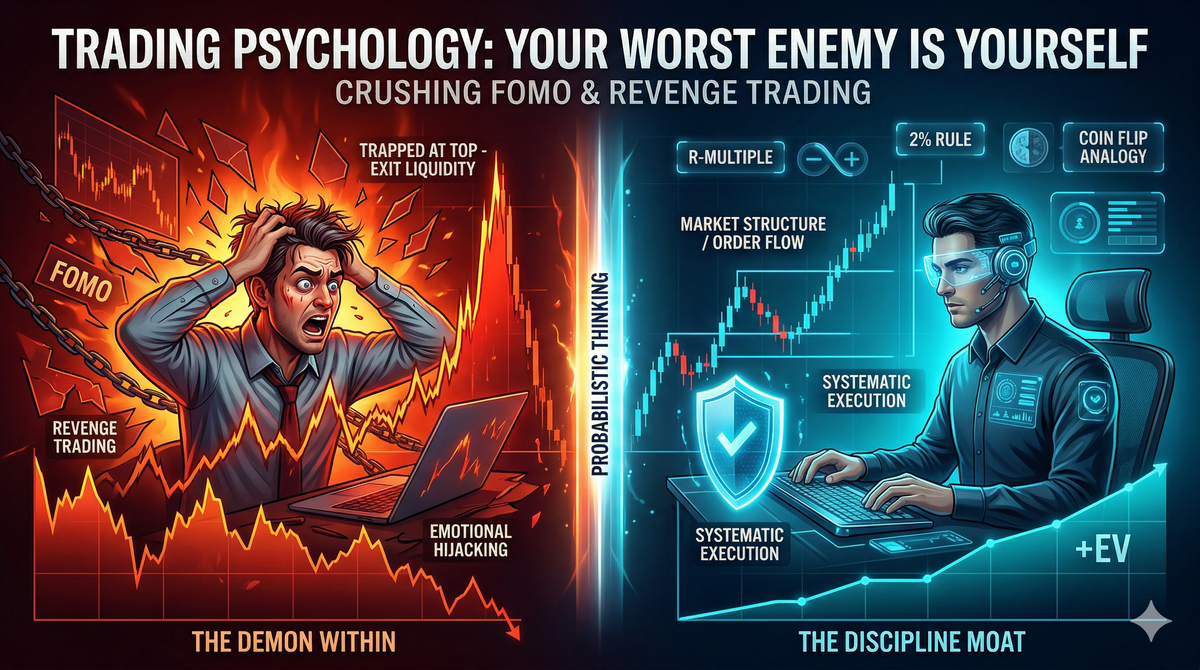
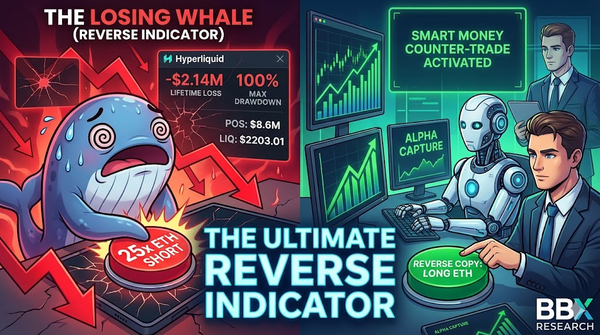
TL;DR (Core Summary): The ultimate adversary of any trading system isn't the market maker; it is the dopamine and adrenaline hijacking your own brain.FOMO (Fear Of Missing Out): Watching others make money hurts more than losing your own. Blindly chasing assets that have already gone parabolic essentially turns you into Exit Liquidity for institutional profit-taking.Revenge Trading: The anger and resentment following a loss. Abandoning all rules and maxing out leverage just to "make it back quickly" is the number one killer that wipes out accounts instantly.Thinking in Probabilities: Relinquish your obsession with the outcome of any "single trade." Treat each trade as just one in a series of 1,000 coin flips. As long as your system has a Positive Expected Value (+EV), profitability over a large sample size is a mathematical certainty.
Introduction: Why Do You Turn Into an "Out-of-Control Gambler" in Front of the Screen?
In hindsight, when reviewing historical candlestick charts, everyone is a rational market wizard: "Buy the breakout here, stop out below the breakdown there—absolutely flawless." But in live trading, watching the red and green numbers violently tick on your screen, your heart races and your palms sweat. Once you miss a massive macro move or get stopped out twice in a row, your rationality evaporates. Only one thought echoes in your mind: "I need to get in now!" or "I must win my money back immediately!"
This phenomenon is known as Emotional Hijacking. In highly volatile markets, your ancient reptilian brain completely overrides your prefrontal cortex (the area responsible for rational, logical thought). Institutions consistently harvest retail traders precisely because their quantitative algorithms feel no emotion, while retail traders are walking bundles of psychological vulnerabilities. Today, we will use systemic rules and cognitive reframing to lock away the two demons in your mind: FOMO and Revenge Trading.
I. Demon #1: FOMO (Fear Of Missing Out)
You were patiently waiting in cash, only to notice an asset skyrocket 30% in just a few hours. Social media is buzzing, and everyone in your group chats is posting screenshots of massive profits. You feel an intense spike in your heart rate and overwhelming anxiety. You think, "If I don't buy right now, I'll miss the greatest wealth-building opportunity of my life." In a fever state, you go all-in at the absolute peak. The very moment your order fills, the price begins a cascading waterfall dump.
This is FOMO.
The Institutional Perspective: What Are You Actually Buying?
When a price chart prints a near-90-degree vertical rally, it means early institutional capital and Smart Money are already sitting on massive floating profits. To lock in those gains and convert them to cash, they need a massive influx of "buy orders" to absorb the shares they are dumping. Who provides these buy orders? Retail traders consumed by FOMO. Your impulsive buy at the mountaintop is the perfect Exit Liquidity for institutions.
The Discipline Moat:
- The "Let It Go" Rule: If a train has already left the station and is accelerating at full speed, never attempt to jump on. Missing a profitable trade simply means you didn't make money; blindly chasing a parabolic top means facing a devastating drawdown of your actual principal.
- The market will never run out of opportunities; it only runs out of capital. Tell yourself: "This trade does not meet my systemic criteria. Even if it goes to the moon, it has absolutely nothing to do with me."
II. Demon #2: Revenge Trading
Imagine you executed a trade with strict discipline, but you were stopped out by a sudden fakeout, losing 2%. You feel incredibly angry and wronged: "The market makers are targeting me! My directional bias was perfectly right!" To prove you are right, and to "win back that 2% immediately," you instantly reopen the position right where you stand, perhaps even doubling your leverage. Then, the price violently moves against you again, and your account is instantly liquidated.
In poker, this emotional downward spiral is called going on "Tilt." In trading, it is known as Revenge Trading.
The Dangerous Illusion: The Market Owes You
The underlying psychology of revenge trading is the belief that the market is a conscious entity that "stole" your money, and you must "take it back." The brutal reality is this: The market has no idea who you are, and it doesn't care that you exist. Your anger has zero effect on the market; it only blinds you to objective chart structures. All the rules regarding support/resistance and volume analysis we learned previously are completely thrown out the window the moment you tilt.
The Discipline Moat:
- The Daily Drawdown Limit (Circuit Breaker): Elite professional traders employ mandatory circuit breakers. For example: "If I suffer 2 consecutive losses today, or my total daily loss hits 4% of my account equity, I immediately close the trading platform, unplug, and walk away from the screens for 24 hours."
- Physical separation is the most effective cure for "tilt." The sun will rise tomorrow, and the market will still be there. Wait for your emotional baseline to reset before you ever look at a chart again.
III. The Ultimate Antidote: "Thinking in Probabilities"
How do you permanently eradicate FOMO and the urge for revenge? You must fundamentally reconstruct your worldview.
Trading master Mark Douglas, in his seminal work Trading in the Zone, posited that most retail pain stems from attempting to predict the outcome of every single, independent trade. When they lose, they perceive it as an invalidation of their own self-worth and analytical abilities.
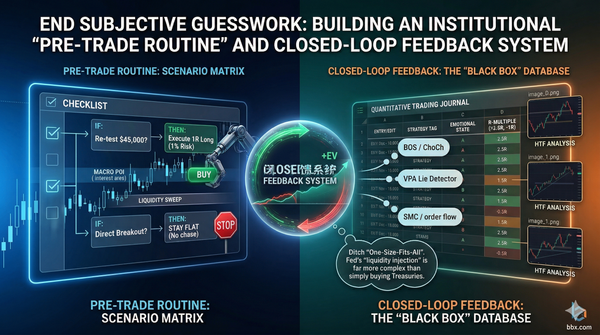
Professional traders do not predict; they operate strictly on probabilities. If your trading system (built via our Technical Analysis and Risk Management SOPs) boasts a 40% win rate and a 1:3 Risk/Reward ratio, it is a money-printing machine with a Positive Expected Value (+EV).
Within this system:
- The outcome of your very next trade is completely random, and you shouldn't care about it.
- As long as you execute your rules strictly over 100 or 1,000 trades, under the Law of Large Numbers, you are mathematically guaranteed to be profitable.
When you shift your mental focus from "I must win this specific trade" to "Did I flawlessly execute my trading discipline?", losses will no longer enrage you, and missing out will no longer make you anxious. You understand that the current trade is merely one tiny, insignificant ripple in a thousand coin flips.
Conclusion: The Lonely Path of Mindful Execution
The optimal state of a trader is akin to a cold, emotionless machine. Unfazed by massive rallies, undeterred by stop-outs. When the price reaches your Point of Interest (POI), and a signal appears, you pull the trigger, set the hard stop, and hand the rest over to probability.
Building a mechanical trading system might only take a few weeks, but battling the vulnerabilities of your own human nature is a lifelong cultivation. Crush your FOMO, lock away your urge for revenge. On this lonely path, discipline is your only moat.
Disclaimer: This report is for informational purposes only and does not constitute financial advice.