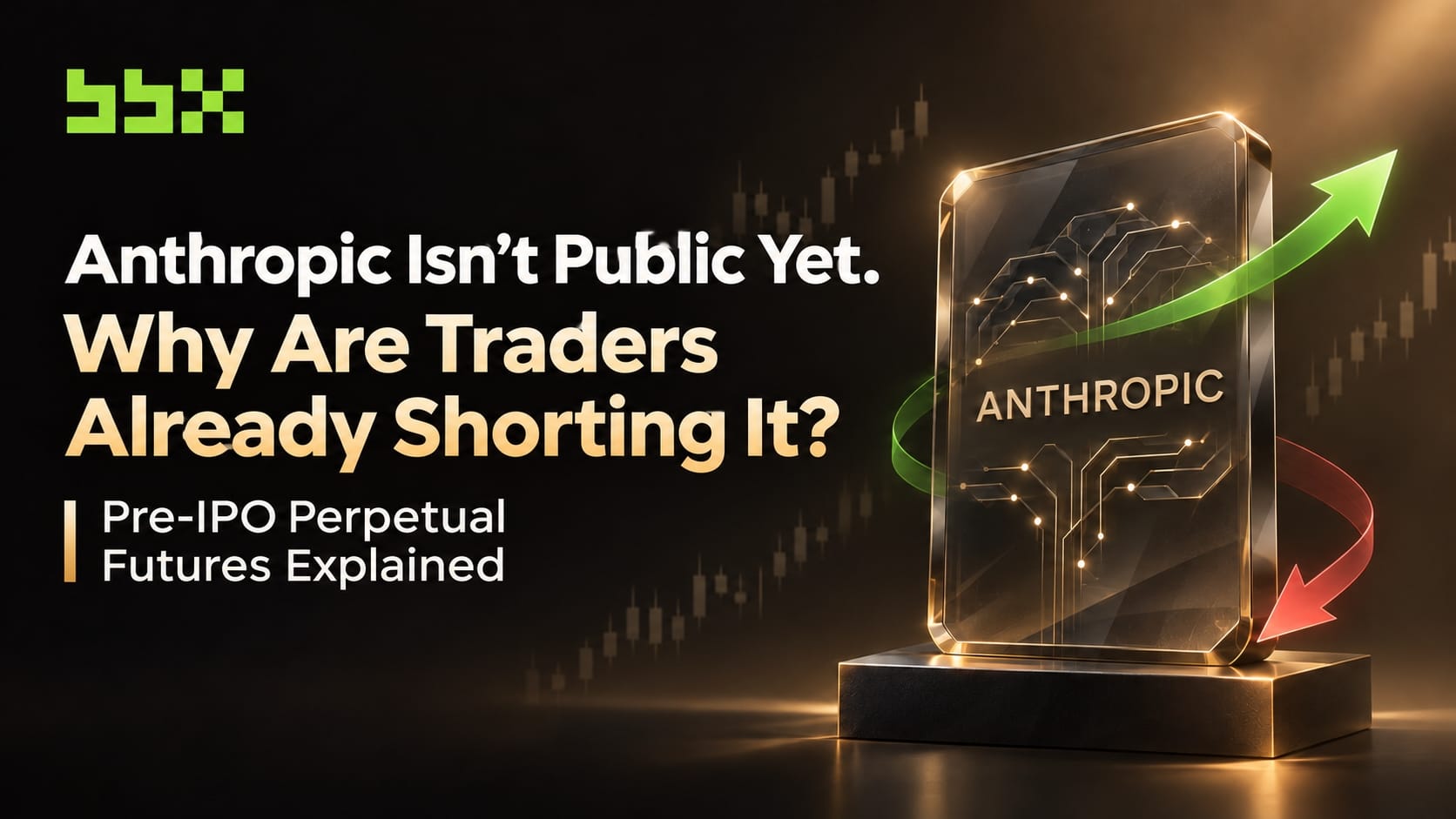
Anthropic Isn't Public Yet. Why Are Traders Already Shorting It? How Pre-IPO Perpetual Futures Trade Pre-Listing Expectations
After Anthropic updated its IPO filing, pre-IPO perpetual futures initially declined before some markets rebounded. Using BBX ANTHROPICUSDT as an example, this article explains Pre-IPO perpetual futures, cross-platform price differences, funding rate strategies, and trading risks.
Summary: After Anthropic filed its IPO registration statement on October 26 and updated its financial disclosures on November 2, the pre-IPO derivatives market experienced significant volatility. During the reporting period ending at 2:00 p.m. Beijing time on November 3, Anthropic Pre-IPO perpetual futures fell approximately 4.20%–4.86% across three sampled markets, followed by a partial rebound in some markets. Why can traders already take long or short positions when the company has not yet gone public? Using ANTHROPICUSDT on BBX DEX as an example, this article explains how Pre-IPO perpetual futures allow traders to express valuation expectations, along with the related mechanisms of price discovery, cross-platform price differences, and funding rate strategies.
As Anthropic Moves Toward an IPO, Valuation Differences Are Already Being Traded
For a company that has not yet gone public, investors generally have limited ways to express short-term bullish or bearish views as directly as they can when trading publicly listed shares. But the emergence of Pre-IPO perpetual futures is changing that.
On October 26, 2026, Claude developer Anthropic publicly filed an IPO registration statement with the U.S. Securities and Exchange Commission (SEC), proposing ANT as its Nasdaq ticker symbol. On November 2, the company submitted an amended registration statement (S-1/A). According to its latest disclosures, Anthropic generated approximately $16.96 billion in revenue in the third quarter of 2026, up nearly 47% quarter over quarter. At the same time, computing infrastructure investments, rising costs, and future capital expenditure commitments became important factors in how the market reassessed its valuation. As of the time of writing, the final offering price and official listing date have not yet been determined.
The market's reaction to these financial disclosures illustrates a key point: the same growth figures can lead to sharply different assessments. Some focus on the rapid expansion of AI demand, while others question whether high valuations already reflect future growth and how continued investment could affect profitability.
These differences in opinion have already been reflected in the pre-IPO derivatives market. According to a snapshot of publicly available market data, following Anthropic's updated financial disclosures and through 2:00 p.m. Beijing time on November 3, the relevant Pre-IPO perpetual futures contracts in three major sampled trading markets fell between 4.20% and 4.86%. The market did not continue to decline in a straight line afterward. During trading on November 4, some markets saw a partial rebound, indicating that traders were continuing to reassess Anthropic's valuation ahead of its IPO.
It is important to note that the 4.20%–4.86% figures represent historical declines in three sampled markets over a specific period. They are not an average for all platforms, nor do they represent the performance of BBX's contract during the same period. Contract specifications, quotation scales, and liquidity may also differ across trading venues.
On BBX DEX, traders can use the listed ANTHROPICUSDT Pre-IPO perpetual futures contract to take long or short positions based on their valuation expectations before Anthropic officially goes public. This does not mean acquiring Anthropic shares in advance. Rather, it provides a way to participate in pre-listing price discovery and attempt to capture trading opportunities arising from changes in valuation expectations.
1.What Are Pre-IPO Perpetual Futures? Trading Expectations, Not Shares
Pre-IPO perpetual futures are derivatives that allow trading around expectations for the valuation of a company before its initial public offering. Unlike direct stock ownership, these contracts do not represent an equity stake or confer shareholder voting rights, dividend rights, or the right to convert the contract into shares in the future.Because the underlying company is not yet listed on a public stock exchange, there is no continuously traded share price to serve as a common reference. Contract prices can therefore be more directly affected by financial disclosures, fundraising news, IPO developments, investor sentiment, and contract liquidity.
Their most immediate value is allowing traders with differing views to participate in the same price discovery process:
- Bullish on Anthropic: Traders who believe the company's AI business growth and commercialization potential have not yet been fully priced in may choose to go long. If the contract price rises, long positions may generate a profit.
- Bearish on Anthropic: Traders who believe the valuation is too high, future cost pressures are underestimated, or near-term market expectations may cool can choose to go short. If the contract price falls, short positions may generate a profit.
For example, suppose a position has a notional value of 1,000 USDT. If the contract price moves 5% in the trader's favor, the illustrative unrealized profit would be about 50 USDT, excluding funding rates, trading fees, slippage, and other contract-specific provisions. A 5% move in the opposite direction would generate a corresponding loss. Leverage does not eliminate risk; instead, it may cause the position's margin to reach the liquidation threshold more quickly.
Pre-IPO perpetual futures are therefore best understood as a way to trade pre-listing price expectations in either direction, rather than as a way to “buy shares in an unlisted company early.”
2.Where Can You Trade Them? BBX DEX as an Example
As interest grows in AI companies, technology unicorns, and other potential IPO candidates, Pre-IPO perpetual futures are becoming a distinct segment of the derivatives market.
BBX DEX offers perpetual futures contracts linked to several unlisted companies, such as Anthropic (ANTHROPICUSDT), Kimi (KIMIUSDT), and Polymarket (POLYMARKETUSDT). The current trading status of each contract is subject to the platform's live listings.
For traders who are bullish or bearish on Anthropic's pre-IPO valuation, BBX DEX provides a way to express their views through long or short positions. Traders can use USDT as margin and trade the ANTHROPICUSDT perpetual futures contract without KYC, participating in the market's pre-listing valuation debate.
Lower barriers to trading do not mean lower price risk. Traders should review funding rates, liquidation rules, geographic restrictions, and other applicable trading conditions before opening a position.
3.What Happens to Pre-IPO Contracts After the Company Goes Public?
Another major question about Pre-IPO perpetual futures is how they are handled once the underlying company completes its IPO. Depending on the platform and contract, the arrangements may include continued trading, a change in contract classification, or settlement under the applicable rules. Traders should not assume that the term “perpetual” determines what happens after listing.
BBX previously listed pre-IPO contracts for companies including Unitree Robotics (UNITREEUSDT) and SHEIN (SHEINUSDT). After those companies went public, the contracts' classifications were changed from Pre-IPO to the corresponding stock-market categories. For the specific arrangements applicable to Anthropic's contract, please refer to the announcements and notices that BBX will publish in advance.
This transition matters because pre-listing valuation expectations may differ considerably from prices in the public market after listing. Final offering prices, the start of public trading, and other related events may trigger significant price movements in the corresponding derivatives.
4.Cross-Platform Price Differences and Funding Rates: What Strategies Exist Beyond Directional Trading?
Pre-IPO contracts linked to the same unlisted company may use different pricing benchmarks, contract specifications, and liquidity structures across trading venues. Without a publicly traded underlying share price to provide a common reference, temporary pricing differences can emerge between markets.
Independent market data provider Kaiko has previously documented notable differences in the prices quoted for the same underlying assets across Pre-IPO derivatives trading venues. This shows that pre-listing price discovery does not always occur simultaneously. However, a price difference does not guarantee risk-free arbitrage. Cross-platform trading is still affected by market depth, slippage, trading fees, fund transfers, contract specifications, and the time it may take for prices to converge.
Another area to watch is funding rate differences. Perpetual futures generally use funding rate mechanisms to facilitate periodic payments between long and short positions. When funding rates for the same underlying asset differ across trading venues, traders may examine the use of offsetting positions to reduce directional exposure and seek to capture returns from the funding rate differential.
BBX's Funding Rates and Arbitrage Dashboard, for example, compares funding rates across trading venues and displays certain potential hedging combinations. Such strategies require careful assessment of funding settlement intervals, contract multipliers, mark prices, hedge ratios, trading costs, margin requirements, and liquidation risk. Annualized funding rates or spreads displayed on the dashboard are dynamic indicators, not promises of future returns. Hedged positions across different venues may also fail to eliminate price risk completely.
In other words, Pre-IPO contracts are not limited to directional bets on price movements. They can also be used to explore price discovery and funding rate differentials. Regardless of the strategy, however, actual profit or loss depends on execution prices and the conditions under which positions are held.
5.Key Risks of Pre-IPO Perpetual Futures
Volatility in valuation expectations. Valuations of unlisted companies lack a stable, publicly traded share-price anchor. Financial disclosures, fundraising developments, IPO news, and market sentiment can all change contract prices rapidly.
Leverage and liquidation. Leverage can amplify gains, but it also magnifies losses. During sharp price swings or periods of limited liquidity, stop-loss orders and liquidations may be executed at prices that differ from expectations.Funding rates and trading costs. The longer a position is held, the greater the potential impact of funding payments, trading fees, and slippage on the final profit or loss. Cross-market trading also involves costs on both the long and short sides.
Post-listing contract arrangements. How a contract is handled after an official listing, an extended period without a listing, or other exceptional events depends on the latest applicable product rules and platform announcements.
No equity ownership. Pre-IPO perpetual futures provide exposure to price movements. They do not constitute ownership of shares in an unlisted company or confer shareholder rights.
6.Why Does Anthropic's IPO Matter?
Anthropic's latest disclosures once again highlight a central tension in the AI industry: can rapid growth support the high valuations assigned by the market, and what costs are required to sustain that expansion? The same financial data may prompt some traders to take a bullish view while leading others to reassess the risks.
In the past, such differences in opinion often remained within research reports and discussions. Today, Pre-IPO perpetual futures provide a way to express those views before a company officially goes public.
For traders following Anthropic, the more important questions are not simply “Will it go public?” but “Is the market's current valuation of its future prospects reasonable?” and “How might upcoming developments affect expectations?” On the BBX ANTHROPICUSDT trading page, users can review the relevant contract and choose a trading direction based on their own assessment, while fully considering volatility and leverage risks.
Frequently Asked Questions (FAQ)
Q: Anthropic has not gone public yet. How can traders short it?
A: They can short a perpetual futures contract linked to expectations for Anthropic's pre-IPO valuation, rather than borrowing and selling Anthropic shares. A short position may profit if the contract price declines and may incur losses if the price rises.
Q: Does trading ANTHROPICUSDT mean owning Anthropic shares?
A: No. It provides derivative price exposure, not an equity stake, dividend rights, or other shareholder rights.
Q: Is KYC required to trade Pre-IPO contracts on BBX DEX?
A: According to BBX's current product description, KYC is not required for DEX perpetual futures trading. Specific trading conditions and availability are subject to the platform's published rules.
Q: Can traders pursue funding rate arbitrage with Pre-IPO contracts?
A: Traders may analyze funding rate differences across venues and potential hedging arrangements, but rates can change, and trading involves slippage, margin, contract-rule, and liquidation risks. There are no guaranteed risk-free returns.
Q: Will the BBX contract automatically become a stock perpetual futures contract when Anthropic goes public?
A: That cannot be guaranteed based solely on previous cases. The subsequent handling of the Anthropic contract will be subject to specific announcements and notices published by BBX.
About BBX
BBX is a multi-asset trading platform that uses stablecoins as its funding gateway. BBX's stock account offers trading in actual U.S. and Hong Kong stocks: U.S. stock trades are executed through FINRA-registered partner brokers, with clearing and custody handled by partner clearing institutions; Hong Kong stock trades are executed through partner brokers licensed by the Hong Kong Securities and Futures Commission (SFC). BBX DEX supports 24/7 trading of tokenized stocks and USDT-margined multi-asset perpetual futures, along with automated strategy tools such as futures grid trading.One Account. Global Markets.
Disclaimer and Risk Warning
This article is based on publicly available information and historical market data from specific points in time. It is intended solely for industry information and discussion and does not constitute investment advice, a guarantee of returns, or a recommendation to buy or sell any asset. Pre-IPO perpetual futures are high-risk leveraged derivatives and may result in substantial losses, including the loss of all margin. The market performance figures cited in this article do not represent BBX's performance over the same periods. Illustrative examples exclude actual trading fees, funding rates, slippage, and liquidation effects. Traders should read the applicable contract rules and assess their own risk tolerance before trading.
References
- Anthropic: October 26, 2026 IPO Registration Filing Announcement
- U.S. SEC: Anthropic November 2, 2026 S-1/A Amendment
- Reuters: November 2, 2026 Report on Anthropic's Latest Financial Disclosures and Computing Commitments
- Public Market Performance Data: Through 2:00 p.m. Beijing Time, November 3, 2026
- November 4 Intraday Pre-IPO Contract Market Data Reference
- Kaiko: Cross-Platform Pricing Observations for Pre-IPO Contracts
- BBX DEX: Funding Rates and Arbitrage Dashboard
- BBX: Announcements