
What is the VIX (Fear Index)? A 3-Minute Guide to the Market's Barometer
The VIX, or Fear Index, is the ultimate gauge of market volatility expectations. Discover how the VIX works, how to read its signals, and how to hedge your portfolio.

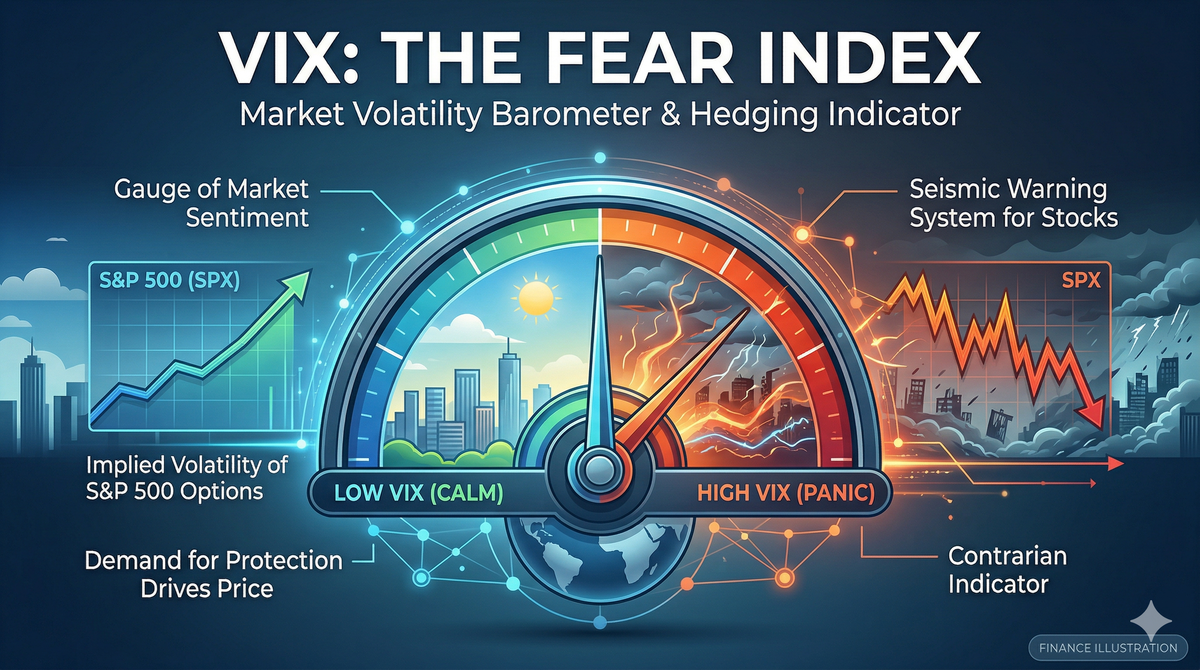
TL;DR: The VIX (CBOE Volatility Index), widely known as the "Fear Index," is the premier benchmark for measuring the expected volatility of the S&P 500 over the next 30 days. It directly reflects investors' anxiety levels: a higher reading signals expected turbulence and market panic, while a lower reading indicates a calm, optimistic outlook.
1. What is the VIX? (What is it?)
In financial markets, the VIX isn't designed to track the rise or fall of stock prices. Instead, it specifically measures the market's "emotional volatility."
It operates by tracking the implied volatility of S&P 500 options. When institutional and retail investors fear an impending market crash, they scramble to buy put options to hedge their portfolios. This massive surge in demand for downside protection directly drives up the value of the VIX.
💡 Real-World Analogy: Think of the VIX as the stock market's "seismic warning system."
- Low VIX (Clear Skies): Like a seismograph with a flat line, investors believe the "tectonic plates" are stable. Everyone is comfortably making money (buying equities).
- High VIX (Storm Approaching): The seismograph needle jumps violently. The market anticipates an imminent "earthquake" (massive price swings), and investors are frantically paying a premium for "insurance."
2. How Does the VIX Work? (How it works)
Without getting bogged down in complex math, we can easily understand the ebb and flow of the VIX through the basic mechanics of supply and demand:
During a steady bull market, investors are confident and don't feel the need to buy options to protect their positions. Because the demand for options is sluggish, options premiums remain cheap, causing the VIX to hover at low levels.
Conversely, when unexpected negative news strikes (e.g., rate hikes, geopolitical conflicts), panic selling ensues. To prevent mounting losses, investors buy put options as insurance at any cost. This frantic buying aggressively bids up the market price of these options. As the system captures this data, the VIX skyrockets.
3. Practical Application: How to Use the VIX? (How to use)
In actual trading, smart investors treat the VIX as a highly effective contrarian investing indicator:
- Reading < 20 (Extreme Optimism/Complacency): The market is in a smooth, mild uptrend. Risk Warning: Prolonged periods of ultra-low VIX often breed complacency. If a "black swan" event occurs, it can trigger a violent and sudden pullback.
- Reading 20 - 30 (Spreading Fear): Market volatility expands significantly. This usually accompanies rapid index declines or precedes major macroeconomic data releases.
- Reading > 30 (Extreme Panic): The market enters an irrational sell-off phase. There's a famous Wall Street adage: "When the VIX is high, it's time to buy." Historical data shows that when the VIX spikes above 35 or 40, selling pressure has largely been exhausted, often signaling an imminent oversold rebound.
💼 bbx.com Actionable Insight: For bbx.com users structuring their portfolios, the VIX is an excellent position-sizing tool. If the broader market is hitting all-time highs but the VIX starts quietly creeping up from the bottom (price-volume divergence), it means "smart money" is secretly buying put options to hedge. That’s your cue to deleverage and lock in profits rather than blindly chasing the rally.
4. Top 3 Traps & Risks When Trading the VIX (Risks)
While the VIX is a superb observation tool, you must avoid these pitfalls if you plan to incorporate it into your strategy:
- The VIX does not predict market direction: A high Fear Index only guarantees "large swings." While it usually accompanies market plunges, rare cases of extreme, euphoric melt-ups can also trigger a spike in volatility.
- You cannot buy the VIX directly: Retail investors cannot buy the VIX like shares of Apple. You can only gain exposure through derivatives such as VIX futures or VIX ETFs (e.g., VXX, UVXY).
- The "Silent Killer" of long-term holding: VIX-related ETFs and futures suffer from severe contango (where futures prices are higher than the spot price). This means funds continuously bleed money when rolling over monthly contracts. Therefore, VIX derivatives are strictly for short-term hedging or speculation and should never be held as long-term investments.
5. Frequently Asked Questions (FAQ)
- Q: What is the baseline safe level for the VIX?
- A: Historically, the long-term average of the VIX is around 18-20. The 20 mark is generally considered the dividing line for market sentiment: below 20 indicates calm and optimism, while above 20 suggests fear is taking over the market.
- Q: Why does the VIX usually move inversely to the S&P 500?
- A: Because when the S&P 500 drops, the demand for hedging peaks. Massive capital floods the options market to buy protection, immediately pushing the VIX up. Conversely, during a rally, protection isn't needed, and the VIX falls. This strong negative correlation makes it a premier hedging indicator.
- Q: Is there a "Fear Index" for the cryptocurrency market?
- A: Yes. Crypto markets typically use the Bitcoin Fear & Greed Index or reference the DVOL (Deribit Implied Volatility Index). However, during global liquidity crises, the US stock market's VIX still exerts a strong gravitational pull and provides essential macro guidance for crypto assets.
Disclaimer: This report is for informational purposes only and does not constitute financial advice.