
The AI Oracle’s 67% Drawdown: When a Winning Thesis Meets Too Much Leverage
Leopold Aschenbrenner’s AI-focused hedge fund gained 439% through June before suffering a 67% July drawdown. The episode shows how leverage, concentration and disappearing liquidity can overwhelm even a powerful long-term investment thesis.

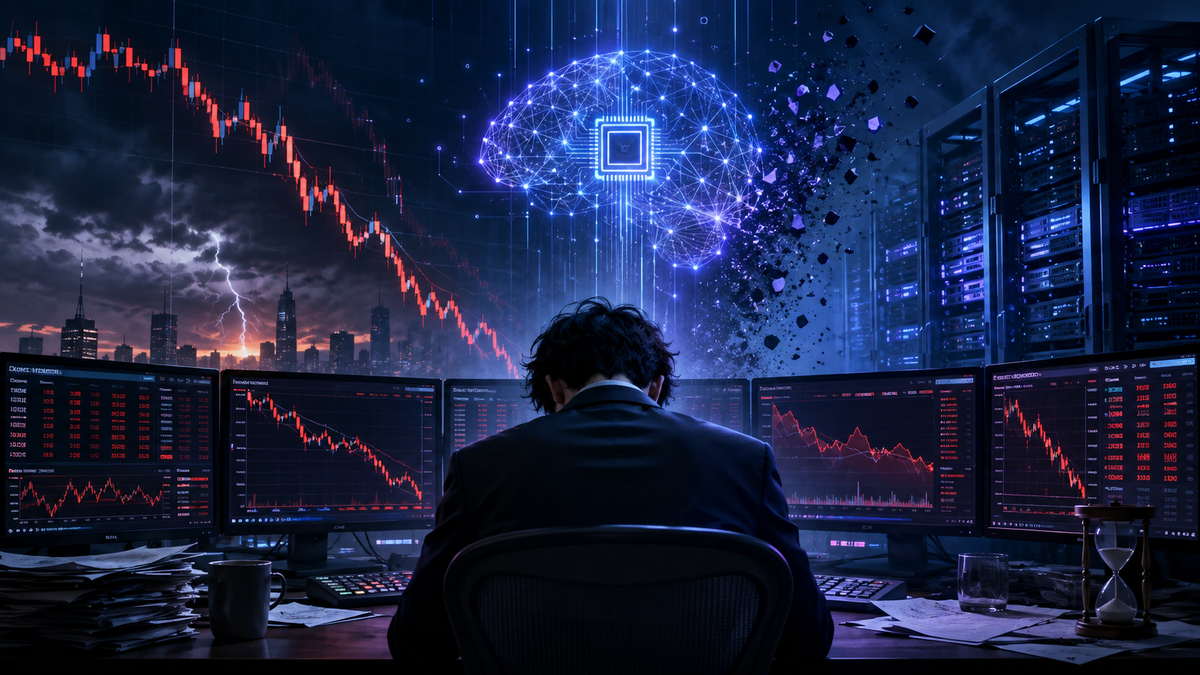
A spectacular rise, a brutal reversal, and a reminder that being right about the future is not enough to survive the market.
For much of 2026, Leopold Aschenbrenner appeared to represent a new kind of Wall Street star.
A former OpenAI researcher with a highly publicized thesis on the future of artificial intelligence, Aschenbrenner had turned his technological convictions into an investment strategy. His hedge fund, Situational Awareness, made concentrated bets across the AI economy—from semiconductors and data infrastructure to power-intensive technology companies.
The results were extraordinary. By the end of June, the fund had reportedly gained 439% since the beginning of the year.
Then July arrived.
Within a single month, Situational Awareness’s portfolio value fell approximately 67%. The fund removed its leverage, unwound most of its publicly traded equity positions, and sold the bulk of its stock portfolio to Ken Griffin’s Citadel. :contentReference[oaicite:1]{index=1}
The story was quickly framed as the downfall of an “AI oracle.” But the real lesson is more complicated—and more useful for investors.
Aschenbrenner may not have been fundamentally wrong about AI. The crisis instead illustrates how a strong long-term thesis can still produce catastrophic short-term results when it is combined with leverage, concentration, crowded positioning and deteriorating liquidity.
From AI Researcher to Wall Street Phenomenon
Before launching Situational Awareness in 2024, Aschenbrenner worked on OpenAI’s Superalignment team. He later published Situational Awareness: The Decade Ahead, a widely discussed collection of essays arguing that rapid improvements in AI could drive an enormous expansion in computing capacity, electricity consumption, data centers and industrial infrastructure.
His basic investment thesis was clear: if advanced AI development accelerated, the economic beneficiaries would extend far beyond software companies.
The world would need more chips, memory, energy, networking equipment, computing facilities and physical infrastructure. Companies positioned along these bottlenecks could experience exceptional growth.
That thesis attracted considerable attention from technology investors and Wall Street. Situational Awareness grew rapidly after its launch, while Aschenbrenner developed what Reuters described as a cult-like following among investors. :contentReference[oaicite:2]{index=2}
The fund’s early performance appeared to validate his analysis. As AI-related equities surged, leverage amplified the gains. A manager known for predicting the technological future was suddenly producing returns that few established investment firms could match.
Success, however, changed the risk profile of the strategy.
The Difference Between a Thesis and a Portfolio
An investment thesis answers one question:
What is likely to happen over time?
Portfolio management must answer several others:
- How large should the position be?
- How much volatility can the portfolio absorb?
- How much money is borrowed?
- What happens when correlations rise?
- Can positions be exited without moving the market?
- How long can the strategy survive before the thesis is proven?
These questions became critical for Situational Awareness.
Public reporting confirms that the fund used significant borrowed capital to increase its exposure. An exact leverage multiple has not been reliably established in the available reporting, but the structure left the fund vulnerable to margin pressure when its core positions moved sharply against it. :contentReference[oaicite:3]{index=3}
Leverage does not merely increase returns and losses proportionally. It can change the entire nature of a trade.
An unleveraged investor can often hold through a 20% or 30% decline, provided the underlying thesis remains intact and the capital is not needed elsewhere.
A leveraged investor may not have that choice.
As asset values fall, lenders can demand additional collateral, reduce financing or require positions to be sold. The investor is no longer deciding whether the asset remains attractive. The financing structure begins making the decision.
That is the central distinction in this episode:
The fund did not necessarily sell because its long-term AI thesis had disappeared. It sold because its ability to carry the positions had deteriorated.
How the July Sell-Off Became a Feedback Loop
AI and semiconductor stocks experienced a violent global reversal in July. Crowded positions across the sector came under pressure, while liquidity weakened and investors rushed to reduce exposure.
For a concentrated and leveraged portfolio, the sequence can become self-reinforcing:
Falling prices reduce portfolio equity.
That increases leverage relative to the remaining capital.
Higher effective leverage creates financing pressure.
Prime brokers may ask for additional collateral or lower exposure.
The fund is forced to sell into a declining market.
Large sales place further pressure on prices.
Other market participants anticipate additional forced selling.
Short sellers and event-driven traders may target securities known to be associated with the distressed investor.
The resulting decline creates another round of margin pressure.
In his investor letter, Aschenbrenner compared the dynamic to a bank run, describing a situation in which vulnerability generated further vulnerability. He also acknowledged that liquidity had dried up as core positions moved rapidly against the fund. :contentReference[oaicite:4]{index=4}
This is an important point. Markets are not passive systems in which every investor trades against an unlimited pool of liquidity.
Once a large portfolio becomes distressed, its need to sell becomes information.
Other traders adjust their behavior. Potential buyers demand lower prices. Short sellers increase pressure. Lenders become more conservative. Assets that appeared liquid during normal conditions can become extremely difficult to exit without accepting substantial discounts.
The portfolio’s size becomes part of the risk.
Why Citadel Became the Buyer
With the fund facing pressure to raise capital or reduce its positions, Situational Awareness ultimately chose to unwind most of its public-equity portfolio.
Reuters reported that Citadel purchased the portion of the portfolio financed through broker leverage. Major prime brokers, including Goldman Sachs, JPMorgan, Bank of America and Citigroup, helped facilitate the transaction. Situational Awareness retained a smaller portfolio containing both stocks and private investments, including its Anthropic stake. :contentReference[oaicite:5]{index=5}
The transaction shows how differently strong and distressed balance sheets behave during periods of market stress.
Situational Awareness needed certainty, liquidity and rapid risk reduction.
Citadel had the capital, infrastructure and risk capacity to acquire assets from a forced seller.
The buyer did not need to prove that every position would immediately recover. It only needed to negotiate terms that adequately compensated it for the portfolio’s volatility, liquidity risk and uncertain short-term outlook.
This is one of the oldest patterns in financial markets: when leverage forces one investor to sell, another investor with stronger liquidity can acquire the same assets under more favorable conditions.
A Collapse—but Not a Total Wipeout
The phrase “AI fund explosion” spread rapidly across social media, but some of the more dramatic descriptions have overstated what happened.
Situational Awareness did not disappear, and the fund was not reported to have lost all investor capital.
Because its gains before July had been so large, the fund reportedly remained up approximately 80% for 2026 even after the 67% monthly decline. It also retained private investments and a reduced portfolio after the Citadel transaction. :contentReference[oaicite:6]{index=6}
That does not make the drawdown minor.
A 67% loss requires a gain of more than 200% merely to return to the previous portfolio value. The forced unwinding also removed much of the fund’s ability to benefit if its former holdings subsequently recovered.
More importantly, the episode damaged confidence in the fund’s risk controls. Aschenbrenner told investors that the firm had come closer to permanent capital impairment than it considered acceptable and accepted responsibility for the situation. :contentReference[oaicite:7]{index=7}
The precise conclusion is therefore not that the fund went to zero.
It is that a historically strong period of performance was followed by an extreme drawdown, emergency deleveraging and the loss of strategic control over much of the public portfolio.
Was the AI Thesis Wrong?
The July crisis does not, by itself, settle the debate over AI valuations or the long-term economic impact of artificial intelligence.
AI infrastructure spending may continue rising. Demand for computing power, memory, energy and data-center capacity may remain structurally strong. Some of the securities sold during the liquidation may eventually recover or reach new highs.
But a correct structural thesis does not guarantee that every company is correctly valued today.
It also does not guarantee that the path toward the predicted future will be smooth.
Several risks can exist at the same time:
- The AI industry may continue growing while individual AI stocks decline.
- Company revenues may increase while valuation multiples contract.
- Long-term demand may remain intact while short-term financing conditions tighten.
- An investor may correctly identify the winning sector but choose the wrong securities, position sizes or entry prices.
- A portfolio may ultimately be right but become insolvent before the thesis is realized.
That final risk is the one investors often underestimate.
Markets do not reward an investor merely for being correct eventually. They reward investors who can remain solvent, liquid and disciplined while waiting for the thesis to play out.
Five Lessons for Traders
1. Direction Is Only One Part of the Trade
Predicting which industry will grow is not the same as constructing a resilient portfolio.
Entry price, leverage, time horizon, liquidity and position sizing can matter as much as the underlying thesis.
2. Concentration and Leverage Multiply Each Other
A concentrated portfolio can deliver exceptional returns when its core positions move together in the intended direction.
When they reverse simultaneously, diversification disappears exactly when it is needed most. Adding leverage turns that correlated decline into a financing event.
3. Liquidity Is Not Constant
A position may appear easy to exit during stable markets.
During a stress event, buyers step back, spreads widen and the cost of selling increases. The larger the position, the greater the potential difference between the quoted market price and the price at which the entire portfolio can actually be liquidated.
4. Public Positions Can Become Vulnerabilities
Large regulatory disclosures and closely tracked holdings can attract investors during a rally. During a downturn, the same transparency allows other market participants to anticipate forced selling.
Once the market believes a fund must exit, that expectation can affect the prices of the assets themselves.
5. Survival Matters More Than Brilliance
The best trade is not simply the one with the highest theoretical return.
It is the trade that allows the investor to remain in the market when the environment becomes hostile.
Risk management can appear overly conservative during a bull market. Its value becomes visible only when the market changes.
What This Means for the Broader AI Trade
The Situational Awareness episode should not automatically be interpreted as the end of the AI investment cycle.
A distressed fund sale can mark excessive leverage leaving the system rather than the collapse of an entire technological theme. The underlying companies must still be evaluated according to earnings, cash flow, capital requirements, competitive position and valuation.
However, the event does expose fragility within a crowded trade.
When large numbers of investors own similar securities for similar reasons, the market can become vulnerable to synchronized deleveraging. A relatively small change in expectations can trigger disproportionately large price moves as portfolios reduce risk at the same time.
For traders, the question is therefore no longer simply:
Will AI continue to grow?
The more useful questions are:
Which parts of that growth are already priced in?
Which companies can convert investment into sustainable cash flow?
How dependent are current valuations on inexpensive capital and uninterrupted spending?
Where has leverage accumulated, and what happens if volatility rises again?
These questions do not invalidate the AI thesis. They determine whether the thesis can be traded responsibly.
The Bottom Line
Leopold Aschenbrenner became famous for arguing that a small group of people understood how rapidly AI could transform the world.
His fund’s July drawdown delivered a different kind of situational awareness.
A powerful long-term narrative cannot protect a portfolio from excessive leverage. Strong fundamentals cannot guarantee short-term liquidity. Being early does not help if financing forces the position to be closed before the future arrives.
The most accurate summary of the episode is not that the AI thesis was definitively proven wrong.
It is that a potentially winning thesis was placed inside a portfolio that could not withstand the path taken by the market.
In investing, predicting the future matters.
Surviving the journey matters more.
Disclaimer: This article is provided for informational purposes only and does not constitute financial, investment or trading advice. Market conditions can change rapidly, and leveraged products involve a high risk of substantial loss.