
The Great Divergence: Cooling Inflation vs. Burning Debt
While stock markets celebrate cooling inflation, a $40 trillion debt inferno is quietly sending Treasury yields to multi-decade highs. Discover why the bond market is sounding the alarm, and how BBX traders should navigate the ultimate macro contradiction of the year.

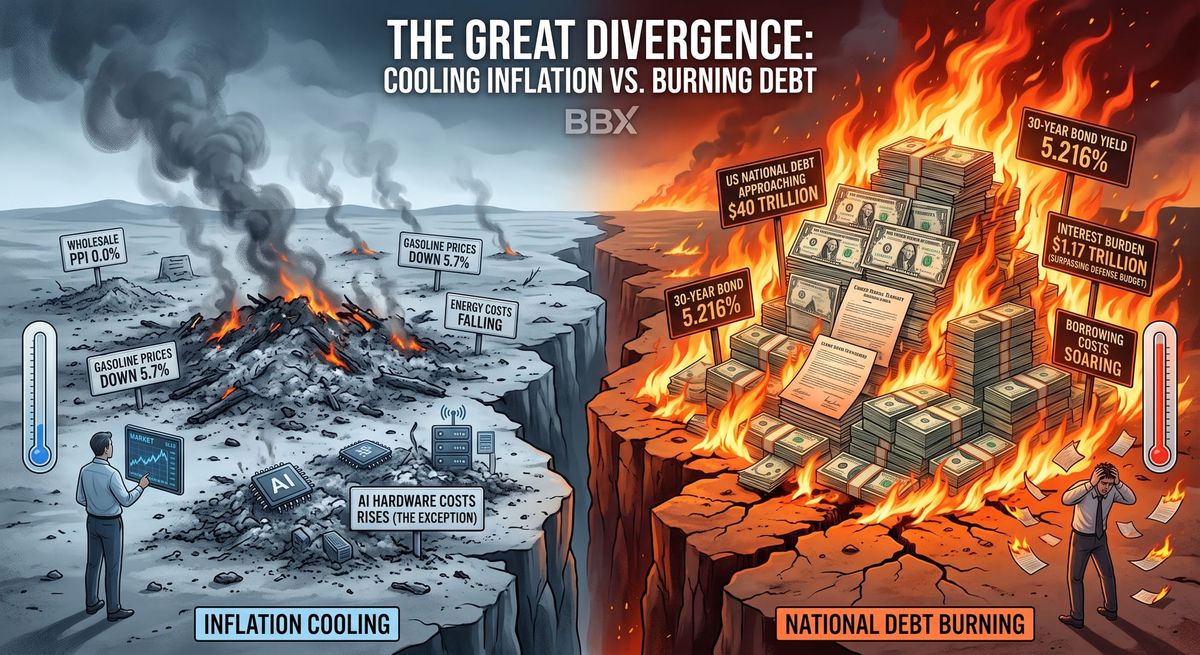
In the span of a single 24-hour cycle, global financial markets were presented with two sharply contrasting realities: wholesale inflation is practically grinding to a halt, while the cost of financing the United States government is surging to multi-decade highs. For traders and investors navigating this landscape, this divergence presents the ultimate core contradiction of the current macro cycle. At BBX, we believe understanding this dichotomy is essential for positioning your portfolio in the months ahead.
The Good News: The Inflation Fever is Breaking
Recent data from the U.S. Labor Department delivered exactly what equity markets have been praying for. The July Producer Price Index (PPI) registered a flat 0% month-over-month growth, defying expectations of a 0.1% rise. More importantly, the year-over-year rate fell dramatically to 4.7% from June’s 5.5%.
Breaking down the numbers reveals a broad-based deceleration:
- Energy and Transport: Gasoline prices plunged by 5.7%, contributing to more than half of the drop in the final demand goods index. Transportation and warehousing costs also fell by 1.8%.
- Core Inflation: Even stripping out volatile food and energy components, core PPI cooled to 4.2% YoY, indicating that wholesale pricing pressures are genuinely easing.
- The AI Exception: Interestingly, the only sector bucking this cooling trend is AI and data centers. Computer hardware costs jumped 9.8% YoY, while electronic components soared nearly 28%. The "AI trade" remains highly inflationary on the hardware side.
The immediate market reaction was euphoric. Money markets slashed the probability of a September Federal Reserve rate hike from 50% down to roughly 35%, and major tech benchmarks pushed toward new historical highs.
The Hidden Crisis: The Debt Inferno
While the stock market threw a party over cooling inflation, the bond market was quietly sounding an alarm. On the exact same day, the U.S. Treasury auctioned $25 billion in 30-year bonds. The winning yield? A staggering 5.216%—the highest cost of long-term borrowing since 2001.
The fire of inflation may be dying down, but the fire of national debt is burning hotter than ever.
Why are borrowing costs refusing to come down despite softer inflation? Because the market's primary fear is no longer monthly CPI or PPI fluctuations, but the sheer gravity of the U.S. national debt itself.
- Mounting Obligations: The U.S. national debt is rapidly approaching the $40 trillion milestone.
- Interest Burden: For this fiscal year alone, interest payments on the debt have reached $1.17 trillion—an amount that now surpasses the entire U.S. national defense budget.
- The Buyer Strike: The Federal Reserve is no longer the primary buyer of U.S. Treasuries. Private capital is now expected to absorb these massive issuances, and these yield-sensitive buyers are demanding much higher risk premiums to compensate for fiscal uncertainty.
The Treasury's Fragile Pivot
Aware of the brutal costs at the long end of the yield curve, the Treasury has begun tweaking its issuance strategy by pivoting toward issuing more short-term bills. While this provides short-term optical relief, it comes at a systemic cost: the U.S. government must continuously roll over its debt at a higher frequency. This strategy makes the nation's massive debt pile exponentially more sensitive to short-term interest rate volatility—effectively trading future stability for present convenience.
What This Means for BBX Traders
Currently, asset prices are resting on a fragile assumption: that the ashes of cooling inflation can safely blanket the flames of a runaway debt crisis. But how long can markets ignore this fundamental disconnect?
Trading Psychology: Staying in the Game In macro environments characterized by conflicting signals—where equities surge on bad economic news and bonds sell off on good news—volatility and false breakouts are common. As a trader on BBX, your most crucial asset is your psychological capital.
Whether you are trading Crypto, Commodities, or Equities, the market chop will occasionally trigger your stop-losses. However, professional trading requires maintaining your presence and composure. Do not let short-term whipsaws grind down your emotional resilience. When the macro trend eventually establishes its true direction, the only way to capitalize on it is to ensure you are still in the game.
Disclaimer: This article is provided for informational purposes only and does not constitute financial, investment or trading advice. Market conditions can change rapidly, and leveraged products involve a high risk of substantial loss.