How Taiwanese Investors Can Buy US Stocks: A Complete Guide to Trading On-Chain US Stocks with USDT
Skip high broker fees and wire delays! Discover how to trade on-chain US stocks directly with USDT. Tokenized equities let crypto-natives bypass traditional accounts, offering 24/7 fractional trading for frictionless access to global assets.

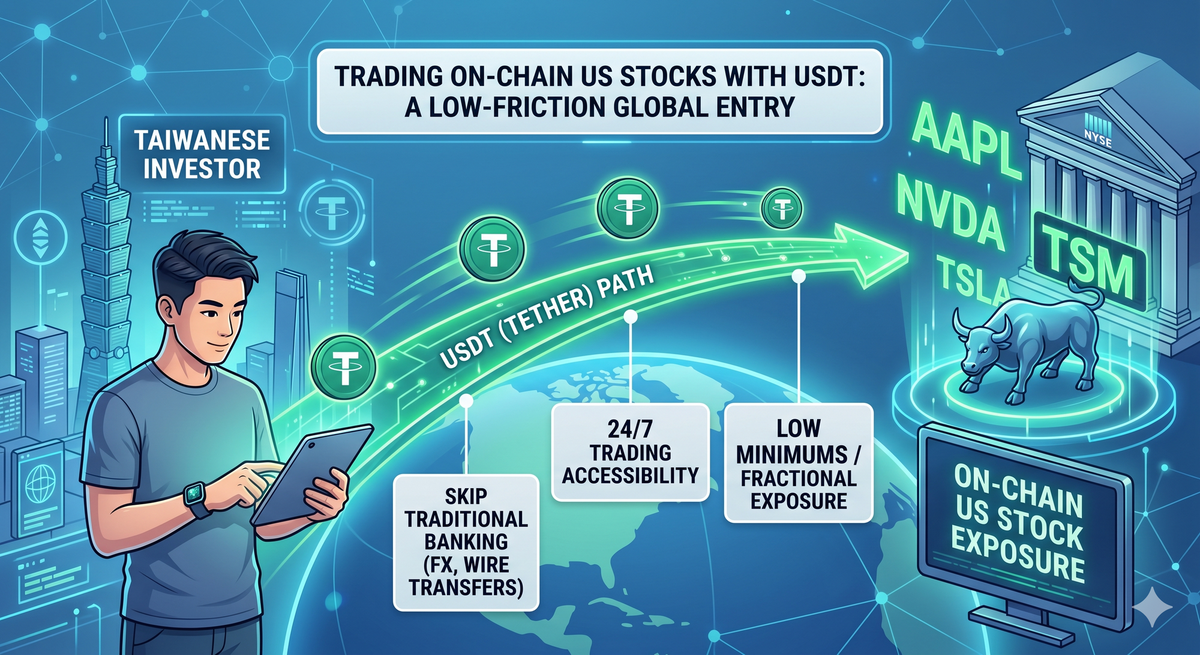
Buying US stocks is no longer a novelty for Taiwanese investors. Through local sub-brokerages, overseas brokerages, or bank and mutual fund platforms, Taiwanese people can participate in US stocks, ETFs, and global markets.
However, traditional processes might not suit everyone. If you simply want a small price exposure to Apple, NVIDIA, Tesla, or TSM, you might encounter friction such as minimum sub-brokerage fees, currency exchange costs, overseas brokerage funding issues, trading hours restrictions, complex tax reporting, and account management challenges.
In recent years, with the maturation of stablecoins and on-chain financial products, an alternative has emerged: using USDT/USDC to directly trade on-chain US stocks or price exposures. This does not mean on-chain stocks completely replace traditional brokerages, nor is it a way to bypass taxes or regulations. More accurately, it is a new option for crypto-native investors: using stablecoins to enter global asset markets with lower friction.
Section 1: 3 Mainstream Ways Taiwanese Buy US Stocks
Currently, Taiwanese investors primarily use three methods to buy US stocks:
- Taiwanese Sub-Brokerage (複委託): The most common and beginner-friendly method. You place an order through a local Taiwanese broker, who then delegates it to an overseas partner broker to execute. Pros: Chinese interface, local customer service, clear fund pathways. Cons: Higher fees; some brokers impose minimum fee thresholds, which significantly inflates the cost ratio for small investments.
- Directly Opening Overseas Brokerage Accounts: Opening an account directly with foreign brokers. This route typically offers lower trading costs and a more complete product range, making it ideal for advanced investors looking to use advanced trading tools or make global allocations. Cons: Account opening, funding, tax documentation, cross-border wire transfers, and account inheritance are much more complex.
- On-Chain US Stocks via USDT/USDC: Trading on-chain US stocks or price exposures using stablecoins. This method is highly suited for investors who already hold stablecoins and are familiar with wallets or crypto trading. Its core advantage is not "bypassing regulation" but reducing the friction associated with traditional account opening, bank wire transfers, foreign exchange (FX) spreads, and trading hour constraints.
⚠️ Regulatory Note: The Financial Supervisory Commission (FSC) of Taiwan reminds investors that foreign securities investments should be conducted through legitimate financial institutions. Soliciting clients to open accounts and trade foreign securities in Taiwan without FSC approval may violate the Securities and Exchange Act. Therefore, when choosing any overseas or on-chain platform, investors must verify the platform's background, compliance framework, and user rights protection.
Section 2: Why Do Sub-Brokerage Costs Spike for Small Investments?
Sub-brokerage is not inherently bad; for many long-term investors, it remains a stable, familiar, and manageable way to invest in US stocks. However, for investors who are small-scale, high-frequency, short-term, or looking for flexible asset allocation, the cost structure can become highly unfriendly due to three main reasons:
- Minimum Fee Thresholds: Many sub-brokerage accounts enforce a minimum fee per transaction. If your single investment amount is small, even if the nominal rate looks low, the actual cost ratio can be massive. For instance, if a transaction has a minimum fee of NT$500, investing NT$10,000 instantly incurs a 5% cost burden. Conversely, for an NT$1,000,000 investment, NT$500 represents just 0.05%.
- Exchange Rate Spreads: Buying US stocks usually requires converting TWD to USD. Bank or broker exchange rates carry a buy/sell spread. While this cost isn't explicitly displayed as a "handling fee," it directly erodes profitability via the execution rate.
- Cross-Border Funding Friction: Opting for overseas brokerages involves international bank wire transfers, waiting times for deposits, potential rejection/refund risks, bank compliance reviews, and withdrawal costs. Under Taiwan's foreign exchange regulations, any FX income or transaction equivalent to NT$500,000 or more must be declared according to regulations. For corporate groups or individuals, cumulative annual foreign exchange purchases or sales exceeding an equivalent of USD 5 million require bank submission to the Central Bank for approval before processing.
This explains why on-chain US stocks are attractive to existing USDT/USDC holders: they can bypass traditional FX conversion and international wire processes, utilizing stablecoins to build US stock price exposure directly.
Section 3: Cost Comparison for NT$10K / NT$100K / NT$1M
When investing small amounts, "fixed costs" are easily underestimated. Let's break down three distinct financial scenarios.
Scenario 1: NT$10,000 Small Investment
Investors in this category are hit hardest by minimum fees. Even if the nominal rate is low, fixed fees destroy profitability. If you just want to test-buy a bit of NVDA, TSLA, AAPL, or TSM, the fixed cost of sub-brokerage makes small trades highly inefficient.
| Trading Method | Est. Fixed Fee (NT$) | FX / Transfer Friction (NT$) | Total Cost Ratio | Cost Pain Point Analysis |
| Taiwan Sub-Brokerage | ~$300 - $500 (Hit by minimum fees) | ~$100 (FX spread) | 4.0% - 6.0% | Minimum fee traps directly consume a massive chunk of capital. |
| Direct Overseas Broker | $0 (Commission-free) | ~$600 - $1,000 (International wire fee) | 6.0% - 10.0% | While trading is commission-free, fixed international wire fees are extremely high. |
| On-Chain (USDT) | ~$30 - $100 (Proportional fee) | ~$30 (On-chain Gas fee) | 0.6% - 1.3% | No minimum low-fee barrier; perfect for micro-investing price exposures. |
Scenario 2: NT$100,000 Medium Investment
At an NT$100,000 level, the impact of minimum fees begins to dilute. However, exchange spreads, transaction fees, platform fees, and funding costs must still be calculated collectively. Investors in this bracket usually evaluate the comprehensive total cost rather than focusing on a single handling fee.
| Cost Component | Sub-Brokerage (Long-Term) | Overseas Broker (Active) | On-Chain USDT (Flexible) |
| Commission / Fee | Progressively diluted (approx. 0.15% - 0.3%) | $0 Commission-free | Proportional, no minimums |
| FX & Funding Cost | Medium (TWD/USD bank exchange spread) | High/Medium (Wire fee diluted to ~0.6% - 1%) | Extremely Low (No fiat friction if crypto is held) |
| Best Suited For | Dollar-cost averaging & holding long-term | Swing trading with comprehensive market tools | Instant allocation alongside crypto portfolio |
Scenario 3: NT$1,000,000 Large Investment
When capital reaches NT$1,000,000 or above, fixed minimum fees are negligible. Priority completely shifts to platform security, trading depth, tax tracking, asset custody, funding efficiency, and legal/ownership rights. Large-scale investors value structural protection and liquidity over shaving off the lowest fee.
| Evaluation Dimension | Taiwan Sub-Brokerage | Direct Overseas Broker | On-Chain (USDT) |
| Funding Friction | Lowest. Direct TWD auto-deduction and exchange. | Requires large cross-border wires & bank compliance audits. | Very Low. Instant on-chain settlement. |
| Asset Security | Highest. Heavily regulated by Taiwan FSC. | High. Protected by US SIPC (up to USD 500,000). | Depends on platform compliance, audits, and reserves. |
| Tax & Inheritance | Simplest. Local brokers provide explicit tax statements. | Complex. Cross-border inheritance procedures are tedious. | Self-reporting. Must track transactions via wallet records. |
| Core Value | You pay for peace of mind & local service. | You get advanced tools & low fees. | You get borderless capital & 24/7 agility. |
Section 4: Advantages of Trading On-Chain US Stocks with USDT
The primary advantage of trading on-chain US stocks with USDT/USDC is dramatically lowering the entry barriers for crypto-native users. Traditional routes demand brokers, bank accounts, foreign exchange, and days of settlement latency.
- Stablecoin Settlement: Investors avoid repeated TWD-to-USD conversions and international bank wire delays. If your wallet already holds USDT/USDC, you can instantly establish price exposures.
- Flexible Trading Hours: Traditional US markets open overnight in Asian time zones. On-chain trading delivers a near 24/7 experience, allowing investors to manage risk dynamically during local hours.
- Fractional/Micro-Investing Friendly: Platforms supporting fractional trading mean you do not need to purchase a full share. You can allocate precise micro-amounts to gain exposure to expensive stocks or ETFs.
- Multi-Asset Integration: Crypto investors usually manage BTC, ETH, and stablecoins under a single interface. Integrating US stocks, ETFs, indices, and commodities under the same stablecoin umbrella makes asset allocation centralized and highly agile.
Section 5: How BBX Enables Taiwanese Users to Trade US Stock Exposure via USDT
Want to skip the tedious brokerage account opening process? Investing in global stocks can now be as seamless as online shopping.
This guide introduces the novel paradigm of Tokenized Equities. In short, this technology "maps" real-world equities onto the blockchain. Every single token is backed 1:1 by real stock shares held in custody by licensed institutions, ensuring asset security. Without needing cross-border wire transfers, you can execute orders and clear trades using USDT.
Buy Global Stocks Without Opening a Brokerage Account
For decades, investing in securities required a fixed pathway: opening an account with traditional offshore brokerages (such as IBKR, Robinhood, Tiger, or Futu), executing international fiat wire transfers, and being rigidly confined to specific market hours of traditional exchanges.
As we move through 2026, allocating capital to equities outside traditional brokerage rails has transitioned into standard practice due to tokenized equities. On this platform, investors completely bypass traditional friction. Buying and selling shares without a standard securities account has transformed from theory to everyday reality via asset tokenization.
The core infrastructure driving this transition is a model known as "Licensed Custody + On-Chain Mint/Burn." Let's dive into the mechanics, legal standing, structural differences compared to traditional brokers, and how you can complete an on-chain settled trade in under 5 minutes.
① What Are Tokenized Equities?
Tokenized equities represent the digital evolution of traditional financial assets. Every fully compliant tokenized stock is issued on the blockchain, backed 1:1 by real-world underlying assets of publicly traded companies (such as NVIDIA).
- 1:1 Real Asset Backing: These tokens are not synthetic derivatives created out of thin air. For instance, every unit of a tokenized equity traded on the platform (e.g.,
NVDAbb) corresponds to actual shares held 1:1 by a licensed custodian. This synchronizes token pricing with traditional markets and remains fully auditable. - Direct Settlement via USDT/USDC: Traditional equities require currency conversion, incurring costs and settlement latency. Tokenized equities clear natively in stablecoins, eliminating fiat routing networks and maximizing capital efficiency.
- Removal of Account Barriers: Acquiring overseas assets no longer means navigating strict traditional brokerage sign-ups. Connect your Web3 wallet, and you immediately face global markets.
- Highly Fractionalized Shares: Tokenized assets support deep fractionalization. Investors are unconstrained by whole-share limitations, permitting precise capital allocation.
② The Underlying Model: Why No Account is Needed Yet Safety is Preserved
Traditional onboarding presents massive physical and financial hurdles. Setting up standard offshore brokerage accounts often requires providing overseas work visas/residence permits, local utility bills within three months, and exhaustive source-of-wealth verifications. More critically, lacking an overseas bank card makes bank wires practically impossible for standard investors due to strict FX rules.
Bypassing traditional brokerage accounts does not compromise asset safety. The underlying logic replaces the standard clearing rail with institutional-grade tokenization:
- Custody & Compliant Issuance: For every tokenized asset (e.g.,
NVDAbb), a licensed issuer purchases the underlying stock through regulated broker networks and secures them in institutional custody. Regulated entities then mint corresponding 1:1 compliant tokens on-chain. - Smart Contract Wrapping: These compliant tokens are locked within smart contracts and wrapped into tradable
bb tokens. Investors trade using USDT/USDC directly, bypassing traditional remittance delays and fees. - 1:1 Rigid Redemption Baseline: The cornerstone of asset safety is the redemption mechanism. The protocol supports burning
bb tokensto reclaim the underlying compliant tokens, which can ultimately be redeemed 1:1 for actual shares on traditional stock exchanges.
⑤ Risk Disclosures
While tokenization dramatically optimizes clearing efficiency, investors must maintain an objective and disciplined understanding of its inherent risks:
- Smart Contract & Technical Risk: Even though contract codes undergo standard security audits, smart contract ecosystems inherently carry risks of undiscovered vulnerabilities, network congestion latencies, or node anomalies.
- Pegging & Market Closure Liquidity Risk: When traditional stock exchanges close for nights, weekends, or holidays, or face extreme market imbalances, on-chain liquidity pools may encounter short-term supply/demand mismatches. This can lead to temporary premiums or discounts relative to traditional spot closure prices.
- Dual Market Volatility & Currency Risk: Investors take on dual risk exposure: the price action of the underlying equity itself, and the exchange rate volatility of stablecoins like USDT/USDC.
- Redemption vs. KYC Constraints: Trading on-chain requires no KYC. However, if an investor triggers the rigid physical redemption mechanism to extract on-chain tokens into actual equity shares on a traditional exchange, they must submit verifiable identification documentation and pass rigorous KYC/AML checks.
Section 6: How to Trade On-Chain US Stocks on BBX Using USDT
Traditional fiat rails and offshore onboarding are completely overhauled here. Follow this standardized on-chain trading flow:
Step 1: Login and Connect Wallet
- Visit the official website:
bbx.com. - Click the "Connect" button in the top right corner.
- Choose a decentralized crypto wallet like MetaMask, or use quick web options like Telegram or Email.
- Once connected, your exclusive public account address will appear beneath your profile name in the top right corner. This address serves as your primary financial account credential on the platform.
Step 2: Deposit USDT/USDC
The platform separates the Funding Account from the Contract Account. Deposits must follow these explicit rules:
- Path A: Depositing to the Funding Account (Requires Manual Transfer to Trade)
- Go to "Personal Account" -> "Portfolio" -> "Funding Account" and click "Deposit".
- Select your network (e.g., Arbitrum) and asset (USDT/USDC). This deposit address matches your primary account address.
- Note: Funds arriving here sit in your funding wallet. You must transfer them to your contract account before trading.
- Path B: Depositing Directly to the Contract Account (Auto-Routed)
- Under "Portfolio", select "Contract Account" and click "Deposit".
- Select your network and asset. Crucial Note: The Contract Account utilizes a distinct, standalone deposit address separate from your default funding address.
- Note: When depositing here, funds initially hit the underlying funding system, and the platform automatically routes them into the Contract Account so you can trade instantly.
⚠️ Critical Capital Safety Warning: Always double-check your network and address. The minimum single deposit is 10 USDT. Any deposits below this threshold will fail to credit, resulting in a permanent loss of funds. On-chain confirmations take seconds and carry no traditional bank charges.
Step 3: Internal Asset Transfers
You can move funds between your Funding and Contract accounts dynamically by selecting "Transfer":
- Funding Account ➔ Contract Account: Instantaneous internal routing, taking effect immediately with zero friction.
- Contract Account ➔ Funding Account: When moving funds back out, the underlying assets route through a secure, institutional custody multi-sig wallet architecture before crediting your funding balance. The user experience is seamless, but every node step remains transparently verifiable on-chain via block explorers.
Step 4: Asset Selection & Order Execution
Once funded, you can access global financial instruments. Navigate through the left-hand asset directory. The platform natively supports trading the full spectrum of tokenized assets via USDT (you can visit specific asset links like [https://dex.bbx.com/zh-Hans/futures/trade/nvdabb_usdt](https://dex.bbx.com/zh-Hans/futures/trade/nvdabb_usdt) to check real-time compliance data and underlying holdings).
To execute a trade, choose your asset (e.g., NVDAbb), navigate to the right-hand trading terminal, set your preferred order type, price, and quantity, and click "Buy Long" or "Sell Short".
Step 5: Withdrawing USDT/USDC
Withdrawals are efficient but come with a strict structural rule: Withdrawals can only be initiated from the Funding Account.
- Click the "Personal Account" icon, enter "Portfolio", and click "Withdraw".
- Select your destination network and token, input your target external wallet address and amount, and confirm the transaction.
- Note: If your trading capital is currently sitting in your Contract Account (e.g., after closing a position), you must first use the "Transfer" function to shift it back to your Funding Account before submitting a withdrawal.
Section 7: What Assets Does BBX Support?
The platform allows direct trading of multiple tokenized asset classes using USDT, complete with transparent audited data links:
- Tech & Major Equities: Apple (
AAPLbb), NVIDIA (NVDAbb), Tesla (TSLAbb), Amazon (AMZNbb), Google (GOOGLbb), AMD (AMDbb), MicroStrategy (MSTRbb), Palantir (PLTRbb), Robinhood (HOODbb), Circle (CRCLbb). - Global Equity Indices: S&P 500 (
SPX500bb), Dow Jones (Us30bb), Russell 2000 (US2000bb), Nikkei 225 (JP225bb), FTSE Taiwan (Tw88bb), FTSE 100 (UK100bb), Hang Seng Index (HK50bb), ASX 200 (AUS200bb), DAX 40 (GER40bb). - Global Market ETFs: Nasdaq 100 (
QQQbb), S&P 500 ETF (SPYbb), Short QQQ (SQQQbb), UltraPro QQQ (TQQQbb), South Korea Market (EWYbb), Japan Market (EWJbb), Taiwan Market (EWTbb), KraneShares CSI China Internet (KWEBbb). - Commodities & Precious Metals: WTI Crude Oil (
WTIOILbb), Gold (XAUbb), Silver (XAGbb). - Cryptocurrencies: The platform concurrently provides clearing and execution for mainstream crypto assets and native on-chain pairs.
Section 8: Tax Focus for Taiwanese Buying US & On-Chain Stocks
Taiwanese investors navigating overseas investments face three main tax pain points:
- US Dividend Withholding Tax (30%): If a Taiwanese investor holds US-registered company shares or US ETFs, dividend distributions trigger non-resident alien rules. The US Internal Revenue Service (IRS) mandates a flat 30% withholding tax on US-sourced dividend income. If a stock distributes a $100 dividend, $30 is automatically withheld at the source, and only $70 credits your account.
- Taiwan Overseas Income Tax Rules: Capital gains (price differences from buying/selling) are not taxed by the US government for non-residents. Instead, they fall under Taiwan's Alternative Minimum Tax (AMT) framework. The Ministry of Finance dictates that if an entire tax-filing household accumulates annual overseas income reaching NT$1,000,000 or more, the total amount must be declared within the basic income assessment. Actual taxes are only triggered if the basic income aggregate exceeds NT$7.5 million, calculated against specific tax thresholds.
- On-Chain Profits Are Not Exempt: Trading on-chain stocks using USDT optimizes capital velocity and layout efficiency; it is not a method for tax evasion. The taxation of on-chain profits depends heavily on your tax residency status, the platform's layout, asset structure, and income classification. In official documents submitted to the Legislative Yuan, Taiwan's Ministry of Finance clarified that individual income derived from occasional buying and selling of non-securities virtual assets constitutes Property Transaction Income (財產交易所得). Net gains (selling price minus initial acquisition costs and related fees) must be integrated into the individual's consolidated gross income for income tax assessment. Highly secured practices dictate keeping meticulous records—including wallet addresses, platform statements, execution prices, gas fees, and deposit/withdrawal timestamps.
Section 9: Security, Compliance, and Risk Boundaries
Every route to global equities carries clear structural trade-offs:
- Taiwanese Sub-Brokerage: Offers high regulatory peace of mind and local legal protection under the FSC. However, it imposes high minimum fees that punish small or frequent traders, limits pre/post-market agility, and offers restrictive product variety.
- Direct Overseas Accounts: Delivers excellent cost-to-performance ratios and advanced institutional tools. However, investors take on high cross-border overhead, complex W-8BEN compliance, wire expenses, and incredibly intricate cross-border inheritance gridlocks if an unexpected life event occurs.
- Capital Flight & Bank Audit Oversight: Moving massive fiat sums to offshore brokers means complying with rigorous banking AML, explaining remittance purposes, and documenting origins.
- On-Chain USDT Assets: Optimizes execution speed and clears traditional account barriers. However, investors must look closer at the asset architecture: is it an asset-backed token, a synthetic tracking vehicle, or a perpetual derivative contract? Furthermore, when traditional equity markets close, on-chain price feeds rely entirely on decentralized oracle systems and automated market makers (AMMs), creating potential price gaps or premiums relative to the traditional market's subsequent open. Investors must also weigh stablecoin de-pegging risks and geographic restriction clauses found within platform service agreements.
Section 10: FAQ
- Q1: Can Taiwanese citizens legally buy US stocks?Yes. Taiwanese investors can access US equities via local sub-brokerages, direct offshore brokerages, bank fund programs, or compliant on-chain tokenization platforms. The pathways differ in capital friction, ease of onboarding, tax structures, and investor protection frameworks.
- Q2: What is the main difference between sub-brokerage and an overseas broker?Sub-brokerage utilizes a local intermediary broker, offering easy local funding and localized service but higher costs. Overseas brokers require direct offshore onboarding and international wire transfers; they feature lower fees and better features but higher management complexity.
- Q3: Can I literally use USDT to buy US stocks?If a platform supports tokenized equities or on-chain price exposure instruments, you can clear trades natively using USDT/USDC. However, this does not automatically equal holding standard equities inside a traditional legacy securities account. Always verify the underlying asset architecture.
- Q4: Does owning on-chain US stocks give me true shareholder voting rights?Not necessarily. It depends entirely on the product structure. Asset-backed tokens might pass down economic rights like dividend adjustments, while synthetic assets simply track price vectors. You cannot assume you possess traditional corporate shareholder voting rights just because an asset uses a traditional stock ticker.
- Q5: Do Taiwanese investors owe taxes on US stocks?It depends on the income type. Dividends suffer an automatic 30% US withholding tax. Capital gains are exempt from US taxation but must be declared under Taiwan's overseas income tax rules if your annual global income exceeds NT$1,000,000.
- Q6: Is using USDT a legal way to save on taxes?No. While on-chain structures can bypass traditional US dividend withholding layouts depending on how they are architected, capital gains are classified by Taiwan's Ministry of Finance as property transaction income. You remain legally responsible for declaring these gains.
- Q7: How are on-chain stock prices derived when the traditional US stock market is closed?Platforms utilize decentralized oracles, liquidity pool AMM equations, or designated market makers to provide continuous pricing. Prices can diverge or premium-gap during corporate earnings or major macroeconomic events before the next traditional market opening bell.
- Q8: Who is the ideal user for USDT-based on-chain US stocks?It is ideal for crypto-native individuals who already store wealth in stablecoins, understand Web3 wallet operations, desire micro-scale or fractional investments without minimum fee penalties, and want to manage global market risks flexibly during Asian time zones.
Conclusion: USDT is a Low-Friction Entry, Not a Tax Haven
Traditional routes to US stock markets remain robust and useful. Sub-brokerage serves passive or long-term investors well, and overseas brokerages accommodate advanced market participants.
However, for crypto-native investors with stablecoin liquidity, on-chain US stocks introduce an entirely new paradigm: accessing global assets seamlessly without dealing with traditional banking hours, international wire delays, or exchange rate spreads. Its core value is not avoiding regulation or dodging tax obligations, but providing a lower-friction, highly agile, and Web3-native global asset trading experience.
Ultimately, sophisticated investors must understand what asset structure they are buying, what rights they hold, where the risks lie, and how to properly report their returns. On-chain equities are not a simple replacement for traditional brokerages; they are the next borderless interface for tokenized real-world assets.