
The Trillion-Dollar Reshuffle: The Underlying Logic of the US Stock Market Amidst Computing Hegemony, the Twilight of Software, and the Energy Shadow War
Beneath the surface of indices hitting record highs, a quiet wealth transfer driven by AI computing monopolies, software architecture restructuring, and underlying energy battles is taking place.

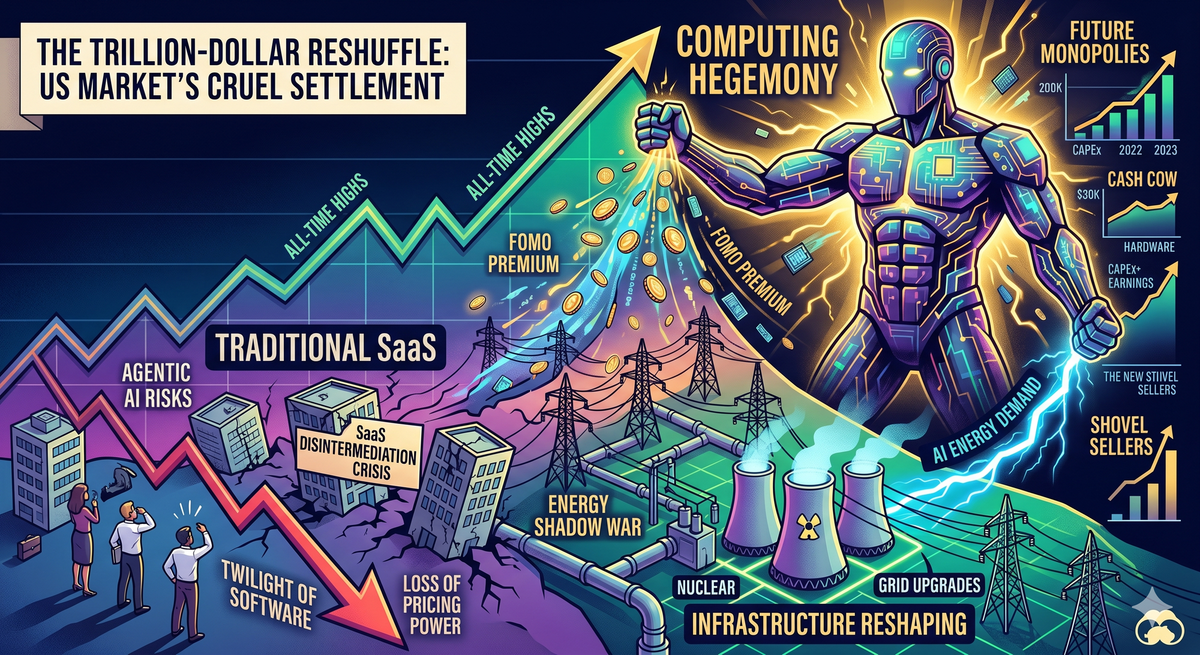
Today, we will unpack the most extreme and fascinating underlying logic of the current US stock market: beneath the surface of record-breaking indices, a trillion-dollar wealth transfer regarding AI computing monopolies, software architecture restructuring, and underlying energy battles is quietly unfolding.
The current US market is a rare "winner-takes-all" game. As the market capitalization of top tech giants repeatedly breaks the multi-trillion-dollar mark, this is no longer just a carnival of chip stocks—it is a global capital's epic pricing of "Artificial General Intelligence (AGI) infrastructure."
Here is a deconstruction of the behind-the-scenes dynamics of the extremely polarized US stock market, the truth of the underlying value chain, and why Wall Street is quietly conducting a cruel "great settlement."
1. Valuation Logic: Buying the Computing Hegemony of "Future Monopolies"
Why is the market willing to give a few AI infrastructure companies such astronomical valuations?
The answer lies in "Future Monopolies." The capital market is not paying for current single-quarter revenues, but pricing the vision of dominating the underlying computing power of the global digital economy in the future. Much like Standard Oil in the oil age, or Amazon in the early internet era, Wall Street is betting heavily on who will control the "digital crude oil" and "refineries" of the AI era.
In this frenzy, the sky-high premiums enjoyed by computing giants are essentially a "FOMO Premium" (Fear Of Missing Out) that global sovereign funds and Big Tech must pay to avoid falling behind in the next technological revolution. As long as the Scaling Law of underlying large models has not hit its ceiling, this logic of buying the future is hard to completely falsify.
2. A Tale of Ice and Fire: Hardware Cash Cows vs. The Disintermediation Crisis of Traditional SaaS
Examining the fundamentals of the current US stock market, we find an extremely cruel duality.
On one hand, hardware infrastructure, represented by GPU manufacturing and data center servers, is becoming the undisputed "cash cow." Every upward revision in capital expenditures (CapEx) by Silicon Valley giants translates directly into massive profits for these underlying hardware companies.
On the other hand, traditional SaaS (Software as a Service) sectors are facing a "Judgment Day." As the capability boundaries of large models continue to expand, especially with the rise of Agentic AI, many SaaS companies that previously relied on providing simple user interfaces (UI) or basic workflow tools are facing the risk of complete disintermediation. The market is beginning to realize that if future AI agents can directly complete end-to-end tasks, the traditional software in the middle layer will lose its pricing power. This is the core reason why some leading US software stocks have recently suffered brutal sell-offs and their valuation centers have shifted downward significantly.
3. The Shadow War at the End of Computing Power: The Trillion-Dollar "Money Eater" and Energy Infrastructure Reshaping
Behind the staggering valuations, the AI industry is also a massive "money eater."
The real bottleneck has quietly shifted from chip production capacity to "power and cooling." Training and running the next generation of hundred-billion or trillion-parameter large models requires billions of dollars and an electrical load comparable to that of a mid-sized city.
The flow of funds in the current US stock market acutely reflects this trend: "Smart Money" is spilling over from pure tech concepts and pouring heavily into traditional but indispensable "old infrastructure" sectors such as nuclear power, grid upgrades, and liquid cooling technologies. When tech giants sign decade-long locked-in power supply agreements with energy companies, traditional energy and new infrastructure quietly become the invisible big winners—the "shovel sellers" in this tech gold rush.
4. The Ultimate Blueprint: The Three-Tier Architecture Restructuring from Large Models to Data Oligarchs
In this trillion-dollar reshuffle, how will the future ecosystem close its loop? AI is forcing the software and tech industries to undergo a cruel three-tier architecture restructuring:
- Computing Base: Winner takes all. Giants are building nearly insurmountable hardware and network moats through tens of billions of dollars in CapEx.
- Data Infrastructure Layer: Enterprise-grade data platforms that control core private data are experiencing massive market value revaluations as the "refineries of the new oil." They hold the most core proprietary data of enterprises, which is the key for general large models to move towards vertical commercial applications and generate real value.
- Application and Execution Layer: Only those platforms capable of deeply integrating proprietary workflows and leveraging Agentic AI to achieve a true business automation loop will survive the reshuffle and enjoy valuation premiums.
Core Insight
Regardless of how the macroeconomic monetary policy's interest rate cut path wavers, the underlying AI paradigm shift in the US stock market is an irreversible established fact. This is no longer a simple "bull-bear" market cycle, but an underlying industrial architecture reset spanning hardware, software, and energy sectors.
In this extremely fragmented market, the prosperity of the indices masks the cruel elimination at the bottom. For investors, true excess returns no longer come from blindly chasing large-cap stocks at high prices, but from finding those critical nodes that control core data assets or have a stranglehold on energy and infrastructure, positioned between the consolidated "computing hegemony" and the disintegration of "traditional software." Ultimately, this tech frenzy is not just a carnival of the capital market, but the first great settlement as humanity marches towards the era of intelligent automation.